| This page was last revised on Aug. 25, 2020.
ALLIANCE SCHOOLSchool board minutes of July 3, 1899, have: “The patrons of Alliance School filed a petition asking the appointment of the teacher elected by the patrons. No action was taken in the matter as the school was discontinued.”
ARGO SCHOOL/ARIPEKA SCHOOLThe Gulf Key post office was established on Oct. 9, 1883. It was renamed Argo on Nov. 12, 1886, and renamed Gulf Key on Dec. 24, 1892. On Feb. 11, 1895, the Aripeka post office was established and on Jan. 6, 1896, the Gulf Key post office was discontinued.The 1886-87 Florida State Gazetteer shows Miss Dora Agincourt as the teacher at Gulf Key. On Dec. 3, 1888, school board minutes show Argo School No. 33 with 19 students enrolled and an average attendance of 9.5. On Aug. 8, 1889, school board minutes show J. G. Guthrie as the teacher at Argo School, No. 33. A deed dated Sept. 28, 1889, transferred property in S6 T24 R17 from J. H. Pinkerton and Annie E. Pinkerton to the school board. On July 7, 1892, school board minutes show Argo School No. 8. On Aug. 7, 1893, school board minutes show G. W. C. Littell as the teacher at Argo School, No. 33. A 1908 newspaper article refers to a school in Aripeka, Hernando County. A 1915-1916 directory of schools shows Miss Pearl Reid as the teacher at the Aripeka school, which is shown in Hernando County. School board minutes of Mar. 24, 1916, refer to a school at Aripeka: “Superintendent reported on matter of Aripeka school, and upon motion duly seconded, Board granted appropriation of $100.” School board minutes of May 1, 1922, indicate that Harvey and Cobb of Aripeka offered to furnish lumber for a school in return for tuition for county line pupils. Minutes of Aug. 21, 1922, indicate the board agreed to pay its pro-rata share for conducting a school at Aripeka. In August 1930, Miss Maud Griswold was appointed by Hernando County to be the teacher at Aripeka. Apparently, an Aripeka school was closed by the Hernando County school board during World War II, and students were bused to a Pasco County school.
BAYONET POINT JUNIOR HIGH/BAYONET POINT MIDDLE SCHOOL This school began with its students attending in the Gulf Junior High School
building in the afternoon session.
A July 1973 newspaper article mentioned principal Gordon Tucker.
The new Bayonet Point Junior High School
building opened on March 10, 1975, allowing both schools to end double sessions.
The school was built in a joint contract with Hudson High School, which
had an identical design, and was one of eight new schools that were
built from the proceeds of a $16-million bond issue approved by
Pasco County voters in September 1972. The principal at the time
of the opening of the new building was Gordon Tucker.
The school was designed for a maximum capacity of 1200 students but opened with
1307 students. Tucker said that the school would not be overcrowded as long
as the county used the 45-15 year round school program because no more than 1100
students would be in school at any time.
This school began with its students attending in the Gulf Junior High School
building in the afternoon session.
A July 1973 newspaper article mentioned principal Gordon Tucker.
The new Bayonet Point Junior High School
building opened on March 10, 1975, allowing both schools to end double sessions.
The school was built in a joint contract with Hudson High School, which
had an identical design, and was one of eight new schools that were
built from the proceeds of a $16-million bond issue approved by
Pasco County voters in September 1972. The principal at the time
of the opening of the new building was Gordon Tucker.
The school was designed for a maximum capacity of 1200 students but opened with
1307 students. Tucker said that the school would not be overcrowded as long
as the county used the 45-15 year round school program because no more than 1100
students would be in school at any time.
In 2014 Shelly Carrino became the principal, succeeding Mike Asbell, who retired on July 31. A picture of the BPMS band in the 1998 Chasco Fiesta parade is here.
BETHLEHEM SCHOOL/BEE TREE POND SCHOOLBee Tree Pond School appears in an 1885-86 list of Hernando County schools. The school was located near the intersection of Hudson Ave. and Hays Road, about 7 miles east of Hudson.A deed shows that Randall Rewis transferred property in S35 T24 R17 to the school board on Feb. 15, 1886. School board minutes of Aug. 6, 1888, have: “The petition of [illegible] J. H. Dicks and others of the Bethlehem School was read and duly considered. The Board would advise that the Bethlehem and Vereen Schools unite by moving one or the other of the school houses to a location more central and convenient for both neighborhoods in order that one good school be established instead of two weak ones.” School board minutes of Sept. 3, 1888, show the board decided to close the Bethlehem School, as it appeared patrons were willing to attend the Vereen School instead. Minutes of Oct. 1, 1888, show that the trustees of the Bethlehem School presented petitions requesting that the school be reopened. The board decided that the school superintendent should visit the area and make a decision. School board minutes of May 6, 1889, have: “The next matter under consideration was a petition from the Bee-Tree School signed by W. J. (?) Hilliard (?) (trustee), D. Keen, S. F. (?) Douglas (?), E. Frierson, M. H. Hurst, Jane Ruis, and Green Goodman, asking that an appropriation be made to cover cost of a bill of lumber to be used for the purpose of erecting a new school-house, and also asking that the present school site be retained. The matter was laid over under the rules.” School board minutes of June 3, 1889, have: “The matter of the Bee Tree School was taken up after discussion was tabled until further information could be obtained relating to the matter.” School board minutes of Aug. 7, 1893, show J. H. Ryals recommended as supervisor of the Bee Tree Pond School.
BISHOP LARKIN CATHOLIC SCHOOLIn 1989, the West Pasco Catholic School opened on the grounds of St. James Parish in Port Richey, becoming the third Catholic school in Pasco County's history (St. Anthony School -1884, St. Leo College -1889). The school's name was later changed to Bishop Larkin Catholic School to honor retired bishop, Thomas W. Larkin, Second Bishop of the Diocese of St. Petersburg, and under whose episcopy the school was founded. In 1990, the school moved to St. Michael the Archangel Parish in Hudson where it was temporarily quartered while its permanent home was under construction. In 1998, Bishop Larkin Catholic School moved to its permanent home in Port Richey at 8408 Monarch Dr., next to St. James Catholic Church. Bishop Larkin celebrated its 25th Anniversary in the Fall of 2014.
BISHOP McLAUGHLIN CATHOLIC HIGH SCHOOLBishop McLaughlin Catholic High School, located in Shady Hills but with the mailing address 13651 Hays Road, Spring Hill, was established in 2003. According to the school’s web site, the mission of the school is to provide “a Christ-centered education that nurtures the development of the whole person and prepares young men and women to meet successfully the challenges of our global society.” According to the Wikipedia article, the school was named after Charles Borromeo McLaughlin, the first bishop of the Diocese of St. Petersburg. Since he was nicknamed Hurricane Charlie, BMCHS is the home of the Hurricanes, and their mascot is Hurricane Charlie. The first principal, Jane Moerschbacher, held the position until she retired in 2007, following the graduation of the school’s inaugural class. There were 41 graduates that year. The current President/Principal is Sarah M. Regan
BRUSHY BRANCHBrushy Branch is shown in a list of Hernando County schools in operation in 1877-78, with E. S. Benson the teacher. The trustees were J. W. Jackson, Jno. W. Platt, and W. S. Holton. [An article has J. S. Jackson.] Julia Howell Dowling recalled “a community called Emmaus or Brushy Branch.”
CALUSA ELEMENTARY SCHOOL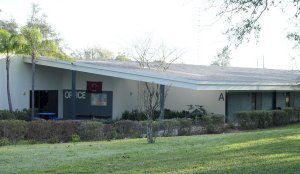 Calusa Elementary School is located at 7520 Orchid Lake Road in New Port Richey, near Ridgewood High School and Marchman
Technical Education Center.
Calusa Elementary School is located at 7520 Orchid Lake Road in New Port Richey, near Ridgewood High School and Marchman
Technical Education Center.
At its meeting on May 15, 1979, the Pasco County School Board voted 3-2 to name the school Calusa Elementary School. Board member Agnes Deal picked the name from more than 200 suggestions made by students who would be attending the school. The name was proposed by Mindy Anderson, a sixth-grader at Anclote Elementary School. After board members were informed by a teacher that the Calusa Indians did not live here, several members expressed second thoughts about the name, but Mrs. Deal said, “Surely they wandered up here at some time or another.”
Principals of Calusa Elementary School are:
Sara Best (Hollander),
Patty Smith,
Marti Meacher (1978-1981),
Richard Tauber (1981-1991), Henry "Chip" Wichmanowski (1991-1997), Deborah N. Minshew (1997-2000),
Christopher Dunning (2000-2003), DeAnna DeCubellis (2003-2010), and Kara Merlin (2010- ).
CENTENNIAL ELEMENTARY SCHOOLCentennial Elementary opened in October 1987, a few months after the school year began. Students briefly attended the old Moore Mickens Middle School in Dade City at the start of the school year. The school was named Centennial Elementary because it opened on the 100th anniversary of the founding of Pasco County.
CHESTER W. TAYLOR ELEMENTARY SCHOOL
CHILDERSSchool board minutes of July 1, 1893, have: “On motion a school was established two and one half miles S. E. of School #22 - as the children in that section can reach no school. H. D. Ryals appointed supervisor. Name - Childers School #12.” [#22 was apparently New River.]An early map shows the Childers School about a mile west of Bramlett, which was located just southeast of Zephyrhills. According to a source, Childers was an earlier name for Bramlett.
COOTIE SCHOOL/COOTIE RIVER SCHOOL In 1887, school board minutes referred to a Cootie School. The school was named for the Pithlachascotee River, often
called the Cootie or Cotee River.
In 1887, school board minutes referred to a Cootie School. The school was named for the Pithlachascotee River, often
called the Cootie or Cotee River.
School board minutes of May 7, 1888, have: “The action of the Supt. in establishing the Schools at Cootie and at Argo was endorsed.” School board minutes of Aug. 4, 1908, reported that on motion the Board granted a special school for the term “on Cootie River.” School board minutes of Aug. 2, 1909, show Della White was appointed the teacher. In June 1913 school board minutes show Cephas Geiger as the teacher at the Cootie School. A 1915-16 directory shows Harold Stephenson as the teacher at the Cootie River School, which had 11 students. Pupil rosters indicate that the teachers at the Cootie School included: Flora Williams, 1912-1913; R. E. Hatch, 1914-1915; Bessie Godwin, 1920-1921; Ellen Heath, 1921-1922; Katie St. Clair, 1922-1923. In August 1917, Helen Ziegler was appointed the teacher at the Cootie school. In September 1919, Miss Bessie Goodwin was appointed the teacher. On Sept. 17, 1912, the Tampa Morning Tribune reported, “The heavy rains
of the past week have resulted in delaying the opening of school on the Cootie River
for a week. Miss Flora Williams, the 16-year-old daughter of Mr. and Mrs. J. D. Williams,
of [Tarpon Springs], who has been engaged to teach in that district, is one of the
youngest teachers in the State. She just completed a course in the State Normal
at Dade City.”
COTEE RIVER ELEMENTARY SCHOOL
In 2007, the school’s library was named the Joan F. Palma Media Center, in honor of the first principal, who had died earlier in the year. Lou Cerreta resigned as principal effective May 20, 2014, to become director of professional development for Pinellas County schools.
CRYSTAL SPRINGS SCHOOLOn Aug. 7, 1914, the Tampa Daily Times reported that Miss Lulu Burkett will be principal and Miss Elsie Hansen, her assistant. On Aug. 20, 1914, the Tampa Weekly Tribune reported, “Walter Roush attended the meeting of the County Board of Education at Dade City Monday in the interests of the rapidly growing Crystal Springs school.” Aug. 21, 1917, the Tampa Tribune reported that Miss Ruth Davis of Dade City had been appointed as teacher at Crystal Springs. On Nov. 13, 1921, the Tampa Tribune mentioned principal Z. G. Hawk. On July 20, 1922, the Tampa Tribune reported that Zariel G. Hawk, who taught the school last year, had accepted a position of principal of a school at Brownville. In August 1922, Miss Mildred Hudson was appointed to teach at Crystal Springs, no. 18. In April 1928 closing exercises were held. Miss Mildred Hudson was teacher for the intermediate grades and Mrs. N. E. Burrus was teacher of the primary grades. On July 2, 1928, Maggie Pennington was appointed the teacher. A report card signed on April 25, 1930, shows Lucile Matthews the teacher. On July 3, 1930, Mrs. Helen Hamilton was appointed the teacher at Crystal Springs, no. 6. On June 15, 1931, Mrs. Helen Hamilton was appointed the teacher at Crystal Springs, no. 6. A report card signed on Mar. 24, 1933, shows Mrs. Helen Hamilton the teacher. On Sept. 4, 1936, the Dade City Banner reported that Ivan B. Whitehead was appointed to teach at the Crystal Springs School. On July 5, 1938, Ivan B. Whitehead was appointed the teacher. On Aug. 7, 1939, Elizabeth Gall was appointed the teacher. On Sept. 15, 1931, Willie Mae Ellmaker was appointed the teacher. On April 5, 1943, Willie Mae Ellmaker was appointed the teacher. On Sept. 29, 1943, Lula A. Royal was appointed the teacher. On April 17, 1944, a delegation came before the Board and presented a petition, petitioning the Board to close the Crystal Springs School and transport the children to the Zephyrhills School. The Board delayed their action until the end of the school term. Bert L. Ketchum was appointed the teacher.
DADE CITY ELEMENTARY, GRADES 5 - 6 - 7 This school is a separate school from Dade City Grammar School, which taught lower grades. On May 11, 1951, the Dade City Banner reported that D. C. Cripe was appointed principal of Dade City Elementary School, consisting of grades 5 through 7. However, in June it was decided to make Joseph B. Benson the principal. Clyde Hobby wrote on Facebook, “It was the old Pasco High School which was remodeled to house the 5th, 6th and 7th grades of Dade City Grammar School. We moved in there mid school year when we were in 5th grade which would have been 1951-1952.” On Aug. 24, 1951, the Dade City Banner reported: Although the faculty has not been completed for the Dade City elementary school, the majority of teachers have been appointed and they are: Benson later wrote: The summer session of FSU overlapped the beginning or preplanning session of public school, so I was three days late getting to Dade City. My school was to consist of a large two-story building that was being completely remodeled, plus three frame buildings—one a two-story frame and another with two large rooms and a lunchroom which had to feed both my school and the high school across the street. When I got there, one of my teachers said, “Mr. Benson, under which tree do you want the faculty to meet?” This expressed our situation pretty well. Dade City Elementary School closed at the end of the 1954-55 school year. It was replaced by the new Pasco Elementary School. Principals 1951-55 Joe B. Benson
DENHAM OAKS ELEMENTARY SCHOOLAt the school board meeting on Nov. 22, 1994, member Kathleen Wolf suggested the name Denham Oaks, combining two local names. Denham was the name of a community in south-central Pasco County, and the road leading to the school site had been tentatively named Oak Road. The school opened in 1995.
DREXELSchool board minutes of July 5, 1920, have: “...board voted to establish school at Drexel, and gave same the number of 39; also further agreed with patrons to give the amount of $100 provided patrons give deed to land and construct building.” Subsequently, persons from Ehren protested the granting of this school. On July 8, 1921, a newspaper reported that a delegation from Drexel asked for a school house, and J. J. Tucker offered to build a houose 16 x 24 feet if the board would appropriate $175. The board approved and made the appropriation. In August 1922, Miss Talitha Waddy was appointed the teacher at Drexel, no. 40. School board minutes of Nov. 2, 1931, show that the old Drexel school building was sold to Horace Tucker for $10.
EAST ZEPHYRHILLS ELEMENTARY SCHOOLAccording to Madonna Wise, in 1959 Thomas McCree became Principal.School board minutes of Apr. 11, 1961, and Apr. 10, 1962, show Charles A. Henderson appointed Principal. School board minutes of April 24, 1963, show Ferdinand E. “Ferd” Renninger (1930-2009) appointed Principal. He was Principal until 1967, according to Madonna Wise. The 1973-74 personnel directory shows James B. Walker was the Principal.
EILANDMcCormick has "Daniel Eisland at home" in a list of early schools in the Blanton area.
ELLERSLIEAn 1883-84 list of Hernando County schools shows teacher Miss Belle Meacham and trustees J. G. Wallace and P. R. Weaver.The Fort Dade Messenger of July 11, 1884, carries an advertisement: “Ellerslie Academy! This school opens its next term on the 1st day of Oct. The usual english branches taught. Tuition thorough. Terms very moderate. Vocal Music, (with instrumental accompaniment), taught without extra charge. Board can be had in less than a half mile of Academy building, by those who come from abroad. J. G. Wallace, Pres. Bd. Trustees.” The 1886-87 Florida State Gazetteer indicates Ellerslie has a school and shows Mrs. L. D. Austin as a teacher. Ellerslie is shown as school No. 1 in the minutes of Nov. 7, 1887. A deed dated Jan. 25, 1889, shows a two-acre lot in the town of Ellerslie sold by Industrial Machine Works of Duval County to the Pasco County School Board for $74. The location was S12 T25 R21. At the school board meeting of July 3-5, 1916, Mrs. E. D. Dodson was appointed the teacher at Ellerslie. At some time, the Ellerslie school may have been held in the Enterprise Church.
ELLUSTIEAn 1885 directory shows Ellustie as one of the three academies at Fort Dade. This could be an alternate spelling of Olustee or a misspelling of Ellerslie. It implies that Robert O. Carter, Esq., was the teacher.
EMMAUSEmmaus Baptist Church was located two miles west of San Antonio. An 1883-84 list of Hernando County schools shows teacher R. E. Bell and trustees J. W. Jackson, G. G. McKendree, and J. S. Glass. Before Pasco County was created, Hernando County school board minutes show that Robert O. Carter appeared before the board and promised to give up intoxicants if the board would give him a school, so they assigned him to teach at the Emmaus School. On March 24, 1906, the Tampa Tribune reported, “Emmaus school will close in a few weeks, after a successful term taught by Miss Bonnybel Shofner, of Dade City.” On Dec. 4, 1907, the Tampa Tribune reported, “Emmaus College will close in a few weeks for Christmas holidays and the principal, Miss Creekmore, will return to her home in Live Oak to spend Christmas.” In March 1920 the school board members, county superintendent, and attendance officer inspected the schools in western Pasco County. Their notes show: “EMMAUS, attendance small, account sickness. Work in school was good.” In August 1922, Miss Pearl Dees was appointed the teacher at Emmaus, no. 34. However, she resigned shortly thereafter and was replaced by Miss Katie St. Clair.
FIVAY HIGH SCHOOLFivay High School opened at the start of the 2010-2011 school year. The name was adopted by the school board on Sept. 15, 2009, after the board asked for name suggestions from the public. The name Fivay High School was the most popular proposed name. The name was suggested in a column by David Chauncey in the Suncoast News on Aug. 22, 2009, and in a letter to the editor by Jeff Cannon in the St. Petersburg Times on Sept. 4, 2009. The school was built to relieve overcrowding at Ridgewood and Hudson high schools. The school colors chosen for Fivay High School included both Ridgewood and Hudson colors. The first principal was Angie Stone, from 2010 to 2015. She was succeeded by Marsha Van Hook. In 2017 Christina Stanley, principal of Norwalk High School in Norwalk, Calif., was named principal. Jason Joens, who had been principal of Gulf Middle School, was expected to be appointed as principal of Fivay High School during the summer of 2019.
FIVAY SCHOOLSchool board minutes of Aug. 6, 1906, report that $150 was paid to aid in the building of a schoolhouse at Fivay.The 1910 census indicates that Henry A. White, age 23, was the teacher for Aripeka Saw Mill. On Apr. 29, 1910, school board minutes show that John A. Brady, W. A. Hayes, and E. J. Carraway were elected trustees for the Fivay District. Minutes of May 1-3, 1916, show that N. D. Eiland, E. J. Carraway, and J. D. Middy were elected as trustees. Minutes of Dec. 2, 1918, show that A. E. Lane was the teacher at Fivay. The minutes of the school board meeting on Sept. 4-5, 1916, have: “Board authorized trustees of Fivay No. 29 to make arrangements for the schooling of the children of the district either by transportation or otherwise, said expense to be met from the special fund.” School board minutes of April 1-2, 1918, indicate that the board voted to discontinue the Fivay school at the close of the fifth month on account of attendance as per the request of trustee J. D. Middy. A deed dated Aug. 16, 1918, transferred property in S6 T25 R17 from N. D. Eiland and his wife to the school board. A Sept. 1922 newspaper article refers to Mrs. Tracey as the teacher at Fivay. A 1927 map shows the Fivay school in the NW ¼ of the NW ¼ of Section 6 (in Range 17). This is approximately a mile north of what is now State Road 52 and about 1½ miles NE of the marked center of the town of Fivay. On Apr. 29, 1927, the Dade City Banner reported: "The Fivay school, under the able management of Prof. Emmet Jenkins, closed Tuesday noon with a delightful program, followed by a picnic lunch and fish fry on the grounds. Supt. E. B. O’Berry delivered the address to the graduating class composed of Frank Lessig, Charlie Murkle and Miss Catonne (?) Lessig.” Minutes of July 6, 1931, show that Mrs. Della M. Gay was appointed the teacher at Fivay. On Sept. 4, 1936, the Dade City Banner reported that Mrs. Beatrice Stanley was appointed teacher of the Fivay School.
FIVAY JUNCTION/TUCKER SCHOOL (BLACK)On July 1, 1912, a request for a Negro school for Tucker was granted, with 76 children.School board minutes of Dec. 2-3, 1918, show Julia V. Lennox was paid for services as the teacher at the Tucker colored school. On Nov. 30, 1934, the Dade City Banner reported that Mr. Hill was authorized to set up a colored school at Fivay Junction at the school board meeting of Nov. 5. School board minutes of Aug. 5, 1935, show that Mr. Tom Hill was authorized to arrange facilities for colored pupils at Fivay. In the early 1940s records show Bessie Barefield as the teacher at the Fivay colored school.
FLAT FORDSchool board minutes of Sept. 3, 1894, have: “On motion a colored school was granted to be taught at Flat Ford and T. L. Scriven was appointed supervisor.” A local researcher believes this community may have been a few miles from Lumberton. The name of the Pedrick Post Office was changed to Flat Ford on April 26, 1892. The post office was discontinued on July 6, 1896, with service continuing from Richland.
FOX HOLLOW ELEMENTARY SCHOOL Fox Hollow Elementary School, at 8309 Fox Hollow Drive, Port Richey, opened at the start of the 1991-92 school year.
Two other schools opened at that time—River Ridge Middle/High and Thomas E. Weightman Middle School.
When Fox Hollow opened, Pasco County schools moved sixth grade students from elementary to middle schools. The first
principal was Richard Tauber. In 1999 he was succeeded by Arlene Moreno. In 2005 Lisa Miller became the principal.
She was succeeded in 2013 by Dawn Scilex. In 2016 Karyn Kinzie, who had been assistant principal, succeeded Scilex as principal.
Fox Hollow Elementary School, at 8309 Fox Hollow Drive, Port Richey, opened at the start of the 1991-92 school year.
Two other schools opened at that time—River Ridge Middle/High and Thomas E. Weightman Middle School.
When Fox Hollow opened, Pasco County schools moved sixth grade students from elementary to middle schools. The first
principal was Richard Tauber. In 1999 he was succeeded by Arlene Moreno. In 2005 Lisa Miller became the principal.
She was succeeded in 2013 by Dawn Scilex. In 2016 Karyn Kinzie, who had been assistant principal, succeeded Scilex as principal.
GILLETT SCHOOLA 1917-1918 roster of pupils shows Cora Cripe as the teacher at the Gillett School, no. 40.
HARRY SCHWETTMAN EDUCATION CENTER The Schwettman Education Center opened in August 1993 at 5520
Grand Boulevard, in the building originally occupied by Gulf High School.
The school is for those students who are unable to function
in a normal school environment because of academic or
social difficulties.
Harry William Schwettman was a community activist and founder
of WESPAC, a coalition of homeowners and civic associations.
He was born on Oct. 8, 1896, and died on Dec. 31, 1984. He grew up in Cincinnati and started working at age 13.
He attended night high school and college while working in various departments of the Gruen Watch Co.
The 1930 census shows that he was a production manager, working in watch manufacturing.
Schwettman retired from Gruen after 42 years.
He came to Florida in 1959.
He was named Outstanding Citizen of the Year in 1972 by the Greater New Port Richey Chamber of Commerce.
He served on a committee which recommended that
the abandoned old Gulf High School building should be renovated and used as a vocational school.
The Schwettman Education Center opened in August 1993 at 5520
Grand Boulevard, in the building originally occupied by Gulf High School.
The school is for those students who are unable to function
in a normal school environment because of academic or
social difficulties.
Harry William Schwettman was a community activist and founder
of WESPAC, a coalition of homeowners and civic associations.
He was born on Oct. 8, 1896, and died on Dec. 31, 1984. He grew up in Cincinnati and started working at age 13.
He attended night high school and college while working in various departments of the Gruen Watch Co.
The 1930 census shows that he was a production manager, working in watch manufacturing.
Schwettman retired from Gruen after 42 years.
He came to Florida in 1959.
He was named Outstanding Citizen of the Year in 1972 by the Greater New Port Richey Chamber of Commerce.
He served on a committee which recommended that
the abandoned old Gulf High School building should be renovated and used as a vocational school.
Earlier, the Schwettman Adult Education Center operated in the same building.
HEBRON SCHOOLAn 1883-84 list of Hernando County schools shows trustees M. W. Page, N. A. Williams, and A. M. White.School board minutes of Sept. 5, 1887, show Hebron School, no. 2, with trustees M. W. Page, N. A. Williams, and A. M. White. The school was located near Macon (now Trilby) and was apparently conducted at a church having the same name.
HERNANDO COLORED SCHOOLThe list of Pasco County schools from the minutes of Dec. 3, 1888, shows a Hernando Colored School, with an enrollment of 14 black students. The other schools in the list show only white students enrolled. A local researcher believes this school was near the Pasco-Hernando County line near Trilby. He notes that census records before 1900 show the Trilby-Blanton-Spring Lake triangle was the only area in Pasco County with a significant black population.
HUDSON ELEMENTARY SCHOOLThe following is from The Story of Hudson, Florida (1973):During the early 1960’s the school population was on the upswing. This was evident to everyone except the educational authorities. A bond issue to build new schools in the western part of the county was defeated because there was no provision in it for a school in Hudson. A revamped proposal, including facilities for this area, was submitted to the voters and passed. Even in the face of this the school people dragged their feet on the local building which had been authorized by the bond referendum, although they immediately began to work on the other schools which were included in the vote. Finally a group of Hudson citizens threatened a suit to stop all building unless Hudson was included. During the 1966-67 term classes were organized for the Hudson school but taught in New Port Richey, pending completion of the building here. There were 199 pupils in the classes which included the first six grades. This was quite a change from the 12 children in the same number of classes only eleven years before. The school opened here the next year with 314 children on the rolls. There were eight classrooms with a normal capacity of 240 pupils. More space was added through the following years, but always the increase in children outstripped the building program. During the latter half of the 1972-73 term, the pupil count reached 1500. Classrooms were still being built and space in the cafeteria and storage rooms was being utilized. All classes were then on double sessions. David H. Clark Jr. was named Principal of the school when it opened in New Port Richey apparently in the building which is now Schwettman Education Center. In a newspaper interview he recalled that the school started with 180 students. It moved to Hudson, just off U. S. 19, in 1966. He recalled that the enrollment grew to 1620 and the school operated on double sessions before Shady Hills, Schrader, and Northwest Elementary Schools were opened, after which the enrollment dropped to 740. Arthur F. Engle was principal from 1979 until he died in September 1986, at the beginning of the school year. More recent principals of Hudson Elementary School are Dalne Dola, Margaret Lewis, John Shafchuk, Kathryn Rushe, and Linda McCarthy. In 2016 Dawn Scilex became principal.
HUDSON MIDDLE SCHOOLOn March 2, 1982, the school board voted 4-1 to build a new middle school adjacent to Hudson High School. It was projected to serve 1200 pupils in the seventh and eighth grades. Construction cost was set at $6.5-million. The school was projected to open in September 1984.
JAMES IRVIN EDUCATIONAL CENTERJames Irvin Center was designed to assist those students who were discipline problems in the other area schools. The school was named for James H. Irvin (b., Aug. 8, 1909; d., Oct. 31, 1993). Irvin moved to Dade City from Georgia in 1920. As part of the Dade City business community, Irvin and his brother-in-law founded Main Street Cleaners in 1945. The first black Boy Scout troop in Florida was chartered by Irvin. His dedication to children led him to volunteer as an umpire for the Dade City Little League and raise funds for black schools in Pasco County. Irvin committed his time to the Pasco Public Schools Foundation, the Alliance for Race Relations and the County Historic Society. [Information from a St. Petersburg Times article.] A 2012 photo showing Superintendent Fiorentino, James Irvin Principal Nancy Guss, Maurice Irvin (grandson of James Irvin), and Chairman Hurley honoring James Irvin is here.
J. W. MITCHELL HIGH SCHOOL J. W. Mitchell High School opened at the start of the 2000-01 school year, although there was no senior class until
the second year of operation. The school, designed to relieve overcrowding at River Ridge and Gulf High Schools,
was constructed adjacent to Seven Springs Middle School on Little Road.
The school consists of separate buildings originally designed for each of the five learning communities.
From the beginning, classes met according to a modular schedule which allowing longer classes which do not
meet every day. The school is named for James Mitchell, a rancher, community leader and businessman.
His wife Dorothy (1928-2010) was first elected to the school board in 1978 and served on the school board for about 20 years.
The school is located on a pasture where Jim and his brother Jack once spent all their time on horseback.
J. W. Mitchell High School opened at the start of the 2000-01 school year, although there was no senior class until
the second year of operation. The school, designed to relieve overcrowding at River Ridge and Gulf High Schools,
was constructed adjacent to Seven Springs Middle School on Little Road.
The school consists of separate buildings originally designed for each of the five learning communities.
From the beginning, classes met according to a modular schedule which allowing longer classes which do not
meet every day. The school is named for James Mitchell, a rancher, community leader and businessman.
His wife Dorothy (1928-2010) was first elected to the school board in 1978 and served on the school board for about 20 years.
The school is located on a pasture where Jim and his brother Jack once spent all their time on horseback.
The first principal was Tina Tiede. She was succeeded in Sept. 2005 by Ric Mellin. In March 2009, Jim Michaels became the principal. He will be succeeded in Feb. 2016 by Jessica Schultz, pending school board approval. By 2006 the enrollment had increased to the point that 29 portable classrooms were in use. In the Oct. 1, 2006, newsletter, the Principal reported that enrollment stood at 2,555 students. On May 30, 2009, 480 seniors were scheduled to graduate at the USF Sun Dome. It was the school’s largest senior class.
On Feb. 18, 2010, Mitchell won Pasco County’s first state title in boys soccer
with a 1-0 victory against Jacksonville Stanton in the Class 4A final.
LACOOCHEE COLORED SCHOOLA November 1942 directory shows Etta Burt as the principal.In 1950 a state auditor’s report on transactions of the Pasco County School Board was critical of the building of a black school in Lacoochee for $40,431. The auditor said the school cost almost twice as much as it should have, and the school was built without requesting bids or letting a contract. The school board released a statement blaming the State Department of Education for requirements for the school which were "extravagant and elaborate.” The statement also said the school had to be built quickly because the owners of the buildings then in use demanded possession of the buildings. Circuit Judge John U. Bird summoned a grand jury panel to convene on July 31 to investigate the auditor’s report.
LAKE BUDDY SCHOOL (WHITE)The 1886-87 Florida State Gazetteer shows Miss Emmit Forbes as the teacher at Earnestville.School board minutes of Sept. 5, 1887, show that a temporary school was granted to be called Buddie Lake School, no. 27. School board minutes of Oct. 1, 1888, show that "trustees of Buddie Lake School presented a petition asking for thirty (30) dollars to assist them in paying for material used in the construction of their School house.” A deed dated Sept. 29, 1899, conveyed property for one dollar from John Stewart to "The school trustees of district No. 8, and their successors in office...” The property is described as follows: "One half acre in the southwest corner of the southeast quarter of the southwest quarter of section fifteen (15) township twenty five (25) South, range twenty one (21) East.” The property was located on the east side of Fort King Road. According to a local researcher, it is on the north or northwest side of Sand Pond, depending on how high the water was at the time. The deed was recorded in 1904. The significance of this deed is unclear. A local researcher suggests two possibilities: (1) the school might have been built on private land which was later deeded to the trustees in district 8, or (2) there were two different Buddy Lake Schools, in which case the latter one may have been known as the Sand Pond School and would have predated the two schools described in the Sand Pond entry on this page. McCormick’s summary of school board minutes show that Lake Buddy School was discontinued in 1905. This community was later served by the Sand Pond School.
LAKE BUDDY SCHOOL (BLACK)School board minutes of Sept. 1, 1890, have: “Alex Brandon came before the Board asking that a school for colored children be established on the south side of Lake Buddie. By motion a special school was granted and the sum of $20 per school month granted as salary of the teacher. Alex Brandon who was supervisor of the Dade City Colored School resigned his position and was appointed supervisor of the former school.”School board minutes of June 6, 1892, have: “Alex Brandon (col) came before the Board asking that a special school for colored children be established near Lake Buddie. The Board decided to grant the school and provide a teacher at $20 per school month on condition that the attendance is kept up.” School board minutes of Oct. 9, 1893, have: “On motion Ben Baisden was appointed Supervisor of col. school No. 12 - vice Alex Brandon deceased. On motion Mrs. E. V. Powell was appointed teacher of said school.”
LAKE MYRTLE ELEMENTARY SCHOOLLake Myrtle Elementary School, located at 22844 Weeks Blvd., Land O’ Lakes, is the only Pasco County school to earn an A from the state every year from 1999 to 2009, eleven years in a row.
LAKE VIEW SCHOOLSchool board minutes of Aug. 19-20, 1918, have: “Board appointed Miss Pearl Ansley to teach the Lake View school (conditions on certificate) salary to be prorated on basis of attendance balance to be paid from special.” In August 1922, Miss Mary Briney was appointed to teach at Lake View, no. 25. In his notes, McCormick has "1924-25 Lakeview School - Mary Briney - teacher.” At a school board meeting in August 1924, a petition asking that the school at Lake View be retained was rejected as it was signed by only one patron of the district.
LENARDMinutes of the Hernando County school board meeting of Nov. 3, 1885, show that a school was granted, and the teacher was J. E. Erwin.
MACON (BLACK)School board minutes of July 7, 1892, have: “A petition was read from colored patrons at Macon asking for the establishment of a school at that place. On motion the matter was deferred to the 1st Monday in August.”School board minutes of Oct. 9, 1893, have: “On motion a special school for colored children was granted to be taught at Macon. Salary of teacher to be $20 per month and George Bu...y to be supervisor.” Minutes of March 1, 1897, have: “A letter showing that there were thirty five colored children of School age in Macon district and asking the Board to grant them a school was filed. On motion the School was granted, and J. D. Moore appointed teacher.
MAYFLOWER SCHOOLSchool board minutes of Aug. 1, 1898, have: “On motion a special school was granted at Mayflower.”
MIDWAY SCHOOLSchool board minutes of Aug. 1, 1898, report that a school was granted near Lumberton, “known as Midway Academy.” The same minutes show that Miss Lois Pedrick was appointed the teacher. The History of Zephyrhills 1821-1921 by Rosemary W. Trottman quotes James Theodore Campbell Jr. as follows: While we were living at The Cedars, as we called the Pedrick place near Lumberton, Robert and I attended the Midway School. A Mr. Shearer from Dade City was the teacher. The Z. T. Roberts children, Junior, Bascom, Lena and Grace; Exa, Mary and Darlington Philmon; Jodie and Josie Stafford; Roy Tanney; Walter and Paul Miller whose father was an immigrant from Hungary also attended the Midway School. During the 1940’s Walter was living on Seventh Street East. Some Johnson children also attended Midway.
MILLERMcCormick has: Miller near Sweetwater or Frank Collura’s place. Blanton area.In 1919, the Dade City Banner reported, “Frank Collura has bought the 160 acre farm of the Alexander estate northwest of San Antonio.”
NEW RIVER SCHOOLAn 1877-78 list of Hernando County schools shows the trustees were L. Kersey and J. P. Smith.An 1883-84 list of Hernando County schools shows teacher Mrs. Lula B. Austin and trustees H. D. Ryals, James P. Smith, and H. Darming. According to Celia Anderson, the New River School was located at “Earnestville, near Buddy Lake.”
OAK-DALE SCHOOL (CHIPCO)McCormick has “Chipco School — 1876” and “1893 - 1914 Chipco.” Chipco School appears in an 1885-86 list of Hernando County schools. Hernando County school board minutes of Nov. 3, 1885, have: “Chipco — Mr. W. L. Osburn wanted aid for the purpose of buying furniture for school room. $25 was granted.” The 1886-87 Florida State Gazetteer entry for Chipco shows Miss Mattie Roberts as the teacher at the Oakland School in the listing for Chipco. School board minutes of Sept. 5, 1887, show the Oak-Dale School (No. 3), post office Chipco. Trustees were: W. L. Osborn, N. D. Eiland, and Wm. Robinson. School board minutes of Dec. 3, 1887, show school No. 3 is Oakland, with a total enrollment of 35 and average attendance of 21. An article about Chipco says, “There was a need for a school and a frame house was built beside the country road opposite the J. N. Nathe home with lumber donated by Mr. Hack. The little school was called Oak Dale and later Chipco and was in operation until 1901, when it merged with Blanton, and in 1905 was sold to the highest bidder for $13.” A 1972 newspaper article about Archie Burnside has "Archie’s last school was the Chipco school, which was across the road from the present home of Mr. & Mrs. J. M. Nathe, south of Jessamine Gardens on Jessamine Road and a few hundred yards from the present home of his daughter Myrtle (Mrs. Jerry) Hunt, whose birthplace was adjoining.” A local researcher believes that, based on this description, Chipco School was near the intersection of Nathe Road and Jessamine Road on a 2005 map, probably in the southwest corner of that intersection, give or take a few hundred feet.
OAKDALE (ZEPHYRHILLS)School board minutes of Sept. 5, 1887, show the Oak Dale School (No. 21), post office Richland. Trustees were: A. E. Geiger, J. D. Spivey, M. G. Frizell.The History of Zephyrhills 1821-1921 by Rosemary W. Trottman has: John Spivey filed for homestead land between Pretty Pond and what is now Lake Zephyr. He built a home and called the place Oakdale. ... John soon started a church, at first holding Baptist services in his home, inviting itinerant ministers to preach and his neighbors to hear. When no preacher appeared, Irvin would read the Scriptures and lead discussions and prayers. He became so proficient at this that most Sabbath days found him leading services at Oakdale and nearby communities. The Spivey home could not contain the crowds; so they constructed an arbor in the adjoining woods. Soon they erected a building which was used for a combined school and church until the Lakeview Baptist Church was built. Trottman also writes: “The Oakdale school was discontinued and the pupils sent to Childers and Richland schools.”
OAK GROVEAn 1885 directory lists Oak Grove as one of three academies in Fort Dade and implies the teacher was Prof. Eatherly. This is presumably George W. Eatherly (born, April 1854).
OAK PONDHernando County School Board minutes of Sept. 30, 1882, indicate that Oak Pond School was established by uniting Sea Island School and Spivey School.
PASADENA SCHOOLThe Pasadena school was built in 1887, according to McCormick.
PASCO SCHOOLSome of these entries from the minutes, particularly school no. 4, may not refer to the school at Pasco. I’m not sure about some of these entries. School board minutes of Sept. 5, 1887, have: “Mr. J. R. Bradley and others appeared in behalf of a new School in the Hancock neighborhood. To be known as Pasco School. Mr. Allen O. Pearce agrees to deed to Board for this school two acres of land, and the patrons agree to build a good and substantial house for School purposes on said land. Upon motion the School was granted.” A list of schools as of Sept. 5, 1887, includes Pasco, no. 4, post office at St. Thomas, with trustees A. O. Pearce, D. H. McCarthy, and Robert H. Parker. A list of schools as of Dec. 3, 1888, shows Pasco, no. 4, with total enrollment 33, average enrollment 15. A list of school as of Aug. 8, 1889, shows Pasco, no. 4, with D. L. McCartey (?) as the teacher. Minutes from June 6, 1892, show that a school at Pasco Station was approved. A list of schools as of July 7, 1892, shows Pasco (Graded), no. 4, and Pasco School, no. 6. A list of supervisors of schools as of Aug. 7, 1893, shows Pasco (4), D. H. McCantry; and Pasco Station (13), B. E. Wells. A list of recommended teachers on Sept. 4, 1893, shows Pasco Station, no. 13, Mary Howell. Minutes of July 1, 1895, show teachers appointed: Pasco School, no. 4, Robert O. Carter; Pasco Station, no. 13, Miss Mary Ansley. Minutes of Aug. 2, 1897, shows teachers assigned: Pasco, no. 4, Alice illegible; Pasco Station, no. 13, Mattie Ansley. Minutes of Aug. 1, 1898, shows Miss Ella Osborne assigned to Pasco, no. 21. Minutes of July 1, 1901, show Miss Ella Goshorn assigned as the teacher to Pasco, no. 21. Minutes of June 6, 1904, show Fannie Mobley and assistant Dollie Osborne assigned as teachers at Pasco, no. 21. A 1905-06 roster of students shows W. H. Stephens as the teacher at the Pasco School, No. 21. A 1906-07 roster of students shows W. Stewart as the teacher at the Pasco School, No. 21. Minutes of July 3, 1911, show that Pasco and Emmaus were consolidated, as they were less than 3 miles apart. On June 15, 1921, minutes have: By request, the board ordered the schools at Pasco and Darby to possibly open in July as these schools are organized for growing strawberries and the children will be needed in the fields early in January. Minutes of July 5, 1921, show Mrs. Florence Sessoms appointed teacher at Pasco. In August 1922, Mrs. P. L. McGeachy was appointed at the Pasco school, no. 21. Minutes of Oct. 2, 1922, show Miss Eugenia Shumate appointed teacher at Pasco. Minutes of Feb. 4, 1924, have: Pasco patrons came before the Board requesting that the school be closed at the end of the sixth month as they wished to use the balance of funds to repair and paint the building. Minutes of July 2, 1928, show Mrs. Lucile Mathews appointed teacher at Pasco. Minutes of July 3, 1930, show District No. 21 Pasco School, Miss Alice Loy appointed. Minutes of June 15, 1931, show Mrs. Lola Bates appointed teacher at Pasco school, district 21. Minutes of July 15, 1932, have: Pasco School was ordered closed until ordered open by the Board. . Minutes of June 4, 1934, show Nealie Tucker appointed as teacher of Pasco School no. 21. On Sept. 4, 1936, the Dade City Banner reported that Miss Dorothy Eck was appointed Principal of the Pasco School. Minutes of April 5, 1937, have: District No. 21, Pasco. Millage assessed, 10. Trustees elected, Bernie McKendree, W. W. Guthrie and Hettie L. Blackburn. Minutes of May 19, 1937, show Miss Dorothy Bok appointed teacher at Pasco, no. 21. Minutes of June 7, 1937, show Mrs. Lula Hancock appointed teacher at Pasco, no. 21. She was reappointed on April 18, 1938. Minutes of July 5, 1938, show Susie King appointed teacher at Pasco. Minutes of Nov. 15, 1943, show that the Pasco School site was sold to M. Bernie McKendree and wife for $25.00.
PASCO-HERNANDO COMMUNITY COLLEGE/PASCO-HERNANDO STATE COLLEGEPasco-Hernando Community College was established in 1967 by the state Legislature and is the newest of Florida’s 28 community colleges. The first classes were held in 1972, taught in rented facilities in Dade City, New Port Richey and Brooksville. Dade City residents and businesses helped raise more than $100,000 to buy 100 acres where the first campus was established in 1974. The grand opening was held in 1975. New Port Richey businessman Alric Pottberg donated 140 acres for the west campus. Construction began in 1975 and was completed in 1976. In 1976 the state donated 100 acres near Brooksville for the third campus in Hernando County. There also are centers, located at Gowers Corner and Land O’ Lakes in central Pasco. The Spring Hill campus opened its doors to nearly 1,500 students on Aug. 23, 2010. (An earlier Spring Hill center was in operation before then.) The Porter Campus at Wiregrass Ranch opened its doors to students on Jan. 13, 2014, on a 60-acre paarcel donated by the Porter family. On Jan. 21, 2014, the name of the college was officially changed to Pasco-Hernando State College.
PASCO ELEMENTARY SCHOOLPasco Elementary School opened with grades 1-6 for the 1955-56 school year, with Joseph B. Benson as Principal. Dallas T. (Ted) Parker became Principal in the fall of 1957.
PASCO JUNIOR HIGH SCHOOL/PASCO MIDDLE SCHOOL
About 1965, the junior high moved to the present campus of Pasco High School where the two-story academic building and cafeteria were completed. The junior high remained on this campus through the 1969 - 1970 school year and endured the construction of seven other buildings which would house the high school when completed. In the fall, the junior high returned to the "Old Pasco High School" building and Pasco High moved to the present campus. The building which housed Pasco Middle School on 14th Street was completed in 1949. It was demolished in April 2010.
On Jan. 11, 2009, when classes resumed after the winter break, a
16-classroom addition to Pasco Middle School was opened.
The $4.8 million project was paid for with money from Penny for Pasco, the 1-cent sales tax increase approved by voters in 2004.
An old locker room building that had been transformed into classrooms was torn down a few months
earlier to make room for the new classroom facility.
The new building is part of a $9-million renovation project scheduled for completion in 2011. In April 2010 the main building was demolished
and crews began work on a new structure to replace it.
PINE GROVE SCHOOLAn 1877-78 list of Hernando County schools shows Pine Grove School with trustees J. R. Dean, A. Ryals, and George Gillett, and teacher M. A. Aderhold. This school may have been located in what is now Pasco County.
PINE VIEW ELEMENTARY SCHOOLPine View Elementary School opened in August 2003, and is located across the street from Pine View Middle School. It was built to relieve crowding at Lake Myrtle, Denham Oaks, and Sanders elementary schools. In May 2013 Principal Judith Cosh was transferred to Gulf Highlands Elementary School.
PINE VIEW MIDDLE SCHOOLAt the school board meeting on November 15, 1977, board member Kathy Edwards said that although the owners of Lake Padgett subdivision had donated the property for the new school, she felt that there would be resentment from residents of other communities if the board selected Lake Padgett Junior High School. She moved that the board accept the name Pine View Middle School, as suggested by Gina Quick, a seventh grade student at Land O’ Lakes Junior-Senior HIgh School. Her motion passed unanimously.
PROSPECT SCHOOLAn 1877-78 list of Hernando County schools shows trustees W. W. Williamson, C. C. Harper, and D. Osborn, and teacher E. S. Benson.An 1883-84 list of Hernando County schools shows teacher J. G. McLean and trustees A. Middlebrook, V. C. Thrasher, and David Osborn. In August 1922 Miss Ellen Heath was appointed to teach at Prospect, no. 17.
QUAIL HOLLOW ELEMENTARY SCHOOLIn August 2013 students began attending Wesley Chapel or Wategrass elementary school for a two year period while the school was being rebuilt. The school re-opened with an entirely remodeled facility in August 2015.
RAVESIES SCHOOLMinutes of the Hernando County school board show that Augustine H. Ravesies, who was the first Pasco County schools superintendent, appeared before the Hernando board in March 1878 and petitioned the board to establish a school. The petition was denied, as the school would have been located within two miles of Fort Dade Seminary, whereas the law required that schools be at least four miles apart.A list of Hernando County schools in 1885-86 shows a Ravesies School. This school may have been located in what is now Pasco County.
RIVER RIDGE MIDDLE/HIGH SCHOOLNew Port Richey, FL 34654
The schools opened using a modular class schedule and no bell to signal the beginning and end of classes. A traditional six-period class schedule was instituted several years later by a vote of the faculty. Bells to signal the start and end of classes were added in 2011. The first principal was Robert Dorn. He was succeeded by Tina Tiede in September 1994. On Feb. 2, 2000, Tammy Rabon became principal. In March 2003, the school board named Jason Joens a separate principal for River Ridge Middle School; Rabon continued as Principal of the high school. At this time the combined school had 3,300 students. In 2004 Jim Michaels replaced Rabon as principal of the high school. In 2009 Maria Swanson became principal of the high school. In 2014 Marcy Maxwell became principal of the middle school, replacing Joens. On Aug. 19, 2015, Pat Reedy was named interim principal of the high school following the resignation of Ms. Swanson. In September 2015, Toni Zetzsche was named principal of the high school. On Sept. 22, 2017, RRHS defeated Ridgewood in football 68-0. The win was the 44th for head coach Ryan Benjamin, making him the
winningest coach in program history, passing former coach Scott Schmitz.
SADDLEBROOK HIGH SCHOOLSaddlebrook High School opened in 1993 as Pasco County’s tennis school. The school was previously operated as a private school. Principal:
SANDY SLEW/SANDY SLOUGHSchool board minutes of Oct. 3, 1887 have: “Mr. James Cooper was again before the Board in the interest of his neighborhood, praying for a temporary school. Name of school to be Sandy Slew, No. 31.”School board minutes of Mar. 4, 1889, have: “By motion it was granted that the Sandy Slew School be allowed two months of school now due them, the last of the present term or during the next school year, as the children of said school cannot now attend on account of high water.” School board minutes of Oct. 9, 1893, have: “J. A. Smith came before the Board asking that his children be permitted to attend Sandy slough School No. 31. On motion the request was granted.” ST. THOMAS (WHITE)The 1886-87 Florida State Gazetteer shows J. M. Randle as the teacher at St. Thomas. The book says St. Thomas is sometimes called Darby settlement. A local researcher believes Randle is John W. Randle or Randal.This school apparently existed at the time of the formation of Pasco County in 1887, identified as School No. 76, west of St. Joe in Section 28 Township 24 Range 20, which is almost exactly halfway between St. Joseph and Darby. The northern boundary of that section is due West of St. Joe. School board minutes of 1887 apparently indicate that Kate Lucas was the second teacher hired for St. Thomas (No. 9) at San Antonio.
ST. THOMAS (BLACK)School board minutes of Feb. 5, 1894, have: “Henry Elijah colored came before the Board asking that a special school be granted for colored children near St. Thomas. On motion the Board granted the school with Henry Elijah as Supervisor and fixed the salary of teacher at $20 per month. The school was named St. Thomas School No. 41.” A local researcher believes that this school was on or near the property of Henry Elijah in the southwest quarter of the southeast quarter of Section 9, Township 24, Range 20, which is east of Lake Iola Road and north of Johnston Road.
SCHRADER ELEMENTARY SCHOOLOn Feb. 2, 1972, the school board presented a plaque to A. H. Schrader, a San Antonio businessman, in gratitude for his gift of 15 acres of land for use as an elementary school site. Supt. Chester Taylor said, “Because of the generous offer by the Schraders, we have had other people either offer reduced prices or consider donating land.” On July 20, 1972, the St. Petersburg Times reported that Michael C. Buckley, a new principal for Pasco County, was on the job organizing plans for the new Schrader Elementary School scheduled to open at mid-semester next year. It reported that Buckley would be working out of the Pasco School Administration Office in New Port Richey. In June 1973, after hiring most of the staff but before the school opened, Buckley was named an assistant superintendent of schools. On June 13, the school board appointed Larry Wayne Robison as the principal. He was 24 years old. The new school building opened on July 18, 1973, although Schrader students had been attending Hudson Elementary on afternoon sessions since the beginning of the 1973-74 school year on July 9. Schrader operated on double sessions initially, until Northwest Elementary School was opened. Joan Palma became the Principal in 1977. In 2003 a two-story classroom building with 16 classrooms was added to relieve overcrowding at the school. In November 2010 longtime principal Mary Ellen Stelnicki retired and was replaced by Tammy Berryhill. Schrader Elementary School began occupying a new building in August 2014. The original main building had been demolished, with only the 16-classroom addition from 2003 remaining. In Oct. 2015 Lee Anne Yerkey succeeded Berryhill as principal.
SEA ISLANDAn 1877-78 list of Hernando County schools shows trustees J. C. Smith, A. H. Smith, and R. W. Hill, and teacher B. L. Blackburn.Hernando County School Board minutes of Sept. 30, 1882, indicate that Oak Pond School was established by uniting Sea Island School and Spivey School.
SPIVEYHernando County school board minutes of Apr. 2, 1881, show that upon petition the patrons of the Spivey neighborhood on the Hillsborough River, a public school known as School no. 48, and situated near John Spivey and named Spivey School was established.A local researcher provides this additional information: Federal Bureau of Land Management; General Land Office (BLM/GLO) records reflect a homestead by John D. Spivy of 160.59 acres comprised by the East 1/2 of the Northeast 1/4 of Section 12, Township 26-S, Range 21-E; and West 1/2 of the Northwest 1/4 of Sec 7, Twp 26-S, R-22-E. Title was granted on this property to Spivy by BLM on 21 June 1889, and it is his probable location in 1881. The property is adjacent to and west of today’s CR-535, and about one-half mile south of the 535 intersection with Highway 54, NNE of downtown Zephyrhills, and about two miles west of the Hillsborough River. Hernando County School Board minutes of Sept. 30, 1882, indicate that Oak Pond School was established by uniting Sea Island School and Spivey School.
STEVENSON SCHOOLSchool board minutes of Aug. 7, 1893, show a Stevenson School (no. 2) with teacher S. H. Stevenson. On Aug. 1, 1898, school board minutes show a Stevenson School (no. 30) with Anna Powell the teacher. On Sept. 4, 1899, school board minutes show that J. B. Hay was appointed as a trustee, to replace S. D. Osteen, who had resigned. On Aug. 6, 1900, school board minutes show that Mrs. Katie Sumner was appointed the teacher. On July 1, 1901, school board minutes show Mrs. Katie Sumner reappointed as the teacher. On Aug. 6, 1903, school board minutes show Lillie Tait appointed as the teacher. School board minutes of July 4, 1904, have: “The petitions of the patrons of Schools no. 30 Stevenson, 31 Baillie, 32 Port Richey asking the Board to unite the three schools in Section 16, Township 25 (?), Range 16 was taken up for hearing and (illegible) ordered that they be united as they requested.”
SUMNER SCHOOL/OAK HILL SCHOOLD. E. Sumner wrote, in a letter printed in History of Pasco County Florida:With reference to the first dedicated school house ever built in Pasco county, especially the eastern part, it was built where Pled Sullivan now lives and I am quite sure is the same little log smoke house that still stands in Mr. Sullivan’s yard. This wonderful school building was erected by Tony Sumner, John Sumner, Cary Sumner, Alec Sumner and Joe Sumner, my father. Those boys' ages ranged from 18 to 24 years at the time they erected their school house and attended school three months which was all the schooling any of them received, each paying the teacher his portion. I do not recall the name of their teacher, but will get the name for you. In later years, Mrs. Sullivan who was a widow was donated the little log house to live in. Later she homesteaded the land the house stood on. Pled Sullivan died on Nov. 15, 1932. His obituary said he lived near the River road east of Dade City. A map shows Oak Hill school in S30 R22 T24, a few miles east of Dade City. An 1885-86 list of Hernando County schools shows a Sumner School. School board minutes of Sept. 5, 1887, show the trustees of Sumner School (No. 23) were K. J. Sumner, J. C. Sumner, and J. C. Mercer. School board minutes of Oct. 8, 1907, indicate that the name of the school was changed to Oak Hill. Closing exercises of the Oak Hill school were held on Feb. 24, 1922. They included an old-fashioned spelling bee which ran for over two hours. Leaders of the two sides were Ida Sullivan and Martha Connell. During this term the principal was Mrs. J. P. Howland and her assistant was Miss Ruth Guy. A Sept. 1922 newspaper article reported that Mr. Hop Valentine is teaching at Oakhill this scholastic year. On Nov. 3, 1922, the Dade City Banner reported, “Miss Bessie DuBose of Starke arrived Monday to take charge of the Oak Hill school, which has been closed for a short time following the resignation of Hop Valentine as teacher. County Superintendent E. B. O’Berry drove her out to the school but found only ten of the fifty pupils enrolled present, the others all being reported ill with dengue or light attacks of flu. The superintendent ordered the school to remain closed till next Monday when it is hoped the sickness will be over and the pupils be able to attend school. Miss DuBose is spending her week of enforced idleness visiting relatives at Trilby.” On Sept. 8, 1925, the Dade City Banner reported, “Miss Emma Boyce has accepted the position as teacher of the Oak Hill school, in place of Miss Loy, who resigned last week.” In 1926-27 Mrs. John A. Vernon was the teacher. At the school board meeting of June 1, 1931, the superintendent was ordered to accept bids on the Oak Hill school.
THOMAS E. WEIGHTMAN MIDDLE SCHOOLOriginally, this school served as a training center for University of South Florida education students.
TILLIS HAMMOCKHernando County school records show that Tills Hammock School was established on Nov. 4, 1879. Trustees were Harrison Slaughter and Charles Byant. The teacher was W. P. Jones. This school may have been located in what is now Pasco County.
TOWNSEND HOUSE CHURCHIn the early 1870s settlers northwest of Blanton built a church under the leadership of W. R. Nicks, N. D. Eiland, H. W. Hancock, Joshua Mizelle, and Osias Mizelle. This church was also used as a school building. [Dade City Banner, May 31, 1935] According to a 2002 Tampa Tribune article, this church was made of logs, with split-log benches as pews. [Some sources say this was the first building used as a school in what is now Pasco County, although the Fort Dade Academy apparently was in operation in the 1850s.]As the first church became too small, and realizing that it was built on government land, Joshua Mizell donated an acre of land about 100 yards west of the old log church and in 1879 the settlers came together again and constructed a second church [Dade City Banner, May 31, 1935]. According to a 2002 Tampa Tribune article, the land was donated by Joshua and Margaret Mizell, Jack Townsend’s granddaughter. This latest church was only recently demolished. An 1877-78 list of Hernando County schools shows that Townsend House operated that year from Oct. 8, 1877, to Dec. 3, 1877, with Jno. Snoddy as the teacher. The trustees were H. W. Hancock, William Nicks, and R. M. Parker. The list says, “This school suspended + was finished by E.S. Benson + (illegible).” An 1883-84 list of Hernando County schools shows teacher C. J. Jenkins and trustees W. R. Nicks and J. E. Burnside. Hernando county school board minutes of Apr. 5, 1886, show that the board approved a petition by Mitchell Jones to begin a school here. Trustees appointed were G. W. Batten, Mitchell Jones, and H. R. Nicks. E. A. Harrison was appointed the teacher. Pasco County school board minutes of Sept. 5, 1887, show that the board voted to discontinue the Townsend House School. School board minutes of Sept. 3, 1888, show that Mitchell Jones requested Townsend House be re-opened. School board minutes of Aug. 1, 1898, show Maude Gregg assigned as the teacher for Townsend House School, no. 36. School board minutes of July 1, 1901, show Cordie Hancock assigned as the teacher. The school operated until 1907, according to a 2002 Tampa Tribune article, or until 1908, according to McCormick. A 1972 Dade City Banner article about Archie Burnside (1870-1972) has: “The Burnside children walked with their nearest neighbors, the Thomas A. Hancock children, to attend the three month term of school which was conducted in the hand-hewn log structure Townsend House Church located a little north of their homes.”
TRINITY COLLEGETrinity College of Florida traces its history to 1932. It began as Florida Bible Institute, which opened with 30 students on Sept. 20, 1932, in Temple Terrace. The College was founded by Dr. William T. Watson, pastor of a large Christian and Missionary Alliance church in St. Petersburg, changing the name to Trinity College in 1947. Little did he realize when he started the College that a young man, Billy Graham, who would enroll in 1937 and graduate in 1940, was destined to become one of the great evangelists in history.The school was later located in hotels in St. Petersburg, Clearwater, and, from 1961 to 1988, in the old Fenway Hotel in Dunedin. The college moved to Pasco County on June 1, 1988, originally operating out of Westside Baptist Church in New Port Richey. Though Dr. Graham is the College’s most famous graduate, he is but one of many in the past 73 years who have gone out from the College to serve the Church all over the world and in many different roles. Although distinctly evangelical it is purposely interdenominational in nature. The College believes this type of education best serves its students as they prepare to live and serve in a world where denominational distinctions among evangelicals are becoming less important. A major milestone in the life of the College was achieved in 1996 when Trinity was accredited by the Association for Biblical Higher Education, a U.S. Department of Education recognized accrediting agency. ABHE Accreditation demonstrates an institution’s commitment to educational quality in general and to the Biblical and theological as well as Christian service requirements unique to Bible colleges. It is currently seeking accreditation with the Southern Association of Colleges and Schools. The Trinity Communities of West Pasco derives its name from the relocation of Trinity College of Florida from Dunedin to the first occupied site in the communities developed by Dr. James P. Gills. Over 35 businesses and professional offices have quickly adopted “Trinity” in their names.
UNION SCHOOL (NORTHWEST PASCO)School board records show the Union School, no. 39, in operation in October 1887 and show Miss Maxine Kennedy appointed to the school on Aug. 5, 1895.School board records show that on Aug. 7, 1893, W. G. Frierson was appointed supervisor of school no. 39. According to Jeff Cannon, this school was located at S21 T24 R17, which is near Sagano.
UNION SCHOOL (SOUTHEAST PASCO)A 1902 roster of pupils shows Maggie Smith as the teacher at Union School, no. 18.A 1903 roster of pupils shows Ida Gorean (?) as teacher at Union School, no. 18. A photo said to be from 1907 shows pupils and teachers Prof. William Willard Truex (b. July 30, 1853, Morrow, Ohio; d. Jan. 30, 1922, Tampa) and Miss Omah Geiger. A map from about 1913 shows the school located between Zephyrhills and Wesley Chapel.
VEREEN SCHOOLA deed indicates that J. D. Vereen transferred property in S32 T24 R17 to the Hernando County School Board on July 9, 1885.An 1885-86 list of Hernando County schools shows a Vereen School. School board minutes of Feb. 4, 1889, show that a petition signed by Hudson, Chaney, and Bellamy was presented, asking that a school be built just southeast of Hudson. The matter was tabled. School board records show the supervisor in Aug. 1889 was A. M. Bellamy and the supervisor in 1893 was J. F. Hay. In Aug. 1897 the teacher was John Barnes, and in Aug. 1898 the teacher was Alma Clement. School board minutes of Apr. 7, 1890, refer to books lost in a fire at the Vereen school. School board minutes of July 2, 1900, show the school district trustees were Taylor Frierson, Ed Lewis, and E. J. Caraway. A deed dated July 20, 1898, transferred property in S5 T25 R17 from C. L. Johnson and Co. (Sessoms, Bullard) to the school board for one dollar. In 1889 a cemetery was established in what became the town of Vereen. The cemetery is located on Hudson Avenue, one-half mile east of Hicks Road. The historical marker reads: ...Stephen P. Douglas who died in 1889 is the earliest marked burial. In 1890 Abraham and Susanna Bellamy donated land to the Methodist Episcopal Church, in memory of her parents Joseph and Susanna Vereen. A building completed in 1891, served as the community’s church and for some years, as a public school, until it was destroyed by a forest fire in 1920. In a 1971 interview, Mrs. Thomas Edwin Brady, maiden name Rose Lee Frierson, great granddaughter of Abraham Bellamy, recalled the church that faced north and the schoolhouse across the road from the church. She described the church as the most beautiful she has ever seen. “It was covered with shingles, placed in a curved design, and the altar and pulpit were of natural wood, polished until it gleamed,” she recalled.
WAKEFOREST ACADEMYOn Mar. 11, 1876, the East Florida Banner of Ocala reported:
[Transcription by Jeff Cannon.] On July 14, 1877, the Thomasville Times of Thomasville, Ga., reported: The Fort Dade settlement is perhaps making more rapid strides in the march of improvement than any other section of the county. Its productive hammocks are being rapidly cleared into farms and its waste places built up.
WESLEY CHAPEL HIGH SCHOOLConstruction began on March 2, 1998, on a 52-acre site next to Weightman Middle School. The school was built at a cost of about $16 million. Wesley Chapel High School opened in August 1999. There was no football field in the first year, so the team played all of its games away. On Sept. 22, 2017, the football team defeated Gulf 71-0.
WEST ZEPHYRHILLS ELEMENTARY SCHOOL
WIREGRASS RANCH HIGH SCHOOL Wiregrass Ranch High School opened in August 2006, although it was originally housed in 44 portable
classrooms behind Thomas E. Weightman Middle School. In January 2007 the school moved into its new
facility located behind John Long Middle School.
The 5,000-acre Wiregrass Ranch was named for James “Wiregrass” Porter, who died in January 2003 at age 86. He and his brother
Bob bought 14,000 acres in central Pasco County from the Rockefeller family in the 1940s.
During the first year, only ninth and tenth grades were taught at Wiregrass Ranch High School.
The first principal was Raymond Bonti.
Wiregrass Ranch High School opened in August 2006, although it was originally housed in 44 portable
classrooms behind Thomas E. Weightman Middle School. In January 2007 the school moved into its new
facility located behind John Long Middle School.
The 5,000-acre Wiregrass Ranch was named for James “Wiregrass” Porter, who died in January 2003 at age 86. He and his brother
Bob bought 14,000 acres in central Pasco County from the Rockefeller family in the 1940s.
During the first year, only ninth and tenth grades were taught at Wiregrass Ranch High School.
The first principal was Raymond Bonti.
The first graduation was held at the USF Sun Dome on May 31, 2009, with about 300 seniors. In 2013 Robyn White became the principal. WRHS adopted a 10-period day beginning at the start of the 2015-16 school year to deal with
a student enrollment which was expected to approach 2,500. Sophomores, juniors and seniors attend school from 7:25 a.m. until 1:56 p.m.
Freshmen attend from 10:18 a.m. to 4:44 p.m.
WOODLAND ELEMENTARY SCHOOL
ZEPHYRHILLS SCHOOL (BLACK) In the early 1940s, Queen Beach Johnson is shown as the teacher at the Zephyrhills colored school.
Principal: Bessie Barefield, 1949-1955. In a 2004 interview in the CARES Bulletin, Carrie Mae Parker recalled, “My children went to school in an old wooden schoolhouse. It was one room for blacks only from grades one to six. The school was on part of the Krusen’s family pasture. I'm not sure whether he donated the land or not. Later, the school was moved to a larger white school building where the Macedonia Church in Zephyrhills is today. That school had a separation with the first to third grades on one side and the fourth to sixth grades on the other side.” A 2008 article in the Zephyrhills News reported: Until 1955, the only school in Zephyrhills to accept African-American students was held in a wooden church located on the corner of a pasture owned by the Krusen family. The Zephyrhills Elementary School at Krusen Quarters, as it was called, included grades one through six. Though the school boasted dedicated teachers and impressive academic standards, it suffered from a general lack of funding and modern facilities. Due to a scarcity of books and other supplies, principal Bessie Barefield and teacher Martha L. Lewis often made their own classroom materials or bought them with their own money. The Krusen Quarters School was closed down in 1955 and classes were moved to a larger building on Brown Street, a location that is currently the site of the Macedonia Mission Baptist Church. After finishing the sixth grade, the majority of Zephyrhills' black students traveled to Moore Academy in Dade City. The academy was the only high school to accept black students in the area until Zephyrhills High School was integrated in the late 1960s.
ZEPHYRHILLS MIDDLE/RAYMOND B. STEWART MIDDLE SCHOOLSince the new high school was constructed in 1975, the brick school constructed in 1926 and renovated following a fire in 1933, has housed grades four through eight, seven through nine, seven and eight, and six through eight. The name changed from Zephyrhills Middle to Zephyrhills Junior High, back to Zephyrhills Middle, and to Raymond B. Stewart Middle in September 1986. Raymond B. Stewart came to Zephyrhills in 1964 to serve as Principal of Zephyrhills High School. He remained a high school principal in Zephyrhills for sixteen years and also was Superintendent of Schools for Pasco County for twenty months. He was elected to the State Legislature in 1982. Stewart suffered a fatal heart attack on May 25, 1986, in Tallahassee, while playing softball with a group of his legislative colleagues. He was fifty-six years old.
On April 12, 2005, the Tampa Tribune reported, "By the time the decades-old red-brick middle school undergoes its $15 million makeover, only the giant camphor tree out front will remain. Little by little, the 79-year-old Raymond B. Stewart Middle School will expand to make way for this growing city and its growing student body. The school that once educated every child in town from first through 12th grades will be able to house 1,350 middle school students, an increase of 350 from its current enrollment. The main building, a 1926 structure, will be demolished.” In August 2006 a new cafetorium opened. In July 2013 the old gymnasium where many high school graduations were held was scheduled to be demo9lished.
|
 Cotee River Elementary School at 7515 Plathe Road in New Port Richey
opened at the beginning of the 1994-95 school year.
A majority of the students and teachers transferred from Richey Elementary School.
Cotee River Elementary School at 7515 Plathe Road in New Port Richey
opened at the beginning of the 1994-95 school year.
A majority of the students and teachers transferred from Richey Elementary School.
 Pasco Jr. High School opened in the buildings which were used
previously by Pasco High School.
Pasco Jr. High School opened in the buildings which were used
previously by Pasco High School.
 River Ridge Middle/High School opened at the start of the 1991-92 school year with 2200 students. The high school
relieved overcrowding at Gulf and Ridgewood high schools. River Ridge Middle and High
School share a cafeteria, gymnasium, and a theater known as the Pasco County Center for the Arts, which
seats 907. The middle and high school classes are located on opposite ends of the same facility. Each
school has its own media center. At its opening, the combined school
was the largest in Pasco County and the
only combined middle and high school.
River Ridge Middle/High School opened at the start of the 1991-92 school year with 2200 students. The high school
relieved overcrowding at Gulf and Ridgewood high schools. River Ridge Middle and High
School share a cafeteria, gymnasium, and a theater known as the Pasco County Center for the Arts, which
seats 907. The middle and high school classes are located on opposite ends of the same facility. Each
school has its own media center. At its opening, the combined school
was the largest in Pasco County and the
only combined middle and high school.
 In 2005 the Zephyrhills News reported,
"The 1927 school building at Raymond B. Stewart Middle School will be torn down according
to new construction plans that will in many ways rebuild the middle school campus said
Principal Jackson Johnson Jr.
The venerable old building, which holds a lot of memories for many who grew up in Zephyrhills
was not able to be renovated and brought up to today’s standards, Johnson said.
All of the 'old' school house that once served all grades in the early days of the city will not be
lost, however, bricks from the building will be incorporated into the design of the new campus as
an aesthetic feature, which has not yet been determined. In addition, the appearance of some of the new
buildings will emulate the original design in honor of the school.”
In 2005 the Zephyrhills News reported,
"The 1927 school building at Raymond B. Stewart Middle School will be torn down according
to new construction plans that will in many ways rebuild the middle school campus said
Principal Jackson Johnson Jr.
The venerable old building, which holds a lot of memories for many who grew up in Zephyrhills
was not able to be renovated and brought up to today’s standards, Johnson said.
All of the 'old' school house that once served all grades in the early days of the city will not be
lost, however, bricks from the building will be incorporated into the design of the new campus as
an aesthetic feature, which has not yet been determined. In addition, the appearance of some of the new
buildings will emulate the original design in honor of the school.”