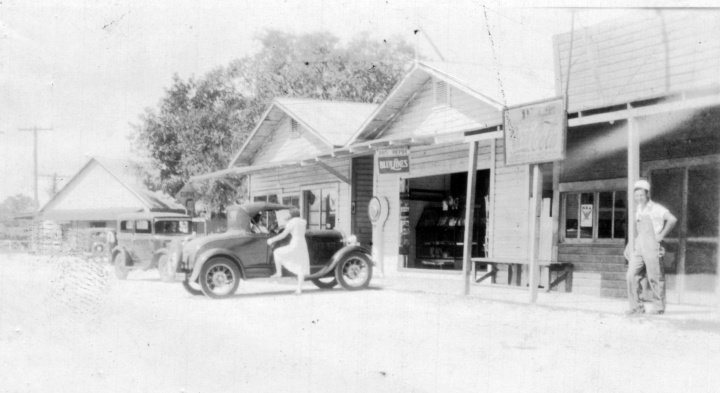
HISTORY OF PASCO COUNTYLacoocheeHistory of Lacoochee (1976)
The following article by Lorise Abraham appeared in East Pasco's Heritage.
Prior to the year 1922, when Cummer first began construction of a sawmill in Lacoochee, the anticipated growth of this community in northeast Pasco County had not materialized. Prospective land buyers had once been brought in by train to invest in what promised to be a large manufacturing center. The area surrounding Lacoochee had prospered for a while by growing strawberries and running turpentine stills. At one time orange groves had lined the banks of the Withlacoochee River, just one-half mile from the center of town. It is said that the "Big Freeze" of 1898 completely wiped out every trace of any orange trees there. Eventually the remains of the homes of the grove owners also vanished. In 1922 Cummer acquired the land in Lacoochee needed to construct a modern, completely electrified sawmill and box factory, the largest of its kind in the South. This continued in operation until 1959, bringing the long-promised prosperity to this area. At one time Cummer offered the largest payroll in Pasco County.
The spiritual lives of the residents were enriched by the construction of several Protestant houses of worship, which included First Baptist Church, Oak Ridge Baptist Church, United Methodist Church, and Assembly of God Church. Christian fellowship in Lacoochee was not only a Sunday affair. The townspeople practised their religion in an everyday manner by helping those of the community who were in need from sickness, poverty, or loss of personal belongings by fire or floods. To a community constructed mainly of lumber, fire was a daily hazard, not only to the mill site but to all the homes and businesses. Each fire was valiantly fought by Cummer's own fire department, assisted by local volunteers, and when needed by the Dade City Volunteer Fire Department. During the Second World War, labor at the mill became a problem because so many of the young men were called to the service and so many people went to work in the shipyards at Tampa. Lacoochee contributed more than vitally needed lumber to the war effort, giving up five native sons in this conflict. Lost in the European theater of war were the Lessig twins, Gerald C. and Harold L. Lessig, Robert Holt, and L. Hawkins. Paratrooper Carmen Thompson gave his life in the Pacific. Killed in action also were Francis Woods and James Mills of Trilby, both of whom had worked at the mill, and whose loss was deeply felt by Lacoochee people too.
The history of Lacoochee is unique because of the feeling prevailing throughout the community of "one family." Many young people who grew up there have ventured out into the world to become leaders in their chosen professions. Lacoochee people take great pride in the achievements of their friends and neighbors. These accomplishments are spoken of without envy whenever two or more people from Lacoochee get together. After Cummer reluctantly closed down the mill operation, the location was purchased by Wood Mosaic Corporation of Louisville, Kentucky in 1960. Wood Mosaic operated a plywood mill there until 1964. From then until 1971 the site remained unused, at which time the property was purchased by Interpace Corporation of Parsippany, New Jersey. At present Interpace, with a work force of about 110 people, is specializing in the making of reinforced concrete pressure pipes for the transmission of water. Interpace is now one of the three main industries in east Pasco County, and the only industry in Lacoochee. The town of Lacoochee still has a large population; several businesses continue to operate there. One of the most modern schools in the county was built there several years ago. This school operates day and night for the continued education of adults as well as children.
Lumber Mill Was Town's Foundation (2003)The following article appeared in the Tampa Tribune on June 13, 2003.By CAROL JEFFARES HEDMAN LACOOCHEE - Several historic sites still dot the countryside. But many pieces of the past are no longer standing in this once-thriving mill town in northeast Pasco County. One such place was the old kindling house, which was still around in the mid-1980s. The house - the last of several built in Lacoochee during the 1930s - finally is gone, according to Lewis Abraham, a Dade City Realtor. Abraham grew up in Lacoochee during the days when the town prospered after Cummer and Sons Cypress Co. established the lumber mill. Earlier in its history, Lacoochee was home to many wealthy citrus and strawberry farmers until the freeze of 1895 wiped out those industries and the town. Things changed when the Cummers came from Michigan, building a modern, fully electric cypress sawmill and box factory in Lacoochee in 1922. The mill was used to cut the company's cypress, pine and hardwood timber holdings in Central Florida. The company also built rental houses for employees and company stores. But the town grew quickly after the mill opened, and soon there was a two-story, 30-room hotel, four churches, two bakeries, two drugstores, three garages, two service stations, two department stores, three barbershops, several restaurants, two doctors, two train depots and more than 1,000 registered voters. Lacoochee survived the Great Depression - mainly because the mill remained open and continued employing the majority of the town's residents. During those hard days of the 1930s, some residents built their homes from the kindling wood the mill gave away free, Abraham said. When a log came into the mill, it would be steamed. Lumber was cooked and moisturized so it could be sheared and would come off in smooth strips. Cypress boards would be air dried outside on slanted slats. Pecky cypress, now an expensive lumber used as a decorative wood, was considered a “nuisance lumber” then, Abraham said. “We use to call the stuff cockroach hotel.” Mill workers cut pines for veneer to be used at the crate mill. But when the lumber was too hard, the company would give away the kindling wood. Most people wanted it for fuel for wood-burning stoves. But a few industrious folks took the kindling and transformed it into houses, Abraham said. Few of the kindling houses survived the years. The kindling particularly was vulnerable to sparks from wood-burning stoves and overturned oil lamps. Electricity didn't come to the outlying areas of Lacoochee until the 1940s when Withlacoochee River Electric Cooperative Inc. provided access. But in the mid-1980s there was one surviving kindling house beneath moss-covered oaks in Coulter Hammock where Abraham played as a child. Already vacant and deteriorating in the mid-1980s, the house was beyond restoration and since has been lost to time, Abraham said. The kindling on that house had been used on the inside and outside walls. The kindling on the outside walls was made into shingles by cutting the wood into rectangles and then angling the bottom by hand. The basic roofs in those days were made of cypress shingles, but in later years tar paper was nailed over the cypress roof on the kindling house. Cummer and Sons Cypress Co. closed in 1959 and with it the town of Lacoochee began to dwindle. But the bond that was formed between its residents and the town during those prosperous years has remained. Many return year after year for a reunion to rekindle old friendships. Others have never left.
Life in a Mill TownThis article appeared in the Tampa Tribune, date unknown.By CAROL JEFFARES HEDMAN The Cummers came from Michigan in the 1920s, when the standing timber was exhausted near their sawmills there. And with the company came new hope for the tiny town of Lacoochee in northeast Pasco County. A town had existed in earlier years, when “a number of well-to-do people” lived there, said Bill Dayton, a Dade City lawyer and local historian. The residents made their homes on the banks of the Withlacoochee River, raising citrus and strawberries. But the freeze of 1895 wiped out agriculture, and the small population of Lacoochee dwindled to only a handful, Dayton said. That all changed in 1922, when Cummer Sons Cypress Co. built a modern, fully electric cypress sawmill and box factory in Lacoochee. The mill was used to cut the company's cypress, pine, and hardwood timber holdings in central Florida. Jacob Cummer, founder of the lumber empire, had worked in his father's mill in Canada and eventually formed his own company, purchasing tracts of timber in Michigan. In the 1880s, the lumber industry prospered there, but by 1893, the supply of timber was depleted, and Cummer sought other properties. Cummer acquired lands in Virginia, North Carolina, Louisiana and Florida. He started operations in Florida in 1896, and in 1897, the Cummer Lumber Co. was organized in Michigan to operate the interest in Florida. To transport the logs, the company built the Jacksonville and Southwestern Railroad, a line that eventually was sold to the Atlantic Coast System. When Cummer died in 1904, his son, W. W. Cummer, and grandson carried on the business. When Cummer started operations in Pasco, it transformed Lacoochee. “You could literally go from cradle to the grave living at Cummer,” Dayton said. What Dayton was referring to was the town within a town that Cummer Sons Cypress Co. created. The company built houses for employees, renting a room for 50 cents per week. Electricity was 5 cents extra per week. There were company stores, and paychecks were paid partially in coupons to be used at the stores, Dayton said. Employees could purchase such items as “outlaw brands” of soft drinks, Dayton said. They were outlawed, he said, because the drinks were made by non-union workers. Dayton said the soda bottles, inscribed with such labels as “Budwine,” can still be found occasionally in the wooded areas where millworkers went to relax. The town of Lacoochee also grew quickly after the mill opened. Soon after the company began operations, downtown Lacoochee boasted a two-story, 30-room hotel, four churches, two bakeries, two drug stores, three garages, two service stations, two department stores, three barber shops, several restaurants, two doctors, two train depots, a constable, and more than 1,000 registered voters. “Cummer was a real godsend,” Dayton said, adding that the mill helped Lacoochee survive the Depression. “They (Cummer) were a major employer when most people didn't have jobs.” Cummer paid 10 cents an hour in those days. But people were just glad to have jobs, Dayton said. Dayton said “an old-timer in Lacoochee” related a story about his younger days working in the mill. “He was a young boy, about 18 or so. And it was his first job,” Dayton recalled the old-timer saying. The employee was pushing a dolly carrying stacks of shingles one day when Cummer had come to the mill to show some people around. The employee came around the corner and bumped into the company's president, knocking him to the ground, Dayton related the story. “Get away, you old fool. Mr. Cummer ain't paying me 10 cents an hour to watch out for the likes of you,” the young man was said to have snapped, without knowing the old man was his boss. As Cummer picked himself up and dusted himself off, someone asked if he wanted to find out who that was and fire him. Cummer said he didn't mind; he was just glad the employees were working so hard. “They were fine people to work for,” remembered 78-year-old Leon Burnsed in an interview in 1984. Burnsed was one of those who worked at Cummer during the Depression for 10 cents an hour. Burnsed had been working in agriculture in Winter Garden during the late 1920s. But when he was laid off, he came to Lacoochee in 1929, seeking a job in the sawmill he'd heard about. When Burnsed began working for Cummer, he was told there were 700 employees in the company's plant and logging industry, he said. Burnsed soon rented one of the company's houses. And he still lived in that house when he was interviewed in 1984, although it had belonged to three different owners since Cummer owned it. Burnsed continued to work for Cummer for 30 years and was foreman of the sawmill when it closed in 1959. “The mill shut down because there was a lack of timber,” Burnsed said. “We had timber in the Everglades, but it wouldn't support the mill.” Burnsed moved to Georgia for a short time but returned to Lacoochee in 1960 to work for other companies that acquired the Cummer properties. He retired in 1981 from Interpace Corp. Interpace bought the old Cummer property in 1974 and began making reinforced concrete pressure pipes for carrying water. Interpace sold out to GHA Lockjoint Inc. in 1982. The pipe-making firm is still Lacoochee's major employer with a work force of more than 10. According to U. S. Census figures, the population of Lacoochee is more than 5,000. |