HISTORY OF TARPON SPRINGS, FLORIDAVarious ArticlesWebb’s Historical, Industrial and Biographical Florida (1885)TARPON SPRINGS is located in close proximity to the Anclote River about 2 miles from the gulf. It was settled in 1883 under the auspices of the Lake Butler Villa Company, the first residence and store being erected by A. Blum, Esq., of St. Louis, Mo. The present population is 150. Among the prominent residents may be mentioned Ex-Gov. A. P. K. Safford, of Arizona. Land companies and agents are the Lake Butler Villa Co., Tarpon Orange Grove Association, and Diston Purchase, J. A. Buckner and H. W. Nassey, agents. The Gulf Coast Herald is published weekly, Camp and Buckner, publishers, J. A. and Lucie M. Buckner, editors. It is a 4-page interesting sheet published every Saturday. The famous Tarpon mineral springs, for which the town has become noted, comprise the Major, extending with a uniform width of 300 feet, a distance of one-half mile to its confluence with the Anclote river, and 10 or 12 smaller springs in the vicinity within a radius of 50 feet. The Major has been sounded to a depth of 103 feet without reaching bottom. These springs are noted for their great medicinal virtue and attract crowds of invalids from all parts of the country. The town is accessible by all the popular railway or steamer lines to Tampa, thence by hack, a pleasant ride of a few hours. There are two excellent hotels, the Tarpon and the Tropical, the former opened for the first time this season, the latter in its second year. Mr. W. F. Meres, proprietor. The general aspect of the place is that of a thriving and progressive town, and during the winter months the large influx of tourists, invalids, etc., adds materially to the permanent population, which comes principally from Pennsylvania and New York. The postmaster is Mr. Edward A. Blum.
Florida State Gazetteer and Business Directory (1886-87)Population, 300. Edward A. Blum, postmaster. Was first settled in 1882. Situated on Anclote River, 27 miles northwest of Tampa, the county seat and nearest express, telegraph and banking point. Tampa is also the shipping point. Has eight stores, two hotels, the Tarpon Springs and Tropical, steam saw mill, public school, and Universalist and Methodist churches, white and colored. Oranges, vegetables and lumber are the principal shipments. Has semi-weekly stage communication with Tampa; fare, $3; to Bayview, $3. Mails north Tuesday, Thursday and Saturday; south, Monday, Wednesday and Friday. Land sells at $5 to $25 per acre. This place is located in a fine fruit and vegetable section, and the yield is remunerative.
Blum Adolphus, warehouse and wharf.
Tarpon Springs Truths (1897)A Beautiful Little West Coast City—A Winter Resort.BOILING SPRINGS ARE BEAUTIFUL.They Are the Admiration of All Visitors—The Largest Sulphur Springs In the State—Beautiful and Progressive HotelThis article appeared in the Tampa Morning Tribune on July 15, 1897. Tarpon Springs is one of the prettiest, most prosperous and up-to-date little cities on the West Coast. It is situated on the Sanford and St. Petersburg division of the Plant System and Anclote river, about twenty-eight miles northwest of Tampa. It is also within two or three miles of the Gulf coast, being about that distance from Sponge Harbor, noted all over the country for its fine sponge fisheries. The finest sheep-wool and grass sponge in the world are taken off Sponge Harbor, and Tarpon Springs is rapidly developing into the leading sponge market of the state. This honor, up to a few years ago belonged to Key West, but owing to the great distance to that port, and to the enterprise and activity of the leading citizens of Tarpon Springs this large and profitable industry is rapidly going to this point. The population of Tarpon Springs is about 700. The municipal officers are: Mayor, Willis Castaing; city clerk, J. C. Buckman; tax collector and marshal, J. O. T. Brown; town council, H. B. Webster, (former mayor), V. Castaing, W. W. Decker, L. D. Vinson and A. P. Weller. However, the latter has recently removed to St. Petersburg, and the vacancy will have to be filled by a special election, which will probably be held in a month or six weeks. The office of tax assessor is also vacant and will be filled at the approaching special election. The Methodists, Baptists and Catholics, respectively, have handsome houses of worship; also the colored Baptists and Methodists are well provided for with church houses. Tarpon Springs has four or five large general stores, two drug stores, one grain and feed store, four hotels, the largest and finest of which is the magnificent Tarpon Springs hotel, H. G. Marvin, proprietor. This hotel is one of the largest and finest on the West Coast, which is noted for its fine hotels. It is situated on the principal street of the town, about 100 yards from the famous Tarpon (sulphur) springs, which throw out the largest volume of water of any spring in the state. It is about 350 feet in diameter, nearly round in shape, and walled up with brick and cement all around. Large fishing smacks and yachts frequently run up into the spring, where they turn around without difficulty. The spring is very deep in places, particularly just west of the boiling spring, where no bottom has ever been found. The waters from the spring flow into the Anclote river, a short distance down, through a beautiful bayou, which is also walled up for a distance of about 200 yards. Large tarpon fish are frequently seen swimming and playing in the bayou and spring, but they are seldom disturbed by the citizens. Other hotels in Tarpon Springs are: The Ferns, W. F. Meres, proprietor; Topliff House, G. C. Gleason, proprietor; and the Russell House, Mrs. Gracie Neligh, proprietress. The Russell House is an all the year round hotel, and is conveniently situated near the depot and business centre of the city. Rates $1 per day or $4 to $5 per week. It is hardly necessary to say that this hotel is filled with guests year round. The leading business houses of Tarpon Springs are: C. D. Webster, drugs; established in 1886 by the present proprietor. J. M. Vinson & Bro., dry goods, clothing, shoes, gent’s furnishings, etc., also undertakers. This firm was established in 1884 by Mr. J. M. Vinson, who removed to Tarpon Springs from Tallahassee, and in 1890 he admitted his brother, Mr. L. D. Vinson to the firm. They have succeeded in building up a fine trade, and now carry between $4,000 and $4,000 stock. Mr. L. D. Vinson, the junior member, is a town councilman of Tarpon Springs, and has done much to secure modern improvements and conveniences for the city. Mr. Geo. McArey is the popular proprietor of the Tarpon Springs Drug Store, established in 1892 by the present proprietor. Mr. McArey is one of the oldest and most enterprising citizens of Tarpon Springs and is always to be found in the front ranks among those who are endeavoring to build up their town. Mr. J. C. Beekman is the enterprising head of the firm of J. C. Beekman & Co., dealers in staple and fancy groceries, hardware, crockery, paints, etc. Mr. G. I. Loucks conducts an extensive general merchandise business near the passenger depot of the Plant System, and while he has only resided at Tarpon Springs something over a year yet he has succeeded in winning the confidence and respect of the entire community and in building up a a large and lucrative business. Mr. H. M. Longstreet has recently removed from St. Petersburg and opened up the “Star Bargain House,” where he does a strictly cash business. But his prices are low and the people recognize this fact. L. S. Fernald & Bro., successors to G. W. Fernald & Son, conduct one of the most extensive general merchandise businesses in Tarpon Springs. In 1890 Mr. L. S. Fernald, the present senior member, removed to Tarpon Springs from Sioux City, Iowa, to join his father, Mr. G. W. Fernald. He has thoroughly identified himself with the people and is esteemed for his honest dealings, and courteous and impartial treatment of all. The Fernald Bros. are also largely interested in the sponge industry, having several vessels of their own, besides they provision and furnish a number of the Key West smacks which gather sponge in the waters near Sponge Harbor. This enterprising firm also bears the honorable distinction of having built in Tarpon Springs one of the finest opera houses on the West Coast, which can seat, comfortably, about 300 (?) people. The bank of Tarpon Springs, N. S. Patten, president, and L. T. Safford, cashier, is incorporated with $50,000 capital, and is one of the most solid banking institutions of the state, and does an immense banking business. The Tarpon Truth, edited and published by Mr. Polk, is one of the best weeklies in South Florida. It has, perhaps, the largest bona fide northern circulation of any newspaper in the state, always excepting the TRIBUNE. The editor is a polished gentleman and erudite writer and, although he has only resided at Tarpon Springs but a few months, has succeeded in winning the confidence an admiration of the entire community. The leading citizens of Tarpon Springs are very anxious for a street railway and electric plant, and are holding out liberal inducements to the right company. They are anxious that the Tampa Consumers’ Electric Light and Street Railway shall take hold of the matter, and send a representative over to their town to examine the country and hear their proposition. Mr. L. M. Vinson, ex Mayor Webster and other enterprising business men of the town will take pleasure in giving that company any information they may wish on the subject. A fine opening is offered at Tarpon Springs for some enterprising corporation or company.
Sponge Industry of Busy Tarpon (1903)This article appeared in the Tampa Morning Tribune on Apr. 5, 1903.Tarpon Springs, April 4.—Work is rapidly progressing on the $30,000 residence of George W. Clemson, which is being erected on the north side of the spring. The building is to be a spacious one, two and one-half stories in height, and will be provided with all modern conveniences that go to make up a thoroughly modernized and ideal home. Mr. Clemson’s new house-boat recently arrived from the East Coast via the Strait of Florida, and is now cruising along the coast, near Tarpon Springs. N. A. VanWinkle has been awarded the contract for erecting a $4,000 boat-house, in which this floating palace will be stored during the summer, while he is looking after his manufacturing interests in the North. The new sponge house of John K. Cheyney, located near the bayou, has just been completed, and will be ready for use during the spring sponging trip, which is expected to begin about the first of May. The main building is 40x80 feet, and will be used for the clipping and packing of sponges. Alongside this are two other smaller buildings 20x40, and 30x40 feet, respectively. One of these buildings is known as the bleachery, and is thoroughly equipped for bleaching the raw product. The other is known as a drying room, and has a glass roof for the utilization of the rays of the sun in drying the product. The building is also steam heated. Some distance from these buildings is located a fire and burglar-proof stock room, 20x30 feet. It is a brick building with cement floor and corrugated iron roof, and will be used for the storage of the baled sponges previous to being shipped. As much as $20,000 worth of sponges is often stored in the stock room at one time. A sponge house is being erected for W. W. K. Decker by N. A. VanWinkle. The building is 36x100 feet, and will be complete in all its appointments. Another sponge house was recently erected for E. P. Meres. It is of corrugated iron. Several residences are in contemplation by winter tourists, who have become infatuated with Florida’s equable climate, and desire permanent winter homes here.
Florida Sponge Industry (1904)This article appeared on Feb. 21, 1904, in the Fort Wayne Journal Gazette, and in other newspapers around the country at about the same time.Few persons not directly connected with the sponge industry are apt to realize the growing importance which this product has assumed at Tarpon Springs, but it is a fact, nevertheless, that from insignificant proportions ten years ago the business here has leaped forward, until now it is the leading centre of the sponge business in the United States and the Western Hemisphere.
The actual sponging is done from rowboats of very small vessels, the hooker, using a three pronged rake thirty or forty feet long, and with the aid of a water pail—an ordinary water bucket with a glass bottom—readily detects and detaches sponges from the bottom—so clear are the Gulf waters and so expert do the men become. The sponges when first obtained are far from what we are accustomed to see at stores. They are full of animal matter, and this must be allowed to die and then be dried and hammered out and finally detached—a process that requires weeks. Sponges are auctioned off to the dealers during the season at Tarpon Springs who represent northern houses, and from there they are distributed all over the country and even in Great Britain, the Netherlands, Belgium and France. At the present time Tarpon Springs produces three-quarters of the total product of Florida sponges, other than those secured around Key West, and probably more than half of the whole Florida yield. The balance of the sponges produced are sold at Key West. In 1903 Key West perhaps sold 90 percent of all the sponges produced in this country, the total Florida produce being 366,000 pounds, with a value of $483,000. In 1896 the product was 236,000 pounds, valued at $273,000. In 1899 the product was 987,000 pounds, in 1900, 567,000 pounds. Since then the yield has decreased, but the average total value has remained the same. The number of pounds of sponges produced any year is not a fair criterion of the value of the sponges that year as compared with many other years, for some sponges are worth many times what others are worth, and some years are prolific of cheaper class of sponges; but on the whole, sponges have steadily increased in value. Thus, sheep’s wool (the highest class of sponges) prices for the past few years were as follows: In 1895, price per pound, $1.57; 1896, $1.67; 1899, $2.16; 1900, $2.67; 1901, $1.67; 1902, $2.85; and at the present time they are worth nearly $4 per pound.
The Largest Sponge Market in the Western Hemisphere (1916)The following article appeared in the Racine Journal-News on March 25, 1916.By FREDERIC J. HASKIN TARPON SPRINGS, Fla., March 22 — This city claims the distinction of being the largest sponge market in the western hemisphere. Over a hundred schooners with their diving boats sail from its little river harbor to the sponge beds in the gulf; and a local colony of 2,000 Greeks are engaged almost wholly in the sponge business. They have imported their native methods unchanged, even employing the same picturesque boats with high-prows and brilliant colors that are used in the Mediterranean. The Greeks have an absolute monopoly on the business of diving for sponges. They go down into one hundred feet of water in rubber suits and helmets, cut the sponges from the bottom with a knife, and bring them to the surface in nets. Now and again a man gets his rubber lines tangled, and his air supply is cut off, or he remains below too long and becomes paralyzed. Sometimes a big man-eating shark becomes unduly curious, and makes a menacing swoop at the diver. His usual defense in such a case is to open his sleeve and let out a rush of air bubbles, which almost invariably frightens the shark away. At any rate, these under-sea adventures to not appeal to the Americans. They are willing to take a risk for sufficient cause; but not for a diver’s wages, so the Greeks have no competition in that part of the business. Before they came to Florida, sponges were taken only by negroes who went out in rob boats and “hooked” sponges in comparatively shallow water with long poles. It was a primitive and ineffectual method, and all Florida did not produce a fraction of what is now exported annually from Tarpon Springs alone.
Although the Greeks dwell in their own quarter of the town, and preserve their national customs they live in perfect amity with the Americans. There are very prosperous firms in the sponge business which are conducted by Greeks and Americans working in partnership. The Greek likes American business methods, American money, American movies, and many other American things; but when it comes to cheese, wine and candy, he insists on having his own. Hence there are in Tarpon Springs many picturesque little shops dealing in these things, and in other strictly Greek dainties which are beyond the appreciation of an American palate. There are also Greek coffee houses, where you may see the divers in from the Gulf, sipping the drink from little cups and smoking water-pipes. As sponges become scarcer, the fleets have to go farther and farther out into the Gulf to get a good harvest. They now usually remain for two or three months at a time, returning all together at certain times of the year, when the great sales are held. Early fall, Christmas and Easter are the times of the most important sales, and upon these occasions Tarpon Springs becomes one of the liveliest little towns upon the globe. The Greek diver is a daring, happy-go-lucky chap, who makes big wages and does not believe in saving them. When he hits town he usually collects several hundred dollars, and proceeds zealously to spend it all before going to sea again. He is a liberal and boisterous patron of wine-shops and coffee-houses and movies. He decks himself in the gaudiest and most expensive clothes that money will buy. He rather overruns the town, but seldom does any harm either to himself or anyone else. Easter is the most important occasion of all, being a great Greek holiday. There is much feasting, and candle light processions through the streets at night. At the time of the Christmas sale, the Greek Cross day is celebrated. The whole colony gathers at the bayou behind the town. The young men, all expert swimmers, line up on the bank, clad only in trunks. The priest throws a wooden cross into the water, and there is a race for it, the boy who wins receiving a prize. When the sponges are brought up by the divers, they bear no resemblance whatever to what you buy in a drug store; for the commercial sponge is merely the skeleton of an animal. In the natural state it is covered with a thick mucous. This is pounded and washed out, the roots are cut off with sheep shears, the sponges are sorted according to variety, and strung in bunches of ten to thirty teach. There are a number of varieties. The wool sponges are the most valuable, others being grass, yellow and wire sponges. Sponges of all kinds are becoming scare and the prices they bring are surprising. Wool sponges bring from $2 to $4 a pound. A little ragged heap of sponges that you could cart away in a wheelbarrow often sells for several hundred dollars. The sponges grow in banks upon the bottom of the gulf, and the great object of the fisher is to discover a new bank, for a huge one is a veritable bonanza. When a sale is held, the sponges are carried to the water front, where they form great heaps, divided according to kind and quality. The buyers are Americans, most of whom live in Tarpon Springs as representatives of various northern firms. The Greeks who own the sponges are on hand to exhibit them and extol their value, but there is no haggling. Sealed bids are made upon each lot and the highest offer gets the sponges. Tarpon Springs is an absolutely complete and independent unit in the sponge business. There is a local supply house which deals in all the paraphernalia of the divers, and the brass helmets which they wear are made by a local machine shop. For the rest, the outfit consists in a rubber suit, iron shoes weighing twelve pounds, rubber hose to connect the diver with the pump on deck, and the rope by which he is lowered. From Tarpon Springs the sponges go chiefly to New York, Chicago and Cincinnati, where they receive the final process of bleaching, and are then placed on the retail market. In addition to Tarpon Springs, the sponges are taken in commercial quantities at Key West, Miami, and in the Bahamas. In all of these places, however, the primitive method of the long pole and the hook still prevails, and the sponges can only be taken near shore, while the men of Tarpon Springs cruise from Rock Island to the Tortugas, and bring in more sponges than all of these other fisheries put together. Tarpon Springs has been rewarded for giving the Greek a fair deal.
Early Days in Tarpon Springs (1928)The following history was written in 1928 by early settler Joshua C. Boyer (d. May 19, 1933) at his home in Eau Gallie.Mr. A. W. Ormond and his daughter, Mary, were the first settlers in what was later to be known as Tarpon Springs. They located there in 1876. The next year, 1877, I came up the Anclote River on a fishing trip and by chance stopped off at Mr. Ormond’s residence. I built a residence there, establishing my permanent home, and the same year Miss Mary Ormond and I were married. Everything there was ours. The land and the game and fish were as free as air. In the words of another, “we were monarchs of all we surveyed.” Our nearest neighbor was Mr. Asa Clark who lived on the Whitcomb place, a mile away. Our next nearest neighbor was W. B. Thompson, in the Curlieu settlement, four miles distant. There was also the Myers family, three miles down the Anclote River. The firm of Mayo & Wall did a sawmill and mercantile business at Seaside, about four miles west on the Gulf coast, where we did our trading. Our nearest postoffice was at Clearwater, 16 miles, which was a tremendous distance in those days over the trails which comprised the only roads of that section. Each and every neighbor, getting his mail at this office, would bring the mail for all of his neighbors. In 1880 my wife gave the name, Tarpon Springs, to the town. This name was selected because of the great number of tarpon fish that frequented the springs. In those days I have often killed deer and wild turkeys and squirrels in my yard. We enjoyed these exclusive privileges until 1880, when Governor W. D. Bloxam sold four million acres of swamp and overflowed land to Hamilton Disston Company of Philadelphia, for twenty-five cents per acre. This purchase money was used in paying off the bonded indebtedness of the state. This swamp and overflowed land was ceded to the state by the federal government. The more valuable high land was retained by the federal government for settlement by homesteaders, except section sixteen of each township which was given to the state for school purposes. As a matter of fact, in surveying this swamp and overflowed land considerable of the high land was included in the survey, to the advantage of the state. When Mr. Disston had selected his four million acres he formed the Lake Butler Villa Company and his agent, Major M. R. Marks, in 1882, selected Tarpon Springs as the site of the city that should eventually become the metropolis of that section. The coming of Major Marks and family was quite a surprise for me. He also brought with him his surveyor, Captain John B. Walton and wife. Also his book-keeper, W. N. Conley, and his attorney, John C. Jones, now of Orlando. Then in 1883, came Governor Safford and family, together with his sister, Dr. Safford, a practicing physician. Governor Safford had been governor of the Territory of Arizona before coming to Florida. I had to take care of all of these new-comers in my residence until later in the year when two hotels were built, named the Tropical and the Tarpon Springs. These hotels were of sufficient capacity to accommodate all comers. The first store-keeper was A. Blum and soon after him came J. M. Vinson. Tarpon Springs post office was established about 1884, and soon after that the town was incorporated, and the rest is familiar history. At Tarpon Springs (1929)This article appeared in Time magazine on Feb. 11, 1929.Sharp official eyes search the gay streets of the Greek quarter of Tarpon Springs, Fla. Alien sponge divers (TIME, Jan. 21) move aside, shift their glance away. Along the waterfront, among the gaudy antique boats, has gone the whispered warning: U. S. Immigration inspectors are about the town to check smuggling of aliens. Every stranger is a suspect. For 25 years the Greek colony of Tarpon Springs has had the local deep sea sponge diving industry to itself. Americans were not interested. Then came the immigration quota law. New recruits from Greece fell off. The new generation of native-born Greeks would not fill up the ranks. By dint of much bickering with government officials an occasional batch of 50 Greek divers would be admitted temporarily, for six months. The sponge boats would go out for a month or two and come back with their fluffy treasures of the deep and, some said, with additional crew members. New faces moved against the bright background, new voiced joined in the native songs. Were these Greeks smuggled in to dive for the sponge industry? Alert U. S. agents are waiting, watching.
A Short History of Tarpon Hi Football (1929)This article appeared in the Tarpon Springs Leader on Dec. 6, 1929.Ever since that autumn day in 1925 when the first call for football candidates sounded in Tarpon Springs, the followers and supporters of T. H. S. football have witnessed many glorious victories as well as heartbreaking defeats. Only one of the candidates for that first team had ever seen a football game, the other ten played in the first game they witnessed. Six games were played the first year, the Spongers winning one and losing five. Three of these losses, however, were by the slender margin of one touchdown. The next season was a more successful one, the home team winning four games, and losing four. One of these, however, was to the strong Green Devils of St. Pete. The year of ’s27 saw a decided change in Tarpon Hi football. The Spongers won six, lost two, and tied two. This year will long be remembered as the first year a Tarpon Hi football team defeated their dreaded rivals, the Clearwater eleven. In 1928 things still improved on the gridiron. The local eleven won eight games, and lost two. The two defeats were at the hands of Plant Hi and Hillsborough I, of Tampa, who possess two of the strongest teams in the state. In the present year the Spongers have witnessed their worst season since their first, winning only two games, tying one and losing six. The team as a whole, however, was inexperienced and also played only “A” class teams. Summing up the football games played by Tarpon Hi, it is seen that the Spongers have won twenty-one, lost nineteen, and tied three.
Tarpon Springs (1949)This article appeared in the St. Petersburg Times on June 13, 1949.TARPON SPRINGS - Unless congress hikes the duty on imported sponges and something is done to increase the demand for domestic sponges in the American market, this upper Pinellas municipality will wither and die on the economic vine. Out of the 85 boats in the Tarpon Springs sponge fleet, only 20 are in service and an average of only 10 are making trips to the Gulf of Mexico sponge beds. Tarpon Springs has fallen into such a quagmire of utter despair that you hear it everywhere you go and some of the stories would turn hearts of stone. This writer Howard W. Hartley remembers the Tarpon Springs of the days of World War II when sponges brought fabulous prices and the men of the sponge fleet were literally rolling in “folding money.” Last night, a shocking picture in reverse unfolded in talks with the few fishermen along the quays and a half-dozen dispirited coffee shop proprietors. “Look around town,” said a cafe operator. “You will discover the young men are gone. You want to know where? They are up north trying to find work in the steel mills at Gary or the automobile factories of Detroit. They have left Tarpon Springs to the old people, the women and children.” A sponge boat owner, holding a majority share in two schooners, took this writer to the quay where his craft was moored. “I am ashamed to show you my boats,” he said. “Look at them. They are dirty and not well kept. We have not been out now in nearly three weeks,” he said. “There is no use to go out. If we bring back the sponges, we cannot get enough for them to pay the expenses of the voyage. But I am an old man, as far as the age to work in the steel mills is concerned. I am 58. If I go north, the boss will tell me. Sorry, you are too old to stand the work,” he said. A coffee shop proprietor nearly wept as he described his personal problem in a community wherein the spark of hope seems all but extinguished. “It cost me $6 to open my place this morning and operate it today,” he said. “Counting the 10 cents you have just spent for a cup of Turkish coffee, I have taken in a little over $3. The people cannot patronize my place. They have no money. You may not believe this, my friend, but there are women and children who will go to bed hungry in Tarpon Springs tonight.” When asked how congressional approval of a higher duty on imported sponges might affect the local economy, the merchant said it might help a little, but the real problem is not foreign competition. “There are too many synthetic sponges on the market,” he said. "The Du Ponts and the big rubber companies have put us out of business with a cheaper sponge that the people seem to prefer to the real article.”
Local Historian Claims Blacks Were First Spongers (1990)This article appeared in the Tampa Tribune on Sept. 16, 1990.By NICHOLAS W. PILUGIN TARPON SPRINGS—While official histories date the start of sponging in Tarpon Springs to just after the turn of the century, Ed Dorsett knows better. “For the (city) centennial, they wanted to know about the old spongers,” said Dorsett, 77. “The old spongers were really the black spongers. We’sve been here long before they (the Greeks) got here. My grandfather was a sponger.” Just in case anyone doubts his word, Dorsett keeps the yellowed, crumbling ledger of the all-black Odd Fellows Lodge No. 3116 in his barbershop to back him up. The battered book’s first entry dates formation of the lodge to 1889. Among the many members registered is Robert Russell, initiated into the lodge in 1895. On the line labeled “occupation,” Russell is listed as a sponger. A look through the book reveals the two most common occupations for blacks at the time were as laborers and spongers. “That gives you an idea there was some kind of organized community,” said Dorsett, whose parents moved to Tarpon Springs shortly after he was born. “It wasn’st haphazard, but organized -- as organized as they’sd let you get at that time. It shows there were intelligent people.” Aside from sponging and having their own lodge, blacks in Tarpon Springs played a role in building the community. For example, a portion of St. Nicholas Greek Orthodox Cathedral was paid for by black spongers. When the Greek sponge fishermen donated the first four or five sponges from their catch to pay for the cathedral, black spongers pitched in too. They also donated their labor, alongside the Greeks. “I mixed the mortar,” recalled longtime resident Samuel Archie. “And that dome on top -- two of us went up and built the scaffold.” But the blacks also built their own community, which at one time included a black business district on Safford Avenue, between Lemon and Lake streets. “It started to disappear in the late ’s30s and early ’s40s,” Dorsett said. “They had those businesses there before I could remember.” Among the black owned and operated shops were a cleaner, several restaurants, a pool hall, a barber shop and a jewelry store. “It was real unusual to have a black jewelry store at that time,” Dorsett said. And while blacks have long lived in the area east of Safford Avenue and south of Lemon Street, they also once lived near what now is the sponge docks, along Park and Athens streets. “A lot of that was owned by blacks,” Archie said. “It was two blocks long, from Athens Street to Park Street. During the depression, a lot of people lost (their property) because they couldn’st pay the taxes.” Archie, now 76, came to Tarpon Springs when he was 4. He said many of the black property owners lost their land because of the Murphy Act, which allowed someone to take over a property by paying the back taxes due. Like other Southern cities, Tarpon Springs had segregated facilities, including a separate waiting room at the old railroad depot. Segregation led the black community to form its own institutions -- such as the all-black Odd Fellows Lodge and more recently, the Better Boys Club in 1962. “We applied for membership in the Boys Clubs of America,” Archie said. “They sent us a nice letter saying we couldn’st be a part of it because of segregation. So we named it the Better Boys Club.” The club still exists today, Archie said, teaching young blacks about good citizenship. Yet despite the South’s racial segregation and the presence of groups such as the Ku Klux Klan, everyone in Tarpon Springs seemed to get along. “We had one or two lynchings, but we never had any Klans doing things ’sround here,” Archie said. “In Tarpon Springs, we always got along pretty well.”
A Brief History of Tarpon SpringsThe author of this article is unknown. It was provided by David Prace. The City of Tarpon Springs is located on the Anclote River less than a mile from the Gulf of Mexico. Its name was inspired by a fish, the tarpon, which was abundant in the waters around the City during the late nineteenth century. Although the details of the naming are uncertain, several accounts attribute it to early settlers who arrived in the 1870s. The first private landholder in the area was Samuel E. Hope, who purchased land on the north side of the river in 1864. In that same year, William and Julia Thompson, originally from the Bahamas, homesteaded land approximately three miles east of the area that is now the City. Three years later two brothers from Ocala, Frederic and Ben Meyers, purchased land from Hope. In 1876 A. W. Ormond and his daughter, Mary, moved from South Carolina and became the first settlers to live in what are now the city limits of Tarpon Springs. The event that hastened the development of Tarpon Springs, as well as the settlement of much of the southern half of Florida, was the Disston land purchase of 1881. Hamilton Disston, a wealthy saw manufacturer from Philadelphia, shrewdly acquired 4,000,000 acres of state land at $.25 per acre from the Florida Internal Improvement Fund. This fund had been set up in 1855 to administer state lands that were available for sale to the public. After the Civil War, the Fund became mired in debt and by state statue could not sell land until the debt was cleared. Approximately 20,000 acres of the purchase were located in what are now Pinellas, Pasco, and Hillsborough counties. In 1882, Disston’s surveyor, Major Mathew Robinson Marks, conducted the first survey and laid out the town of Tarpon Springs. Disston formed the Lake Butler Villa Company (at that time Lake Tarpon was called Lake Butler) and selected Tarpon Springs as the base of operations because of its location. Disston chose Anson P. K. Safford, a Philadelphia business acquaintance, to head his activities here. Safford was born in Vermont and grew up in Illinois. At age 20 he moved to Nevada and was elected to Congress six years later. He was appointed to be inspector general of Nevada and in 1869 was appointed territorial governor of Arizona. One of his major accomplishments was the establishment of the Arizona public school system. His involvement in Arizona mining ventures made him a wealthy man, and he moved to Philadelphia, where he met Disston. Safford became one of Tarpon Springs’ leading citizens, and his influence was felt in a variety of ways. He built the first small school and gave land for several churches. He also brought his sister, Dr. Mary Jane Safford, to Tarpon Springs, where she opened a medical practice and thus became the first female physician in Florida. Gradually the town grew. In 1884 a post office was opened with Ed Blum, a Russian Jew, serving as the postmaster. Within a few years, the town had attracted about 300 residents and decided to incorporate. On February 12, 1887 Tarpon Springs became the first incorporated city on the Pinellas peninsula. The second major event of 1887 was the arrival of the first railroad, the Orange Belt Railway. Three years earlier, Granville Noblit, a surveyor for Orange Belt, surveyed land from Tarpon Springs to St. Petersburg for a railway. The City of Tarpon Springs granted the railroad land and built a depot. The right-of-way for the line was donated by Disston. Before the trains came to Tarpon, the City could be reached only by boat or a circuitous train and steamboat route or overland by oxcart, wagon, or horseback from Tampa. Transportation advances in 1887 also included the construction of the lighthouse on Anclote Key. Tarpon Springs enjoyed the benefits that much of Florida realized in the late 19th century when the state became a popular winter resort for wealthy Americans from various parts of the country. Some of the imposing homes that remain in the city today were built during this period. Growth and progress did not come Without setbacks. In December 1891 the City lost two of its leading citizens when Anson and Dr. Mary Jane Safford died within a week of each other. During the winter of 1894-1895, two periods of record low temperatures severely damaged the Citrus crop, a major source of income for the area. Then in 1894 much of the City’s central business core was destroyed by fire. When merchants rebuilt, they replaced their stores and offices with structures made of brick and stone, with tin ceilings and metal roofs that would be less flammable than the original wooden ones. The founding of the commercial sponge industry in 1890 changed Tarpon Springs forever. Newly arrived American settlers had discovered sponges in the Florida Keys during the 1820s. About 1849, spongers in the Keys organized a commercial sponging operation, using long poles with grapples to harvest the sponges. The west coast sponge beds were discovered accidentally in 1873 by Key West turtle fishermen whose nets were fouled by sponges off the mouth of the Anclote River. Spongers came to the area to work the beds, and some moved to Tarpon Springs. In 1890 John Cheyney, a Tarpon businessman, opened the Anclote River and Rock Island Sponge Company across the river from Tarpon. During the 1890s, sponge packing houses were built in the City, sponge presses were installed, and buyers moved to town. Gradually the sponge business shifted from Key West, Cuba, and the Bahamans to Tarpon, and by 1900 the City was considered the largest sponge port in the United States. It was, however, the Greek immigrants who expanded and refined sponging in Tarpon Springs. The individual who is responsible for the Greek involvement is John Corcoris, who arrived in Tarpon in 1896 as a sponge buyer for a New York firm. He went to work for John Cheyney, who financed Corcoris’ early efforts to make the industry more efficient. In 1905 Corcoris introduced the first mechanized sponge fishing boat to 7 Tarpon Springs and brought in 500 Greek divers from Kalymnos, Halki, Sumi, Hydra, Spetse, Aegena and other islands. Other Greeks soon followed and businesses were established to serve the Greek community, including restaurants, candy shops, coffee houses, and grocery stores. Sponge merchants and brokers then came to Tarpon, and their presence helped to create a well-integrated industry. They built boats, loaned money to boat owners, and supplied tools and equipment to the entire sponge fleet. In 1906 the Sponge Exchange Bank was established, and in 1908 the Sponge Exchange was founded. Profits from sponging also financed other businesses, such as the Sponge Exchange Cigar Company. The City acquired a new look in the decade before WWI. The Tarpon Springs High School was built in 1912, the waterworks was constructed in 1914, and the impressive new City Hall opened its doors in 1915. By 1910 Tarpon Springs included an ice plant, an electric plant, two lumber mills, cigar factories, several banks, and a post office. Tarpon Springs experienced the real estate boom and increase in tourism that characterized Florida during the 1920s. Many new subdivisions were laid out, tripling the area of the original town, and a number of impressive buildings were constructed, including the Sunset Hills Country Club, Arcade Hotel, Villa Plumosa, a new high school, an amusement pier, a water plant, and the City’s first hospital. A local real estate exchange was created to help stimulate development. Unfortunately Tarpon Springs also experienced the collapse of the Florida land boom that occurred in 1926. Coupled with that was a devastating hurricane that hit south Florida in September and intensified that state’s economic woes. By the end of the decade, Tarpon felt the full effects of the Depression. The sponge industry managed to prosper during the period, but in 1938 a blight infested the sponge beds and many of the sponges died. A red tide in 1948 further damaged the beds. Fortunately the sponge beds have survived, and the industry has seen a modest revival, but those who make their living on the water today in Tarpon are more likely to fish for shrimp, spiny lobsters, or crabs. Tourism has replaced sponging as Tarpon Springs’ major economic activity. Thousands of visitors each year come to the City to enjoy the outdoors playing golf or fishing, to visit the Sponge Docks and experience Greek culture, to shop for art and antiques, and to tour charming Victorian neighborhoods. |
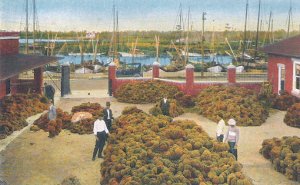 The sponging grounds, other than those of Key West, extend
from Anclote Keys, a few miles from Tarpon Springs, to Apalachee Bay,
and the best sponges are secured from ten to thirty miles off shore, in
from thirty to forty feet of water. The sponge industry of Tarpon
Springs dates back about twelve years, when the Anclote and Rock Island
Company sent out two small vessels to the sponge grounds. The business
grew rapidly; other individuals secured boats and crews to man them,
until today more than 150 vessels are engaged here, giving employment
to probably 1000 men, who, for six or eight months in the year,
practically live on their vessels; at other times residing at Anclote,
at the sponge kraals near Anclote and at Tarpon Springs. Few of the
boats are owned by the people who handle them. The owners of the
vessels employ the crews, supply the rations and take as their pay
one-half the product. Some owners possess a number of vessels, the
business at times proving quite profitable. There are two principal
seasons for sponging, the spring or summer trip, commencing in March
and winding up in June, the fall or winter trip dates from October to
December. During the sponging trip the vessels are at sea six days out
of the seven, usually returning Saturday to unload and secure more
rations. The life at best is a hard one, with very few pleasures.
The sponging grounds, other than those of Key West, extend
from Anclote Keys, a few miles from Tarpon Springs, to Apalachee Bay,
and the best sponges are secured from ten to thirty miles off shore, in
from thirty to forty feet of water. The sponge industry of Tarpon
Springs dates back about twelve years, when the Anclote and Rock Island
Company sent out two small vessels to the sponge grounds. The business
grew rapidly; other individuals secured boats and crews to man them,
until today more than 150 vessels are engaged here, giving employment
to probably 1000 men, who, for six or eight months in the year,
practically live on their vessels; at other times residing at Anclote,
at the sponge kraals near Anclote and at Tarpon Springs. Few of the
boats are owned by the people who handle them. The owners of the
vessels employ the crews, supply the rations and take as their pay
one-half the product. Some owners possess a number of vessels, the
business at times proving quite profitable. There are two principal
seasons for sponging, the spring or summer trip, commencing in March
and winding up in June, the fall or winter trip dates from October to
December. During the sponging trip the vessels are at sea six days out
of the seven, usually returning Saturday to unload and secure more
rations. The life at best is a hard one, with very few pleasures.
 The Greeks saw their opportunity, and went first to another
Florida town farther south, where they invest six thousand dollars in a
schooner and began diving for sponges with great success. The local
people held a mass meeting, decided they did not want any “furriners,”
ran the Greeks out of town, and burned up their boat. The Greeks then
went to Tarpon Springs, where they received a very different reception.
The people realized that Greeks could develop the sponge industry to
the greatest benefit of the town. So they purchased boats and equipment
for these men from the Mediterranean, and set them to work. Both the
Greek colony and the sponge business grew apace. The Greeks now own
their boats, and about half of the local firms dealing in sponges are
owned by Greeks. They also conduct all of the ice cream parlors, barber
shops, and pool rooms in Tarpon Springs. They form nearly half of the
population and have just about a fair share of the business.
The Greeks saw their opportunity, and went first to another
Florida town farther south, where they invest six thousand dollars in a
schooner and began diving for sponges with great success. The local
people held a mass meeting, decided they did not want any “furriners,”
ran the Greeks out of town, and burned up their boat. The Greeks then
went to Tarpon Springs, where they received a very different reception.
The people realized that Greeks could develop the sponge industry to
the greatest benefit of the town. So they purchased boats and equipment
for these men from the Mediterranean, and set them to work. Both the
Greek colony and the sponge business grew apace. The Greeks now own
their boats, and about half of the local firms dealing in sponges are
owned by Greeks. They also conduct all of the ice cream parlors, barber
shops, and pool rooms in Tarpon Springs. They form nearly half of the
population and have just about a fair share of the business.