HISTORY OF PASCO COUNTYTrilbyVideo slide show by Scott Black - History of Trilby A Walk Down Memory Lane, by Ronald Stanley Of Wells and Outhouses, by Arno Surls Webster Life in Trilby During It Heyday — A Young Boy’s Fascination With Trains, by Buddy Nott A Tribute to Angus “Buddy” Nott, by Scott Black “No Woodmen Shall Rest In An Unmarked Grave”, by Scott Black Quiet Extraordinaire From Among Us, by Scott Black The Great Trilby Bank Robbery, by Scott Black Life in Trilby, by Buddy Nott The Railroad Boom Town of Trilby, by Scott Black A Return to Trilby, by Nell Moody Woodcock My Trilby Ties, by Theresa Osbron Smith Incorporation of Trilby in 1901 Incorporation of Trilby in 1913 Trilby’s Origins, by Scott Black Faded Cemetery Speaks To Historian (2004), by Carol Jeffares Hedman Prosperity in Trilby Was Destroyed by Fire (2001), by Carol Jeffares Hedman The Depot, by Sidney Beaver Tragedy on a Sunday Afternoon, by Sidney Beaver This page was last revised on May 27, 2018. 1878. Pleasant Hill Baptist Church is organized. [It would later become Macon Baptist Church and Trilby Baptist Church. See a separate history of this church here.] June 10, 1880. A post office is established at Pinan, a few miles north of what would become Trilby. The postmaster was William C. McLeod. March 30, 1881. The Pinan post office is discontinued. Jan. 6, 1885. A post office is established, named McLeod. [According to Jeff Cannon, the Macon depot existed by this date, as it is referred to in the original post office application. The post office was renamed Macon three weeks later.] 1886-87. The Florida State Gazetteer and Business Directory has: MACON. Population, 130. H. K. Bankston, postmaster. First settled in 1885. Is situated on the Withlacoochee river, and on the line of the South Florida Railroad, at the crossing of the Florida Railway and Navigation Company’s railroad, 14 miles southeast of Brooksville, the county seat. Withlacoochee is the nearest express and telegraph station; Bartow, the nearest banking point. The principal shipments are oranges and vegetables. There are six stores, two steam saw mills, one free school, and a Baptist church and hotel. Mails daily except Sunday. Land sells at $5 to $50 per acre. A good hotel would probably pay here. H. K. Bankston & Son, gen. mdse. Rev. R. E. Bell, pastor Baptist church. R. V. Cox, prop., Cox House. M. Daniel & Son, gen. mdse. Henley & Garner, druggists. Hutton & Noble, gen. mdse. Wily P. Long, hay and grain. McLeod & Co., saw mill. Macon free school, A. I. Wyatt, teacher. George E. Mills & Co., saw mill. H. C. Spinks, druggist. W. A. Vickers & Co., livery and sale stable. George E. Walker, gen. mdse. Farmers and growers: Thomas L. Blitch, H. Bradham, Samuel M. Bryant, F. Croft, James Croft, David Crum, W. C. Crum, W. L. Daniel, T. A. Durance, George E. Mills, J. A. Morgan, J. W. O’Berry, H. H. Flowers, M. W. Page, George W. Pinkston, Thomas Seiley or Seilly, S. Weeks, N. A. Williams, W. T. Daniel, Mrs. T. A. Durance, J. A. Grady, H. C. Spinks, Stephen Weeks, A. M. White, N. A. Williams, T. I. Wilson, Elijah McLeod, H. W. Wooldridge. 1894. The novel Trilby, by George du Maurier, is published serially in Harper’s Monthly. Jan. 24, 1895. A deed conveys property in S22 T23 R21 from Nathan H. Garner and his wife Maggie W. to the trustees of St. John A. M. Church in Macon. [Info from Jeff Cannon] Feb. 27, 1895. A newspaper reports, “A station in Florida has been named Trilby, whereat the Times-Union of Jacksonville remarks that ‘this thing is a De-Maurier-lizing.’” [This is the first mention in print of the name Trilby, for the town, that I have seen. The Los Angeles Times on Feb. 24, 1895, reported, “How this craze is spreading. They have a railway station down in Louisiana named ‘Trilby.’”] Apr. 26, 1895. The Tampa Tribune reports, “Col. L. Y. Jennes of St. Petersburg leaves this morning for Macon, Pasco county, to lay out a town at the junction of the S. & St. P., and S. F. railroads. A large number of lots has already been sold, and from present indications the new town will be one of the liveliest in the State, on account of its important position.” Oct. 4, 1895. The Tampa Morning Tribune reports, “The new rails intended to make the old O. B. R. R. a standard gauge are being laid rapidly and the road will be open to Trilby by December.” The following day, the newspaper reported, “The work of widening the gauge of the S. & St. P. railway goes rapidly on and has reached a point nine miles of St. Petersburg and will be pushed rapidly on to Trilby. The work is being done under the personal supervision of Mr. R. S. McAtier and Mr. W. W. Dixon.” 1896. According to Hendley, the A. C. L. R. R. changes the name to Trilby. April 9, 1896. A newspaper refers to “J. D. Spinks, a prominent railroad man of Trilby.” June 1896. A plat map with this date has “Trilby Townsite.” Oct. 31, 1896. The Tampa Morning Tribune reports, “James Goften and George Griffin, two colored men of Trilby, were bound over to United States District court by Commissioner Crane yesterday, to answer to the charge of illicit liquor selling.” 1897. The Trilby Methodist Church is organized, according to a historical marker, which reads: “Trilby Methodist Church - organized by the Rev. T. H. Sistrunk in 1897 and built by the 12 charter members a year later, this original frame church and steeple of pioneer design has long been a center of community activities. Moved from near the railroad coalchute to the present site about 1920, it was remodeled in 1978. The pulpit, handmade by John Spinks, is still in use.” Feb. 18, 1897. The Tampa Morning Tribune reports, “Lizzie Hodge, a colored woman of Trilby, was tried and acquitted on charge of illicit liquor selling.” May 27, 1897. Several newspapers report: “Tampa, Fla., May 27.—William Edwards was assassinated at his home near Trilby. He and his two children were eating supper, when parties concealed in the woods fired through a window, killing Edwards instantly. He was a one armed ex-Federal soldier. This is the seventh man killed in the Whitehurst-Whiddin-Stevenson feud. Bud Stevenson was assassinated in his field two months ago. It was thought Edwards did it, and he was marked by the friends of Stevenson.” Jan. 17, 1901. The post office is renamed Trilby. Apr. 25, 1901. The Weekly Tallahasseean reports that a bill to incorporate the town of Trilby was introduced by Mr. McRae of Pasco. [The bill, H. B. 249, was approved on May 23, 1901. A later article reported that H. C. McRae of Trilby represented Pasco County in the legislature of 1891.] July 26, 1902. The Tampa Tribune reports, “Mr. J. R. Sloan, a successful sawmill man from Trilby, is in [Tampa] on a business trip.” April 1904. A publication reports, “Clark & Weaver have purchased Berry & Griffin’s drug store at Trilby, Fla.” Dec. 10, 1904. The Tampa Morning Tribune reports, “Leslie Wilson has accepted a position with the Atlantic Coast Line at Trilby. He is a bright and promising young man and we commend him to the people of Trilby.” Mar. 21, 1905. The Tampa Tribune reports, “Masquerading under the name of Jim O’Neil, Will Wood, a bad negro character who is wanted at Trilby for kidnapping a number of small children of his own color, was arrested last night at the Atlantic Coast Line depot in Ybor City by Deputy Sheriff R. C. Jackson.” Nov. 1, 1907. The Bessenger and English Saw Mill near Trilby is destroyed by fire. The loss was $80,000. 1909. A newspaper is established in Trilby, the Pasco News. [It ceased publication in 1916.] 1909. A bill act to repeal the first incorporation is passed. Feb. 29, 1912. The Tampa Morning Tribune reports, “Drs. Devane & Byrd will soon complete their twenty-seven room sanitarium building, ‘The Florida Tuberculosis Sanitarium,’ and when completed and equipped will be one of the most attractive tuberculosis sanitariums in the United States. And will fill a long felt want in Florida. Dr. H. O. Byrd left Sunday for Atlanta, and other north Georgia points, for the purpose of purchasing an electric light plant for the sanitarium.” Aug. 23, 1912. The Tampa Morning Tribune reports, “The Florida Tuberculosis Sanitarium, operated by Drs. W. G. DeVane and H. O. Byrd, is completed with modern equipment.” [According to Scott Black, the corporate charter with the Secretary of State’s office in Tallahassee was not dated until January 9, 1914.] May 1, 1913. Trilby is incorporated for a second time. [The incorporation papers show that Dr. W. G. DeVane was selected Mayor.] May 9, 1913. The Miami News reports, “A petition signed by residents of the Trilby section has been sent to the legislature. The petition asks that Trilby and the adjoining section be annexed to Hernando county. The petitioners believe that Hernando county will furnish more advantages to them than Pasco county does.” Aug. 2, 1913. The Tampa Morning Tribune reports that Trilby voted to incorporate by a majority of eight and these officers were elected: Mayor: Dr. De Vane. Marshal: W. M. Watkins. Clerk: L. Allen Jr. Aldermen: W. H. Edwards, J. J. Roller, Dr. Byrd, N. Blankston, D. H. Pitts. March 15, 1914. The Tampa Daily Tribune reports, “Machinery is beginning to arrive for the Trilby Ice and Power Company. It is a matter of only a few weeks until we will have ice and electric lights which will be a big improvement to our city.” May 1, 1914. The Miami Herald Record reports that Richard H. Pitts, the former postmaster of Trilby, was indicted on a charge of embezzling a $1,900 money order of funds from the Trilby post office. Aug. 11, 1914. The following officers are elected: Mayor, Dr. W. G. DeVane; councilmen, W.H. Edwards and Forrest Bankston; marshal, William Jones; clerk, L. Allen, Jr.; treasurer B. T. Butta. Sept. 5, 1914. The Journal of the American Medical Association reports, “Dr. Hiram Byrd, Port Orange, formerly assistant state health officer, has been appointed president of the Florida Tuberculosis Sanatorium, Trilby.” Sept. 11, 1914. The Dade City Banner reports, “Some time ago the City Council of Trilby passed an ordinance requiring all able-bodied male citizens between the ages of twenty-one and forty-five to either work on the streets six days or pay a street tax of $3.00. Trilby citizens don’t seem to cherish this ordinance very highly, and accordingly application was made by several Trilby citizens to court commissioner E. F. Greene Saturday for an injunction restraining the enforcement of this ordinance. The injunction was granted and a bond fixed at $400. The complainants decided later that they might lose out on the final hearing and not desiring to lay themselves liable on the bond, they failed to have the restraining order served. They intend, however, if they are arrested and convicted for refusal to work or pay to test the validity of the ordinance by habeas corpus proceedings.” Oct. 9, 1914. The Dade City Banner reports: D. W. Pinholster, Jr., spent Sunday with his brother at Tarpon Springs. Rev. G. T. Butler and wife drove down from Inverness Monday. J. R. Walker is relieving J. B. Girardeau for a few days at the bank, Mr. Girardeau being away on a short business mission. Mr. and Mrs. L. B. Hollar and Mr. and Mrs. W. M. Watkins motored to Webster Tuesday. J. J. Roller and T. J. McPherson will return from Green Springs Wednesday evening after a week’s vacation. W. C. Abbott and S. A. Lewis went to Bayport Wednesday on a fishing trip. A delegation of eighteen juryman from Dade City inspected the new roadway Wednesday. The new arrivals for treatment at the Florida Tuberculosis Sanatorium last week were Harvey Galloway, of Miami, and W. B. Noell, of Sanford. W. D. Trunnell purchased the mill site in the north edge of town last week from Colon Monroe. C. Brock was elected to fill a vacancy in the city council at a special election Tuesday. W. J. Duther, of Dunnellon, is erecting a twenty by forty foot frame building between Bud Bankston’s store and L. J. Keller’s Confectionery, and will put in a bottling works. He will no doubt do a thriving business as this is a first class distributing point. Lumber is being placed on the ground for a new residence for Mrs. Julia Barmer this week. The meetings held at the Methodist Church are being well attended. Rev. Mitchel is conducting the day services and Rev. G. T. Butler the evening meetings. Much good is being done. April 23, 1915. The Dade City Banner reports, “John Tippen has broken loose in journalism again, and is now publishing the Pasco County Weekly News at Trilby. The News is a well-gotten-up local paper and should be a great help in developing that splendid, growing little city.” June 18, 1915. An issue of The Pasco County Weekly News of Trilby with this date indicates it is volume I, No. 11. The masthead includes the slogan “Trilby has railroads running in every direction, and 14 passenger trains daily” and the slogan “Trilby is located in the famous Pasco highlands trucking and citrus belt.” John Tippen is shown as editor and publisher. C. D. Bradshaw is shown as business manager. The newspaper has “W. E. Wilson has been appointed deputy sheriff for this district” and “It is stated that the postoffice department has rescinded the appointment of D. G. Allen as postmaster, and E. W. Gideons is to remain in that position.” A letter from the Mayor of Lacoochee expresses support for a proposed merger of Trilby and Lacoochee. [The Pioneer Florida Museum has page 1 of this newspaper.] July 3, 1915. Gov. Park Trammell, future Gov. Sidney J. Catts, and former Gov. Albert W. Gilchrist attend an Indpendence Day picnic at Trilby. July 9, 1915. The Dade City Banner reports, “The Trilby Ice & Power Company’s plant was sold at public sale Monday by a foreclosure of a material man’s lien held by Coleman & Ferguson for material furnished the Trilby concern for the erection of their building. The plant was sold to Coleman & Ferguson for $100. Aug. 6, 1915. Will Leak, a black man, is lynched at Trilby after being accused of attempted rape. He was taken from the county jail and hanged on an oak tree in front of Hilliard’s barber shop in the center of town. An Associated Press article datelined Trilby, Fla., Aug. 6, 1915, reported: “A mob attacked the jail at Dade City late last night, overpowering the jailer, secured Will Leach a negro and brought him here and hanged him in front of the railway station.” Nov. 12, 1915. The Dade City Banner reports that John O’Berry, who lived about a mile from Trilby, was shot and killed Saturday night at Trilby by an unknown assassin. Dec. 16, 1915. The Tampa Morning Tribune reports: TRILBY, Dec. 15.—(Special)—The Florida Tuberculosis Sanatorium, incorporated, burned to the ground this morning about 1 o’clock. The patients escaped in their night clothes, losing all their personal effects, money, etc. Mrs. Holmes jumped from the second story porch, but received only minor injuries. The building was a large two-story modern structure, and the institution has been doing a successful business the past year. The property was valued at $25,000, and carried $11,000 insurance. W. E. Sinclair, of this city, received word last night that his sister was injured as the result of jumping from a second story window in the sanatarium, after she had roused Dr. Vaughn, the head of the institution, and helped in awakening the ten patients who were asleep on the second floor. Mrs. Holmes, who had been confined to her bed for some time, was awakened shortly after 2 o’clock yesterday morning by the sound of something falling. She aroused her room-mate, who discovered that the place was in flames. Realizing the danger to the patients, some of whom were helpless, the two women immediately gave the alarm, and all the people in the building were gotten out safely, with the exception of Mrs. Holmes, whose escape was cut off when the flames swept up the stairway. She jumped from a window and was injured internally. 1918. The State Bank of Trilby is constructed. Feb. 18, 1918. The Tampa Tribune reports, “Thomas Coke Stephens, one of Trilby’s oldest and most highly respected citizens, passed to his reward Friday evening, aged seventy-two years.” 1918-1919. The Florida State Gazetteer and Business Directory has: TRILBY. Population 600. An incorporated town located on the A. C. L. Ry. in Pasco county, 7 miles north of Dade City, the judicial seat. Has a bank, hotel, public school, Baptist and Methodist churches, general and special stores. Tel., W. U. Telephone connection. Exp., Sou. E. W. Gideons, postmaster. Abbott W C, drugs; Bankston A H, genl store; Blitch T J, confectioner and justice; Bradham Henry, shoes; Butler G T, real estate; Byrd H O, physician; Croft T E, cross ties; Croft W A, stock breeder; Crum David, truck grower; De Vane W G, physician; Edwards W H, genl store; Friedman Wm, dry goods and clothing; Gideons E W, General Store and Postmaster; Green J A H Rev (Baptist); Hamage W D, r r and tel agt; Hancock J H, genl store; Hilliard V G, barber; Johnson H V, jeweler; Lee R E, meats; Leedy R F, city clerk; Reed ____, express agent; Roller J J, hotel; Sheffer B F Rev (Methodist); Trilby Drug Co, R F Leedy Prop; Trilby State Bank (cap $15,000), H O Byrd pres, W D Trunnell cashr; Trunnell W D, cashr Trilby State Bank; Valentine H T, blacksmith; Wells H S, genl store Dec. 29, 1922. The Dade City Banner reports, “J. E. Wade, our enterprising druggist, has all the material on hand for the installation of his electric light plant. An expert from the factory of the Delco Lighting Plant has arrived and by the end of this week Trilby will have electric lights. The present plant will have a capacity of a hundred lights and at first only the business houses and the depot will be supplied.” March 1923. J. E. Wade installs a Delco electric light plant in Trilby and contracts to furnish lights to most of the businesses in town. July 19, 1924. The Trilby State Bank fails, closing its doors shortly after noon. June 5, 1925. The New Port Richey Press reports: “Fifteen buildings composing the entire business district of Trilby, seven miles north of Dade City, were destroyed by fire last Thursday afternoon with a loss of approximately $50,000 with only about $5,000 covered by insurance. Requests for help were sent out to Dade City, Plant City and Lakeland. The Dade City fire department responded, but was unable to render any assistance as Trilby has no water works and the fire engine was not equipped to pump water from a nearby lake. A locomotive being run alongside the Atlantic Coast Line station by the direction of Former Chief of the Tampa fire department, W. H. Mathews, prevented that building from being destroyed. There were no casualties.” Apr. 12, 1927. The Dade City Banner reports, “Formal opening of Hotel Trilby, the new hostelry built by Mrs. A. D. Touchton, who will be its manager, will be held Friday evening, April 15, from 6 to 10 p.m. The hotel was informally opened about two weeks ago and has been receiving an encouraging amount of patronage. ... Hotel Trilby is located on the highway running through Dade City, and is convenient to the business section and railroad station. It is a good looking frame building with 16 rooms, with four baths, office, parlor, dining room and kitchen.” Apr. 24, 1935. The Evening Independent reports, “Two Florida towns, Trilby in Pasco county, and Malabar in Brevard county, were wiped off the map today. Legislative bills proposing abolishment of their governments became law. Rep. Burks of Pasco county introduced the measure to abolish Trilby. It became law without the approval of Governor Scholtz, who did not veto it in the required five days.”
History of TrilbyThe following article by Charlotte Tyer appeared in East Pasco’s Heritage. How’s that? Tell you about Trilby, you say? It used to be called Macon, but the mail kept getting sent to Macon, Georgia. Someone who had read George DuMaurier’s novel Trilby, published in 1894, suggested that the town be called Trilby. Some old plats show streets named after characters in the novel.
Folks worked hard, though. They raised most of their food — pork, peanuts, eggs, and vegetables. You could buy enough meal or grits for twenty-five cents to last a big family for a week. Most of the women sewed, though there was a community seamstress. The kids got their ideas from their parents and from Sunday School, though they were not all angels. Once a young boy was about to be baptized in the river, and asked the preacher in other than Sunday School language not to drown him. That same boy played a fiddle made from a cigar box, strung with hairs from the tail of his daddy’s horse.
Most of the kids were pretty well under control, with the help of daddy’s razor strop. Still, they had ways of getting back at their elders. Most of it was innocent enough, just inconvenient, especially if you happened to be in the privy when it was turned over at Halloween. They also took gates off hinges and put unusual things on rooftops. Once they put a railroad float on top of the two-story schoolhouse; this float had four iron wheels with a bed a little lower than the floor of railway express cars, and was used for transferring mail and baggage from one train to another. In 1910 the school was a two-story wooden building on the west side of present Highway 301, across from Cummer Road. It burned on a cold night with frozen ground; the sixty-odd students weren’t too unhappy. The grownups built another two-story schoolhouse of brick, which later burned too. Earl Tyer’s garden on that spot still turns up pieces of desks and old square ink bottles; he irrigates from the old schoolhouse well. Trilby School in those days was the center for political rallies and for social life. Cliff Couey remembers one special softball game when the fat women played the skinny men, with the proceeds going to the school. Everybody went to Friday afternoon programs or plays once a month, there being no electric light for night activities. People were friendly, inviting each other for meals and helping out in sickness. Mrs. Gregg O’Berry’s mother and aunt helped nurse a relative through diphtheria in spite of putting their own lives in danger. Two doctors who practiced in Trilby were Dr. DeVonn and Dr. Byrd.
Gregg O’Berry’s daddy was the only mail carrier from 1905 to 1911. Gregg became postmaster in 1931, and was followed by Eunice Trunnell, Myrtie Hancock (Mrs. John) Thomas, and now Mrs. Jeff Couey. Meeting the trains and talking with the passengers was a favorite pastime for young folks and old. Most of the young boys made pocket money carrying passengers’ baggage. This being in open-range days, one old three-legged pig met the train regularly for scraps thrown from the windows. Two taxis, one belonging to Mr. Edwards, took travelers to two hotels. One engineer named Dunbar had a special whistle to notify local people who brought food to sell at his stops. Once he got buzzard eggs at Lumberton and took them to his wife as turkey eggs to set under their turkey hen. Later when he asked about them, she told him that there were too few to set, and that she had put them in his lunch the very next day. The railroads came to Trilby because of several phosphate mines in the area, and also the Peterson-McNeil Sawmill near present Peterson Pond. After the phosphate and the pines were used up, the railroads were the only big payroll in town. In 1925 most of the stores were along the railroad tracks. On the west side of the tracks, south of present Florida 575, were the Bankston residence, Bradham’s Dry-goods Store, John B. Stephens Feed Store, and the postoffice. Then there was an alley going down an incline to Lake Malaria, now called Railroad Pond, where horses were hitched under the trees. South of the alley was Mr. Edwards’s Redfront General Merchandise (which had the only gas pump in town, and stocked coffins before the days of embalming); Dick Pitts’s Meat Market; Edgar Wade’s Drugstore (nonprescription); a cafe; and Vernon Hilliard’s Barbershop. Mr. Hilliard also worked for the railroad; his daughter, Mrs. Bob Greene, still lives in Trilby. There was also the Drug-Sundries Store (with soda fountain) owned by Bert Edwards’s uncle, Tom Blitch. Then came a cleaning establishment, Bankston’s Grocery, and Matt Lake’s colored rooming house. Except for Blitch’s, the backs of these stores were built up on pilings where the lake came up in heavy rains. On the east side of the tracks, facing present Florida 575 and going east, was the brick jail (regularly set on fire by a father to release his boys) and the present Methodist Church. South of the jail were the two-story Trilby State Bank, a printing shop, the old two-story Masonic Building, Joe Roller’s Hotel (owned by Harvey Worthington’s foster family), Hux’s Rooming House, and Blue Goose Rooming House. Then came two rooming houses owned by a Mrs. Touchton; later she built the two-story Trilby Hotel now being renovated into apartments by Bill English. Between the tracks was an area where the railway express floats operated, and a 24-hour restaurant housed in a tall building with wide eaves over the tracks to protect passengers from the weather. Besides this downtown hub, there were scattered dwellings housing a population of 400 to 500. There were 300 children in the school. That was the bustling little town of Trilby until one fateful afternoon in May of 1925. Cliff Couey, a boy then, remembers eating blueberry pie when he heard the train whistle long and loud for an alarm. He said, "I’m going to finish my pie even if the town burns!" However, when he heard pistols start shooting, he jumped up and ran out, leaving that pie. Young Bert Edwards was walking back from a fishing trip with Earl D. Tyer’s daddy when they spotted the smoke. It was about 1:00 PM when the fire started upstairs in the drygoods store, and it burned until about 5:00 PM. Bucket brigades were formed, using the water hauled from the water tank south of town by train, to protect the train shed. The Dade City Fire Department came out in a Model T firetruck with water hose cart trailing behind; but the stores west of the track burned like tinder. One store, Blitch’s Drug-Sundries, being farthest south and not on pilings, was wrapped with a cable and hauled away to safety by a locomotive. Very little merchandise could be saved. The coffins from the Redfront were rescued, and Mrs. Edwards carried out a 100-pound keg of nails that she couldn’t budge later. It was a terrible fire, and looters added to the heartache. Some businesses tried to carry on, but Trilby was never the same. The postoffice reopened in the bank building, and the young folks still gathered there after meeting the trains. The railroad depot was torn down and the present one built about 1927. The small restaurant there has been run in succession by Mrs. D. G. Tyer, Mr. Boykan, the Cliff Coueys, the Dewey Greens, and Mrs. Bob Greene, The railroad still did a lot of business, reaching its peak in World War II with fifty-five trains in twenty-four hours. Local women, including Mrs. Glen Whittington. passed out sandwiches to soldiers on the troop trains. Activity has gradually been cut back until there is now a possibility that Trilby depot will be discontinued. It’s sad, somehow, to see things change so in seventy-odd years. Things that seemed so important vanished, along with the people that lived with them. But people are still here, old-timers and new folks too. We still work and play, laugh and cry, as always. We’re all just part of a long stream of humanity that passes over this earth for a little while and moves on. We try to cherish what we can learn of the past, even the Indian arrowheads that turn up in the necessary diggings of this life. We muse over the old tombstones in Trilby Cemetery, and wonder about all the people who have walked the same ground we walk. Then we wonder what those who walk this ground in the future will remember about us. That’s when we feel our frail mortality, and ask the good Lord to help us walk worthy of our heritage and preserve the God-fearing independence and grit that made America great. Letter to the Editor (1896)The following is taken from The Critic, Oct. 31, 1896. It is a letter written by Horace Howard Furness (1833-1912), the most important American Shakespearean scholar of the 19th century. To the Editors of The Critic:— As I was travelling last spring through Florida, that veritable “Gan-Eden” or “Garden of Delight,” and picturing to myself the huge tarpons which were the object of my journey, but which I did not catch, my eyes wandered lazily down the list of names, in the time-table, of the stations through which our route lay, when my attention was suddenly arrested by the name of Trilby! There it stood, the veritable name of du Maurier’s heroine, borne by a veritable settlement in the heart of the long Floridian peninsula! Could it be that this station, or village, or town, was named after Little Billee’s Trilby? That this fiction of a storyteller’s brain was destined to share an immortality, hitherto reserved, among mortals, for Antinous? And that dwellings and churches should hereafter keep, in enduring memory, her loveliness of face and of character? Who was the Hadrian that was again, in our times, to immortalize youth and beauty? While I was thus wondering, there entered the smoking-car a prepossessing gentleman with whom we fell into conversation and soon learned that he was the manager of the road. Here was my opportunity, and I at once asked him if he could tell me how the name Trilby came to be given to a station which I saw in the time-table. Whereupon, with a smile, he replied that no long before he had been conferring with Mr. Plant, the owner of this and other railroads in Florida, on the subject of changing some duplicate names in the large system of roads. “Now there,” said Mr. Plant, “is Macon on the Florida road. We have another Macon in Georgia. I’d like to change the former to Trilby, after the heroine of a story which has lately deeply moved me.” “And so,” added Mr. Wrenn, the manager, “the thing was done, and we shall pass through the little rechristened village just before nightfall.” When we reached Trilby, we all stood on the rear platform of the train, to see as much of the village as we could, and to watch it as long as we could. It is much like many another village along that route, but it has this advantage that it is at the junction of another road, and its growth will, therefore, have an added impulse. Its ten or twenty houses have the neat, thrifty appearance which is now so noteworthy throughout this beautiful state; the tall pine-trees about were bearded with moss and stood indistinct in the twilight. Around the houses are neat, blooming gardens with luxuriant pear-trees. As we stood there, Mr. Wrenn said, as he pointed to the left:—“There lies a pretty lake, which adds much to the attractiveness of the place.” “Is it named?” I asked. “Not yet,” was the reply. “Do then,” I exclaimed, “name it Little Billee!” “It shall be done,” he replied. Although I knew that the reverberations from these shores of Trilby’s fame had reached Du Maurier’s ears, yet I thought that he could have hardly heard of this recent apotheosis. So I then and there devised a plan with Mr. Wrenn whereby a letter which I should write to my friend would be mailed from Trilby, and, carrying the Trilby postmark, reach Mr. du Maurier in London. On my return to Wallingford I sent my letter, under cover, to Mr. Wrenn in Savannah, who either took or sent it to Trilby and had it posted from that office. In my letter to Mr. Wrenn, asking him to do me this favor, I suggested that the good work be continued, and that any streets or squares to be hereafter named should be names taken from the novel. Mr. du Maurier’s reply came quickly enough as follows:— “It’s me that’s a proud and happy old person since I received your kind letter—and I thank you for the kind thought which prompted you to let me know of my godfatherhood; and I thank your friend the Manager for mailing me the good news. I shall not lose that envelope, you may be sure! Will you kindly tell Mr. Plant from me, that, unworthy as I feel myself, I accept my responsibility; and trust and believe that by the time it is over, Trilby will have grown into a great and flourishing city; and hope that its oldest inhabitant will not have quite forgotten the poor grisette of the Quartier Latin that had the honour to be godmother; an honour that does not usually fall to the likes of Trilby O’Ferrall!” Now comes the conclusion, which came the other day from Mr. Wrenn, who wrote to me as follows from Tampa, on Oct. 12:— “In furtherance of our conversation, I desire to say that we have made a plan of Trilby Townsite, Pasco Co., Fla., and the following names have been adopted for the principal streets:— Lorrimer Street, Svengali Square, Zou Zou Avenue, Sweet Alice Avenue, Taffy Street, Madame Angle Avenue, Gecko Street, Little Billee Street, Dodor Street, The Laird, Ben Bold Avenue, Durien Street. “I have found it proper to change the name of the Lake, and we shall now call it Lake du Maurier. I am sure this action on our part will be gratifying to you.” Does the round world, in any age, offer to any author a parallel tribute? Horace Howard Furness.
Trilby in Florida (1897)This article appeared in the Los Angeles Herald on May 30, 1897. It was taken from Leslie’s Weekly. Far to the south, nestling amid a lovely wilderness of magnolias and giant pines, palmettoes and jessamine vines, there is a pretty little Florida town by the name of Trilby. Founded by Henry B. Plant, the millionaire railroader, who is president of the Plant system of railways, steamship lines and hotels, and holding its site at the crossing point of two of the railroads of this system, the little Florida village is fast growing into the proportions of a pretentious town; and, strangely enough, its prosperity dates back no further than when it was given the name of Trilby. The railroad station near this point was formerly known as Macon, Fla. There was nothing of a town so long as it went by the name of Macon. Only a little depot beside the railroad track, and a wagon road, winding its white, sandy, path-like track through the pines, marked the vicinity as being inhabited. It became necessary for the railroad authorities to cut down the grade at Macon, and when this was done the little station house was left standing high up on a cliff, like a light house. It was of no use in this position, and President Plant gave orders for it to be torn down and the timber taken to a point close by, where the Sanford and St. Petersburg railroad crossed the Savannah, Florida and Western. By this stroke the town of Macon, Fla., was killed forever. Then the question arose, What shall the new station be called? President Plant was just at the time deeply interested in second reading of Du Maurier’s book the popularity of which at that time amounted to a craze with the American people. The character as drawn by the author and given to the little waif about the streets of Paris had touched the railroad magnate with all its weird and grewsome phases, and when one of his officials came to him and asked what the new station should be named Mr. Plant looked up with his accustomed bright twinkle about the eye, which seems to bespeak a nature full of merriment as well as shrewdness, and said: "We will name it Trilby" — and Trilby it is today. That was enough. Trilby began at once to grow. A place which had never been heard of so long as it was called Macon became known in a jiffy to all the world as Trilby. Ever-alert real estate agents took hold, Winter tourists on the west coast of Florida craned their necks out of Pullman car windows to see Trilby, and went home to talk about it among their fellow-capitalists of the North; newspaper writers wrote about it; the map of Florida held it out the most conspicuous of all names of towns and cities. Under such environment the little town of Trilby bids fair to become an important point some day. The streets have been named after the characters of the famed book; there is a Svengali Square, with the network of railroad tracks in the centre, presenting the fanciful spider web which was the emblem of the book; there is a Little Billee Street, a Taffy Street, and a Laird Lane. The avenues are named for the women of the book.—Leslie’s Weekly Trilby Village (1897)It Has a Svengali Square and a Little Billee StreetThis article appeared in the Evening Republican on May 25, 1897.Now that there is a town named Trilby down in Florida, with streets named for the characters of Du Maurier’s book, it is fair to assume that for years to come the people of that neighborhood will hear nothing, see nothing, but Svengali, Svengali, Svengali. The founding and the renaming of this town are part of a good story. It seems that H. B. Plant, the millionaire, who owns all the railroads on the western side of Florida, was called on to name the new town which he caused to have built at the crossing of two of his railroads. There had been a station there before the new town was started, and it had been called Macon. When it was decided to cut down the grade of the railroad at that point the old station house, which was about all there was to the old town of Macon, was left standing high upon the bluff. It had to be torn down, as it was of no use in its lofty altitude above the track. When the old building was demolished the death knell to Macon, Fla., was sounded, and the question was asked Mr. Plant the railroad president: “What shall we name the new town?” Just at that time the railroad magnate was much absorbed in a second reading of Du Maurier’s book, and when the question was asked, he responded: “Let us call the little town site Trilby.” And so it was. Strange to say, the little village at once began to grow. It was put down Trilby on the maps of Florida, and it became conspicuous by reason of the Trilby craze, which was in full frenzy just at that time. Real estate agents took hold and helped to build it up, while the traveling newspaper men passing over the railroad wrote columns about the town that was growing there to perpetuate the name of Du Maurier’s book. The town Trilby is to-day a pretentious little place, with a dozen or more stores, shops and dwellings. The streets are named appropriately. The principal square is called Svengali square, and the three leading streets which run parallel and lose themselves in this square are called “Little Billee street,” “Taffy street” and “The Laird.” There are several avenues named after the women folks of the book. —N. Y. Sun. In Trilby Town (1898)This article appeared in the Decatur Daily Review on March 20, 1898.A man who recently came back from a trip in Florida says: “They have a town down there named Trilby. It is the production of a real estate firm at Jacksonville, and they get the best advertisement in the world out of it. When the trainmen call out “Trilby!” nearly every one in the cars laughs and looks out to see what sort of place it is. The station is commonplace enough, but standing on the platform as you approach is a man made up like Svengali. Of course every one exclaims, ‘Why, there is Svengali!’ The next you see is a tall girl in Greek costume, with the long, straight nose and regular features of Du Maurier’s heroine. Then every one says, ‘There is Trilby,’ while at the farther end of the platform are seen three men made up to resemble respectively Little Billee, Taffy and the Laird. This calls for the appropriate exclamation, which never fails to come. When the train stops, half the passengers get out to see these curiosities. The characters on the platform turn out to be ‘barkers’ for the real estate firm. I heard that the streets of the town are all named from people or places in the book such as Billie boulevard, Laird lane, Trilby terrace.”
Trilby Has Enjoyed Banner Year in Substantial Gains (1914)Manufacturing Plants and a Big Sanatorium Among Its Latest AdditionsThis article appeared in the Tampa Morning Tribune on Dec. 13, 1914. By R. F. LEEDY TRILBY, Dec. 12.—(Special)—The year 1914 has been a banner year for Trilby. It is generally conceded that our development during the past year far exceeds that of any other year in the history of the town. The progressive spirit that has been shown by our citizens would surprise former residents and those acquainted with the general condition of affairs. Despite the fact that the European struggle has materially hindered the general development of the country, Trilby has forged ahead and has reaped the fruits from her labors. One of the greatest needs has been supplied in the organization of the Trilby State Bank. The following is a list of officers and directors: Dr. W. G. DeVane, president; P. C. Mickler, vice-president; W. A. Croft, vice-president; Dr. H. O. Byrd, B. T. Butts, J. J. Roller, Walter Edwards, directors, and J. B. Girardeau, cashier. Over seventy per cent of the capital stock is held by local men. The bank is located in a fine new two-story brick building with up-to-date marble fixtures. Four nice office rooms are located in the second story. The Trilby Ice & Power Co. has a fifteen-ton ice plant in operation and is doing a good business. W. M. Watkins is president and D. W. Pinholster, Jr., secretary and treasurer. It has a thoroughly modern plant in the south part of town and is having a side track built to the storage room. This is a very convenient point to ice refrigerator cars laden with fruit and vegetables on their journey to Northern markets. The Florida Tuberculosis Sanatorium has been incorporated with a capital stock of $50,000 with the following officers and directors: Dr. Hiram Byrd, Princeton, president, Dr. W. G. DeVane vice president, Dr. H. O. Byrd secretary and treasury, Dr. E. Van Hood, Ocala, and Dr. James M. Jackson, Jr. Miami. The main building has been repainted throughout and the grounds beautified. This institution is located one mile west of town on a fine tract of high pine land consisting of 160 acres, on which is located a very pretty lake. The farm produces all manner of fruits and vegetables besides an abundance of milk and eggs, all of which are used in the successful treatment of their patients. The list of stockholders in this institution includes many of the most successful physicians in the State. The Trilby Bottling Works will be running before the year 1914 comes to a close. It is owned and to be operated by Joseph Dether, who has erected a new two story building just opposite the depot, owing to his having had experience in this line of business his success is assured, as very few points in the State afford better shipping facilities than Trilby. The Baptists are erecting a beautiful new edifice in the northwest part of town which would do credit to a town much larger. Rev. J. M. Lewis has been pastor during the past year and has done much in pushing the work to an early completion. A fine new clay road from the Hernando County line through town and to Dade City is proving a benefit to our community. The Trilby School Building was overhauled an repainted and another room equipped to meet the demands of an ever increasing number of students. Four teachers are employed this year against three used in former years. L. B. Hollar, recently from Virginia, has a first class dairy in operation and is enjoying a good business. Along the line of building, four new business houses have been built and are occupied and ten new residences with several still to be constructed this year. This is a remarkable showing when one stops to consider that Trilby is an old town, and only goes to show that we have passed the dormant state and will hereafter be considered a place of enterprise and thrift. We are looking forward to 1915 when we expect to see much greater development than has taken place this year.
Bandits Rob Trilby Bank and Escape (1922)This article appeared in the New Port Richey Press on Dec. 29, 1922.This morning’s Tampa Tribune has the following story about the robbery of the Trilby State Bank Thursday morning: Three men, one a deputy from Sheriff Sturkie’s office, are hot on the trail of two men who yesterday held up the Bank of Trilby and got away with about $250, all of the cash in sight. At last reports the posse was said to be close on the trail of the fleeing men, who were said to be headed toward Orlando. The robbers, both masked, entered the bank of Trilby, seven miles from Dade City, during the temporary absence of the cashier. Ordering Mrs. L. D. Crum, assistant cashier, to throw up her hands, the robbers were surprised when instead of obeying orders, she reached for a gun. One of the masked men beat her to it and seized the weapon. The two men then took all the cash off the counter and out of the tills, and ordered Mrs. Crum to give them the combination of the vault, which she refused to do. With their small haul the two men ran out of the bank and climbed into a closed Ford touring car, speeding out of Trilby. The alarm was given at once and a posse was soon on the track of the robbers. Sheriff Sturkie stated this evening that he had no knowledge of the cutting of telephone or telegraph wires in the vicinity of Webster, as was first reported. The sheriff also stated that the robbers did not lock Mrs. Crum in the bank vault, and said they got only between $240 and $250, instead of $1,000, as first stated. Mrs. Crum was able to give only a meager description of the two robbers. One, she said, was short and heavy set, smooth shaven and wearing a light colored cap, gray suit and amber goggles. The other man, Mrs. Crum stated, was tall and slender, wore a dark blue suit and appeared to have dark brown or black eyes.
Trilby State Bank Fails (1924)Non-Liquid Assets with Heavy Demands for Cash Believed CauseThis article appeared in the Dade City Banner on July 25, 1924. The possession of too large a proportion of their assets in the form of paper not easily convertible into money, combined with a heavy demand for cash caused by the presentation of a large number of Atlantic Coast Line railroad pay checks by employees living in Trilby and others are understood to have been the cause of the failure of the Trilby State Bank, which closed its doors shortly after noon last Saturday. State Bank Examiner J. A. Perkins of Tallahassee arrived in Trilby Monday morning and at once took charge of the institution and began an examination and audit of the books to ascertain what steps would be necessary to either place the bank once more on its feet, or to wind up its affairs. The examination had not been completed up to noon Thursday and no statements could be secured as to what the outlook was, and as to whether the depositors would suffer losses to any extent or not. The Trilby State Bank was capitalized at $15,000 and according to its statement of business at the close of business March 31, 1924, had deposits of approximately $28,000. Its cash assets, as shown by that statement, were about $10,000. Located as it was at the railroad center of the county, it had heavy demands for cash each month in order to handle the large amount of pay checks which were presented. It is said that inability to realize on these checks, together with other paper which it held, was the cause of the present embarrassment.
To the People of Trilby and Vicinity (1924)This letter appeared in the Dade City Banner on Sept. 12, 1924. Groveland, Fla., Sept. 8, 1924. For the information of people who had any deposit in Trilby State Bank, I wish to say that every depositor will get every penny they had in it. It will take a little time but it will be my aim to see that every person who had any deposits therein is paid the same in full. I have always dealt honestly and honorably with every one and while I have lost heavily in it, my sense of honor prompts me to see that every person gets their money if I have to stand more than any share of the loss if there is any. Assuring all my best friends, I am, Very sincerely,
Business Section of Trilby Burned (1925)Seventeen Buildings, Including Stores and Post-Office, Destroyed FridayThe following article appeared in the Dade City Banner on June 5, 1925.Practically the entire business section of Trilby, comprising a row of frame buildings occupied by stores, postoffice and express office, were destroyed by fire Friday afternoon, causing a loss of approximately $40,000, with insurance of not more than $5,000. The fire was caused from a spark from a chimney, or a defective flue, in a two-story building owned by Mrs. Henry Bradham and occupied by Lonnie Wiggins as a store and residence. The fire was discovered shortly after noon and an alarm immediately turned in. A brisk wind was blowing and as the town had neither waterworks or fire-fighting apparatus, the flames soon spread until the entire row of buildings was ablaze. Calls for help were sent to Dade City, Plant City and Lakeland and the fire truck from Dade City responded, but was unable to do anything, as it is not equipped with a pump and so could not pump water from the lake close by. Plant City and Lakeland sent word that they could not send their apparatus so far away. When the fire was first discovered J. S. Matthews, formerly chief of the Tampa fire department, happened to be in Lacoochee. He saw the smoke and hurried to the scene, where he voluntarily took charge of such fighting as was possible and had locomotives pump water and steam on the Coast Line station, which was close by, and which caught fire in several places. By this means this building was saved without any damage of any consequence. Complete information as to the amount of the loss has been impossible to obtain, as the buildings destroyed were old and their value apparently not known. Only three of the owners of the buildings and businesses they housed carried any insurance, the total of which was not more than $5,000. The losses, as far as it has been able to estimate them, were as follows: Mrs. Bradham, building, $1,000, no insurance; Louis Whidden, who occupied it with a store and residence, lost approximately $1,200 in stock, fixtures and household goods, with no insurance; J. W. Stephens, building and general merchandise stock, $10,000, insurance $2,000; F. Bankston, building occupied by the postoffice, $1,500, no insurance; W. H. Edwards, building and general merchandise stock, $10,000, with no insurance; R. H. Wade, meat market, $250, no insurance; J. E. Wade, Trilby Drug Store, building and stock, $6,000, insurance $1,000; Abbott building, vacant, $800, no insurance; a man named Ward, who had a restaurant in the building, lost his equipment valued at $500, with no insurance; Burt building, $1,000, no insurance; the American Railway Express Company office, located in this building, lost their records and books, but little of value; Hilliard building, $750, no insurance; and Mr. Mullins, who operated a barber shop here, lost his fixtures valued at $200; Bauknight building, $1,000, no insurance; A. H. Bankston, building and grocery stock, $5,000, no insurance; T. J. Blitch, building and confectionery store, $2,500, no insurance; two buildings occupied by negroes as a pressing club and boarding house were burned with a loss of $1,500, and the residence of Mrs. Amy Reynolds was destroyed, adding $2,000 to the total, with no insurance.
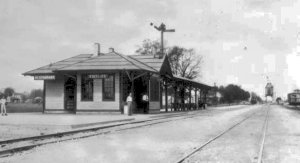
Trains Just Pass By Trilby Stop (1983)This article appeared in the Tampa Tribune on Oct. 29, 1983. By CAROL JEFFARES DADE CITY - Followed by porters with baggage, women with long dresses and parasols once promenaded down the walkway. The distant whistle of a steam locomotive told those waiting that the train would soon be arriving at the station. The walkway, once crowded with those bidding farewell to their loved ones, is empty now. the adjoining whitewashed depot, too, has been stripped of the bustle of its former life when it served the community of Trilby for 80 years as an active railroad station. The depot was constructed in 1896 for the railroad system owned by Henry B. Plant. In 1902, Atlantic Coast Line took over the Plant Railroad Systems and a freight depot, as well as passenger station, complete with a 24-hour restaurant, was constructed. A water tower and coal chute were added later. It was then the third largest railroad yard in Florida, according to information provided by the Pioneer Florida Museum. In May 1925, a fire started in the upstairs of Bradham’s Dry Good Store and the majority of the town was left in ashes. Several attempts to rebuild the town were futile and the small East Pasco community would never again see the thriving days of the early 1900’s. With the town diminishing, a large depot was no longer needed. It was remodeled several times to meet changing railroad requirements. The present building is the result of alterations in 1929. When passenger trains were a primary means of travel, the Trilby depot was one of the stops for such well-known trains as the Orange Blossom Special, the South Land and the Champion. The Ringling Brothers’ trains, heading North from their Sarasota headquarters, also stopped at Trilby to water the circus animals before continuing their journey. In the years before World War II, 12 trains stopped at Trilby daily. And during the war, an average of 55 would make their way daily down the Pasco tracks to Trilby. About 100 people worked at the depot at that time. As a result of the 1965 merger of the Atlantic Coast Line and Seaboard railroads, the Trilby depot was serving the Seaboard Coast Line Railroad in January 1976 when it was closed. After several years of effort on the part of Pioneer Florida Museum members and preservation-minded residents, the old depot was moved to its final resting spot on May 17, 1978, by the Pasco County Commission. It now stands on the grassy hill of the museum grounds, overlooking the present tracks of the Seaboard Coast Line. Nearby, a 1913 model, 35-ton steam engine has also found a home at the museum. The old locomotive was once used by Cummer Brothers Cypress Co. in Lacoochee in their logging operations. Now eight trains carrying freight rumble through each day, but they don’t stop. |
 In the early 1900’s it was like many railroad towns in
America. Folks didn’t seem to be in such a hurry then. All
the businesses in town would close every Thursday noon in
the summer. Practically the whole population would go to
the Withlacoochee River for a fishfry under the oak trees in
what is now Peterson Park. The men would go to regular
stands and shoot the biggest fish with rifles. The boys
would splash into the water and pick up the fish. The women
brought good things from their kitchens which made mighty
fine eating with the crisp-fried fish.
In the early 1900’s it was like many railroad towns in
America. Folks didn’t seem to be in such a hurry then. All
the businesses in town would close every Thursday noon in
the summer. Practically the whole population would go to
the Withlacoochee River for a fishfry under the oak trees in
what is now Peterson Park. The men would go to regular
stands and shoot the biggest fish with rifles. The boys
would splash into the water and pick up the fish. The women
brought good things from their kitchens which made mighty
fine eating with the crisp-fried fish. 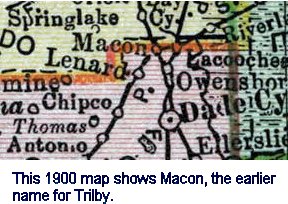 With no T.V., there was
time for fun like peanut boilings,
taffy pulls, hide and seek, postoffice, spin the bottle,
and a homemade game called board on deck. This was often
played at school recess. As few as three or as many as liked
could play. Catcher and batter faced the pitcher, with the
only base behind the pitcher and “deck” just to one side of
the batter. After the batter (using a bat, board, or axe
handle) hit the pitched ball (softball or stuffed sock),
everybody on the field tried to hit him with the ball before
he could touch deck and run to the one base and back home.
If someone caught the ball, he got a turn at bat.
With no T.V., there was
time for fun like peanut boilings,
taffy pulls, hide and seek, postoffice, spin the bottle,
and a homemade game called board on deck. This was often
played at school recess. As few as three or as many as liked
could play. Catcher and batter faced the pitcher, with the
only base behind the pitcher and “deck” just to one side of
the batter. After the batter (using a bat, board, or axe
handle) hit the pitched ball (softball or stuffed sock),
everybody on the field tried to hit him with the ball before
he could touch deck and run to the one base and back home.
If someone caught the ball, he got a turn at bat. 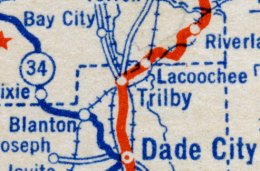 Of course there was some meanness
going on in town.
There were some all-night shooting sprees when all the
street lights at the depot were shot out. During Prohibition
there was homemade moonshine and some bootlegging.
The county sheriff couldn’t be everywhere at once. Walter
H. Edwards, Bert’s daddy, was either constable or deputy
sheriff from the early 1900’s until his death in 1936.
Bert found his handcuffs handy for attaching his girl to
the steering wheel. Walter Edwards had come to Florida at
the turn of the century with his brother-in-law Tom
McCorkle and Bert Fish, who became Volusia County Judge
until President Franklin Roosevelt appointed him Ambassador
to Egypt. Once the Trilby State Bank was robbed. Mrs.
Gregg O’Berry’s aunt, Lena Crum, was teller. Her husband,
Lester Crum, bank president, was out at the time. He had
earlier showed her how to open the vault from the inside,
which saved her life.
Of course there was some meanness
going on in town.
There were some all-night shooting sprees when all the
street lights at the depot were shot out. During Prohibition
there was homemade moonshine and some bootlegging.
The county sheriff couldn’t be everywhere at once. Walter
H. Edwards, Bert’s daddy, was either constable or deputy
sheriff from the early 1900’s until his death in 1936.
Bert found his handcuffs handy for attaching his girl to
the steering wheel. Walter Edwards had come to Florida at
the turn of the century with his brother-in-law Tom
McCorkle and Bert Fish, who became Volusia County Judge
until President Franklin Roosevelt appointed him Ambassador
to Egypt. Once the Trilby State Bank was robbed. Mrs.
Gregg O’Berry’s aunt, Lena Crum, was teller. Her husband,
Lester Crum, bank president, was out at the time. He had
earlier showed her how to open the vault from the inside,
which saved her life.