HISTORY OF PASCO COUNTYDade CityPictures of Dade City Residences Rodney B. Cox Elementary School This page has information about the earlier Fort Dade, located in the 1870s and 1880s in the vicinity of Mt. Zion Cemetery, and the later community of Dade City, established about 1884 several miles to the east. This page was last revised on Oct. 15, 2020. Dec. 20, 1842. James Gibbons is issued a permit for 160 acres in S 27, T 24, R21, in what would become Dade City. [Information from a deed dated Dec. 1, 1849, conveying the property to Gibbons’ heirs.] About 1855. A bridge is constructed across the Withlacoochee River. According to a historical marker, it was constructed by the slaves of James Lanier. June 21, 1856. The Florida Peninsular carries an advertisement: “Look Here Hernando Friends. H. C. Bellows & Co., Ft. Dade, Florida; Dealers in Dry-Goods, Groceries, Hardware, Queensware, and all other articles commonly kept in Country Stores, would call attention to their Stock of Goods, and assure the public that they will sell them as cheap as they can be bought elsewhere.” Mar. 9, 1870. The Florida Peninsular reports: SUPPOSED MURDER.—A dangerous character by the name of James Gibson is supposed to have been killed near the Ft. Dade settlement on the 19th ult., by Jack Osborn and Charles Wells (picture), two young men of that vicinity. It appears that Gibson was eloping with a sister of Mr. Osborn, and he was pursued by Osborn and Wells for the purpose of rescuing the girl from his hands and carry her to her parents. On overtaking them resistance was offered by Gibson, whereupon the pursuing party fired upon him and it is supposed killed him, as nothing has been seen or heard of him since that time. The authorities are making a vigorous search, and at last accounts were dragging a lake where the body was supposed to have been thrown. Miss Osborn has returned to her parents, but no facts can be elicited from her as to the murder. Osborn and Wells have left the country. When we hear the full particulars of the affair, we will give them to our readers. Sept. 28, 1870. The Florida Peninsular reports a political rally at Fort Dade featured speakers T. S. Coogler, colored, John A. Henderson, Capt. F. Lykes, F. E. Saxon. 1872. Mount Zion Methodist Church is constructed in Fort Dade, according to a 1920 article in the Dade City Banner. Feb. 16, 1872. A newspaper reports, “A young child of a family named Rials was burned to death near Fort Dade last week.” 1878. The Enterprise Church is built. [It was moved to the Pioneer Florida Museum in 1977. A sign on the church lists the charter members as: Bishop D. S. Legget, P. E. W. [illegible] Jordan, Robert Sumner, Jane Sumner, David H. Thrasher, J. Cary Sumner, Mary [illegible] Sumner, Willie Thrasher, James Shearer, Jane Shearer, F. A. Barnes, Mary Clement, Elizabeth Tucker, W. H. Parker [illegible].] Oct. 12, 1881. A deed dated Oct. 12, 1881, conveys a donation of 11 acres in S29 T24 R21 from Newton Carter and wife May A. Carter to the trustees of the Fort Dade Church. [A deed dated Sept. 26, 1919, conveys 5 acres of the property from A. A. Boone, John Raymond, J. C. Carter, and W. W. Slone as trustees of Fort Dade Methodist Church to J. W. Urquhart. Both deeds provided by Jeff Cannon.] 1882. The Fort Dade Messenger is established. (Information on early newspapers in Dade City is here.) June 29, 1882. The Sunland Tribune, in an article about Fort Dade reprinted from the Fort Dade Messenger, reports, “There are two post offices in this section, one known as Ft. Dade, and the other Tuckertown. The mail is semi-weekly from Brooksville, but it is getting to be so large that it will soon have to be daily. There are two stores in operation at present, and several others in prospective. The stores, at present established here, are one at the Post-office, owned by our worthy P. M. Mr. N. A Carter, and the other, three miles east as the P. O. owned by Mr. W. C. Sumner.” Oct. 2, 1882. A newspaper reports, “A German baron is erecting a residence at Fort Dade, Fla.” Oct. 30, 1882. A post office is established at Hatton. June 22, 1883. The Fort Dade Messenger, Vol. II, No. 2, consisting of four pages, has “The amount subscribed for the Baptist church organ is almost made up.” R. M. Wilson was in charge of checking off donations. Earnest and Thrasher on Lake Buddy has an advertisement. Land is offered for sale by Judge E. F. Dunne who lived at “Residence E side of Clear Lake, 3 miles southwest of the Post Office.” Jas. A. Grady was selling the “largest lot of buggies ever brought to this market.” Orange trees were sold by D. T. Clements, who could be reached at the International Ocean Telegraphic Office at Tuckertown. July 11, 1884. The Fort Dade Messenger (vol. 3, no. 4) shows John H. Brown is the publisher. R. J. Marshall is the postmaster. R. M. Wilson is listed as secretary of the Masonic Lodge. A Baptist church directory shows R. E. Bell as pastor of Oak Grove, L. Parish as superintendent of the Sabbath School, W. W. Bostick as pastor at Pleasant Hill, R. T. Caddin as pastor of a church at the county line between Hernando and Hillsborough, and B. L. Ray as pastor at Double Branch Church. There are advertisements for:
Dec. 1, 1884. Henry W. Coleman and William N. Ferguson open a store, the second general store in Dade City. Dec. 18, 1884. The Hatton post office is renamed Dade City. 1884 or 1885. Dade City is incorporated. [A newspaper advertisement on Dec. 5, 1885, called Dade City an incorporated town and identified E. A. Hall as Mayor. There is also a reference to the first incorporation in county commission minutes. On April 1, 1927, the Dade City Banner reported: Judging from the questions of number of the pupils in the schools here to older citizens and others, a course in local city and county history is being taught. For the benefit of the children and others interested, the following information concerning the beginning of Dade City, furnished by Col. J. A. Hendley is given. Dade City was first incorporated in 1884, at a meeting held in the old Baptist church, which was located in what is now the older section of the local cemetery. Judge D. O. Thrasher, who later was county superintendent, and concerning whom it is said that he always carried his pockets full of stick candy to give to the children when visiting the schools or campaigning, was the first mayor. Col. J. A. Hendley, John Overstreet, A. C. Sumner, Reuben Wilson and Dr. G. M. Roberts, the first physician to practise medicine in Dade City, and father of “Uncle” Jesse Roberts, composed the first City Council. A second incorporation occurred in 1889.] June 6, 1885. A newspaper mentions the Dade City Observer. [The newspaper is called the Florida Observer in an 1885 newspaper directory, which says it is a weekly newspaper.] Aug. 7, 1885. The Daily Review of Wilmington, N. C., has: Dade City is a lovely place, and the road passes through its principal streets, and it is also the most hospitable town that we have come to. The people are very polite and their manners are not at all reserved. They have lately erected a beautiful church of the Baptist denomination, in which services are held every Sunday, and as this is the only church here, all denominations attend. There are two hotels here, one of which is kept by Mrs. Davis, and the other by a Mr. Sumner. They are both first class in every respect. Considerable business is carried on as the city has some ten or twelve stores and a fine saloon for gentlemen. Sept. 14, 1885. The first regular train of the Florida Central and Peninsular Railway passes through Dade City. Nov. 14, 1885. A letter to The Sunny South has: “Fort Dade is not a city nor a town, as some may think, but a scope of country covering about fifteen miles square; but don’t think it is all country, for every settlement claims that they are going to have the town. Dade City though, I believe, is looked on now as the town. It is quite a growing town; has about two doz. business houses, a hotel and livery stables, and a handsome new Baptist church, also a post office.” 1886. The Dade City hotel is built. 1886. A directory shows William Fletcher Alexander as the pastor at Fort Dade. Feb 17, 1886. The New York Times reports: “PENSACOLA, Fla., Feb. 16.—R. J. Marshall, alias Morton, Postmaster at Fort Dade, Fla., was arrested here yesterday charged with embezzling money order funds by Post Office Inspector Baird, who came here in answer to a telegram from Postmaster Yonge, who had located Marshall the day before. Marshall absconded last July, leaving a wife and two children at Fort Dade.” June 1, 1886. A document in the handwriting of H. H. Henley has, “Recognizing the growing tendency toward strong drink, especially prevalent among the young men of today, we the undersigned under the band of ‘Dade City Blue Ribbon Club,’ hereby pledge ourselves not to drink any intoxicating drink as a beverage, and to lend our influence to the suppression of this monster in the great cause of temperance.” The signatures, dated between Nov. 30, 1885, and June 1, 1886, are: Walter R. Lawrence, J. C. Blocker Jr., H. H. Henley, S. E. Millen, J. D. Sumner, D. M. Davidson, Annie Blocker, S. F. Huckabay, Eddie Davis, J. A. Grady, I. F. Kernegay, John F. Bard, L. Olive Millen, Maggie Thrasher, August L. Loftin, F. G. Wilson Jr., Dollie Maynard, Frankie Davis, Mollie Davis, Fannie G. Lewis, Florrie Lewis, Clara Davis, Lula M. Ray, W. A. Vickers. 1887. The first railroad line reaches Dade City, according to a historic marker. 1887. A second newspaper in Dade City, the Pasco County Democrat is established by Capt. John B. Johnston. See this page for more on this and other early newspapers in Dade City. July 18, 1887. The Pasco Board of County Commissioners meets for the first time. Dade City is named the temporary county seat. Aug. 1, 1887. The County Commission votes to accept the proposal of Coleman Ferguson and Co. for a two-story structure on Meridian St. in Dade City for use as a temporary court house free of rent. The company promised it would be finished by Sept. 5. Dec. 21, 1887. An Iowa newspaper reports, “A special from Dade City, Florida, says Dick Hines and Charley Metz, colored, were lynched there Tuesday for assaulting Mrs. Oberry and her daughter, living near Owensboro. When arrested the negroes confessed their crime and begged for mercy, but were speedily lynched. No particulars can be learned more than they were tortured before being strung up, and the ropes were so arranged that they slowly died of strangulation. Their bodies were left hanging and it is reported they were afterward riddled with shot.” June 7, 1888. A newspaper reports, “Berry Miller of Dade City, Fla., killed an alligator fourteen feet long, weighing 600 pounds on Thursday. Within him was found an alligator six feet long. The vertebra is as large as that of a 4-year-old steer. The monster was very savage, and fought most viciously until killed.” Aug. 21, 1888. The Semiweekly Age of Coshocton reports, “A. J. Gill of Dade City, Fla., is the owner of an orange tree fifty-three years old, which is two and a half feet in diameter and thirty-five feet high. This tree has yielded 10,000 oranges in a single season, and it is believed, if no mishap intervenes, the product will reach 12,000 the present year. It is one of a group of eighteen, each but little inferior in size.” 1889. A Methodist church is erected on College Street by James E. Lee. Jan. 13, 1889. The First Presbyterian Church of Dade City is organized. [A church was erected on College Street in the early 1890s.] Jan. 15, 1889. An election is held to select the city officials of the newly-incorporated Dade City. [According to the Pasco County Democrat, 47 voters, more than two-thirds of the proposed citizens, cast their ballots. City officers elected were: Mayor, John B. Johnston; Clerk, J. C. Calhoun; Councilmen, A. A. Boone, D. T. Clement, J. E. Lee, F. P. McElroy, and J. T. McMichael. This incorporation was approved by the state legislature on June 5, 1889. According to a 1916 newspaper article, Dade City was incorporated as a town in 1889 and as a city in 1909.] Apr. 11, 1889. An election to name the county seat is held. Dade City won with 432 votes. Gladstone received 205 votes. Pasadena received 96; Urbana, 20; Fort Dade, 4; Clear Lake, 2; Jefferson, 2; and Owensboro, 1. Aug. 8, 1889. School board minutes refer to a “graded and high school” in Dade City. [A history of Pasco High School and earlier schools in Fort Dade and Dade City is here.] Aug. 15, 1889. The Bank of Pasco County announces in the Pasco County Democrat that it will open for business as soon as its banking house is completed, but that meanwhile, anyone wishing to borrow money can write to A. A. Parker, Tavares, the president of the bank. [A charter was granted on Sept. 5, 1889. The bank, the first in Pasco County, opened in a two-story red-brick building completed in 1891 at Meridian Avenue and Seventh Street. It was the first brick building in Dade City. On Oct. 30, 1925, a newspaper reported that the Bank of Pasco County moved into its new home, which was remodeled from the old building.] Aug. 28, 1889. The Pensacola News reports, “J. K. Davis has been elected marshal of Dade City.” Apr. 23, 1890. A newspaper reports, “Mrs. N. E. Harwood, while tearing up the flooring of an old school house, about fifteen miles southwest of Dade City, Fla., caused the building to collapse and fall upon herself and little daughter. Mrs. Harwood was instantly killed, her skull being crushed by the fallen timbers. The little daughter was only slightly hurt.” 1891. The county’s first court house is constructed in Dade City. [County government had earlier been conducted in a temporary location. According to Bill Dayton, this court house was moved a couple of blocks east when the brick court house was built in 1909. He says he has always heard that this court house burned down in the 1920s] May 9, 1891. A newspaper reports, “Vol. 1, No. 1 of the Industrialist, published at Dade City, Florida, lies on our table. C. F. De La Mater, a former teacherof Wabaunsee county is the editor. Fremont sticks to his old time democratic faith, but will adhere to Alliance principles as he gropes his way along the thorny pathways of the editorial jungle. We wish C. F. the best of success in his new venture.” The reference is to John Charles Fremont Delamater (1856-1937). Oct. 20, 1891. A Texas newspaper reports, “The farmer’s alliance meets at Dade City today. Nearly 3000 delegates will attend to discuss the sub-treasury bill and a resolution to support only alliance men at the state election, which means a third party in Florida. The convention will endorse the Ocala platform.” Oct. 24, 1891. The Bismarck Daily Tribune has: “DADE CITY, Oct. 28.—The State Farmers' Alliance, after discussion lasting five hours, endorsed the platform adopted at Ocala last year. Senator Pasco, who was not barred from the meeting because of being a lawyer, went on record against the sub-treasury plan.” Nov. 14, 1891. College Street Baptist Church, later First Baptist Church, is organized by ten leading families of Oak Grove Baptist Church, according to an article in East Pasco’s Heritage. 1892. A brick jail is constructed at Dade City. [The marker at the Pasco County Jail lists these county commissioners: B. C. Campbell, T. F. Williams, L. S. Bradham, W. H. Haager, J. W. Clark.] July 20, 1893. The Tampa Weekly Tribune mentions a newspaper, The World, in Dade City. [On Oct. 20, 1893, the Tribune reports John Post and family, merchants, Dade City World newspaper, return to Tampa to live.] 1894. The Cedar Rapids Evening Gazette has: “A letter received from Dr. George C. Muirhead (?) at Dade City, Florida, states that he has been offered an office for the practice of his profession and will remain there. A host of warm friends here are sorry he does not intend to return, but are rejoiced at the news that he is enjoying excellent health.” Aug. 20, 1894. The Trenton Times reports: “Dade City, Fla., Aug. 20—Milton Higgs came home from Floral City, where he works, to see his wife. As he reached home his wife drove up in a cart with another man. Higgs led the woman into the house and blew out her brains. The murderer escaped.” [On Oct. 12, 1894, the Tampa Morning Tribune reported that Judge Barron Phillips sentenced Milton Higgs to hang for killing his wife Susie on Aug. 18, 1894.] May 3, 1895. The Galveston County Daily News reports, “Dade City, Fla.—Leslie Wilson, the 15-year-old son of R. M. Wilson, was caught in the belt at Bass’ saw mill, two miles north of Dade City on the 27th. Both of his legs were broken and he was otherwise badly injured. His condition is critical.” Apr. 27, 1896. A heavy rain, wind, and hail storm passes through Dade City. The Tampa Morning Tribune reports, “The Brown brothers report their great water melon crop totally ruined. H. C. Griffin’s melon crop, corn and other crops were ruined or damaged. The residence of A. T. Hamilton, two miles east of here, was lifted from its foundation. Hamilton’s daughter was injured, but not seriously. The heavy rain breaks the drought of six weeks. Hail-stones filled a ditch six inches deep. H. H. Brown reports hail three inches deep on a level on his melon farm. ... Later reports show that the crops of Major C. Lewis, two miles northeast of town, are completely destroyed. He lost about forty turkeys killed by hailstones.” Aug. 10, 1896. A fire in Dade City destroys Coleman & Ferguson’s general store, T. J. Howard’s drug store, J. J. Wilson’s poolroom, Powell’s barber shop, and A. A. Boone’s grocery store. The loss was estimated at $27,000. Sept. 10, 1896. The Tampa Weekly Tribune mentions Rev. D. A. Cole, Methodist minister in Dade City. 1897. Embry Tobacco Co. is established. Mar. 7, 1898. Minutes of the Dade City City Council meeting have: “Mr. T. F. Cheek and others appeared before the board asking that the Council take some step to rid the town of the illicit sale of whiskey. After discussion C. W. Furman offered the following resolution which was adopted: 'The Mayor and Marshal are commanded to abate all disorder in this city by enforcing the law in its fullest meaning and effect and arrest all parties who are in any way connected with any house of disorder and arrest the proprietors for keeping such hours.'” May 2, 1898. James A. Delcher is elected Chairman of the Dade City City Council, replacing J. D. Sumner, who resigned. Apr. 14, 1899. The Tampa Tribune, in an article of Dade City news, reports, “The business of the cigar factory is exceeding all expectations of its originators. An order for 100,000 of their smokers came in yesterday. A stock company organized and will take charge of the business at once. The company will erect immediately an ample building, and will employ fifty cigar makers.” (A newspaper article in July reported that 14 cigar makers were employed by the Charles Torricella Cigar Manufacturing Co.) June 8, 1899. The San Antonio Herald reports: Dade City was visited yesterday by a conflagration, which terminated in the destruction of a handsome church and several dwelling houses, besides damaging a number of adjoining buildings. At 1:30 p.m. sparks from a defective flue set the fire to the top of Mr. Walter Seay’s residence, and although there was plenty of help, nothing could be done to save the building. Meanwhile Dr. Baker’s house was exposed to all the heat and sparks, but an excited crowd saved it, forgetting, however, all about the Baptist church on the west of Baker’s. It was not long before the roof of the church caught and no efforts could save the structure, owing to the scarcity of water. The next building in danger was the one of the Hon. John Raymond. It was on fire several times, but after heroic exertions it was saved. For a time the High School appeared to be doomed also, but the teachers who were present for examination with some other help stationed themselves on the building, each with a supply of water, and the Superintendent and the chairman of the Board were on hand, ready to act, in case of emergency. This building escaped through a change of wind. The next building doomed was Mr. Keith’s villa, a handsome home, which was soon consumed by the flames, the heat of the burning church being too great for any attempt to extinguish the flames. The sparks from the burning buildings set at different times fire to the Presbyterian church and parsonage and the adjoining woods. Other houses in immediate danger were those of Messrs. Brown, Mobley, Ray and Henley. At 4 o'clock the fire was under control and further immediate danger past. A low estimate puts the loss at $11,000 with but little in insurance. June 29, 1899. The San Antonio Herald reports, “Dr. Lowry, a physician of Plant City, has moved to Dade City with his family and will practise his profession.” (In Aug. 1899, Western Druggist reported, “Dr. F. P. McElroy of Dade City has sold his drug store to Dr. C. S. Lowry, formerly of Plant City.”) Aug. 10, 1899. The San Antonio Herald reports, “The Dade City cigar factory is said to be in a flourishing condition. Over 8000 cigars were shipped last week and sufficient orders are on hand to warrant an increase.” March 8, 1900. The San Antonio Herald reports that Dr. Howard of Dade City has died. Jan. 27, 1901. Early the morning, a riot breaks out at a negro dance at Rice & Phelps' turpentine camp near Dade City. Dan Childers, a white man, is killed and J. B. McNeill is fatally wounded. Two black women and one black man were shot and seriously wounded. [On Feb. 5, 1901, a mob lynched two black men, Will Wright and Sam Williams, in the county jail at Dade City. They had been implicated in the killing of Childers and the wounding of McNeill. Sheriff Griffin refused to give up the keys and the mob, said to be 30 to 50 men, broke down the outer door. Unable to break down the steel doors of the cells, they opened fire through the steel bars, shooting both prisoners to death. The Coroner’s jury found that they came to their death at the hands of “parties unknown.” On Feb. 14, 1901, the Tampa Tribune apparently gave the names as Will Wright and Sam Johnson.] Mar. 11, 1901. American Druggist and Pharmaceutical Record reports: “Dr. C. S. Lowry, of Dade City, Fla., has sold his drug business to J. Clarence Griffin. Dr. Lowry will locate in Lakeland, where he will practice his profession. He has also purchased a drug store in Lakeland.” Aug. 18, 1901. The Tampa Tribune reports, “Fire, early yesterday morning, did $1,000 damage to the building at Eight avenue and Fifteenth street, owned by Coleman & Ferguson, of Dade City, and occupied by A. Noriega, grocer.” Jan. 8, 1902. Jno. B. Johnston is selected as Mayor of Dade City. 1903. The Mount Zion A. M. E. Church is constructed in Dade City. [The trustees of the church at the time of the purchase of the property were Rufus Johnson, George Young, and Butler T. Green. The minister at this time may have been Rev. Amos Thompson. The building was demolished in 2007.] Jan. 29, 1903. The Tampa Morning Tribune reports, “The Dade City House, which has been run for a number of years by Col. J. A. Delcher, has been purchased by Mr. Bragdon and he will assume the management March 1.” May 23, 1903. The Tampa Morning Tribune reports, “The Pasco County Telephone Company is now getting a number of phones into successful operation in Dade City. Poles have been erected to Blanton, Jessamine, St. Leo, and San Antonio. Phones will be placed in all along the line as fast as the wire arrives and is put up.” 1904. The Dade City Star is established. [On Dec. 8, 1904, a newspaper reported, “The Dade City Star is one of the latest ventures on the journalistic sea.” According to a 1972 newspaper article, “Basil Orville (“Villie”) Bowden became owner and editor of the Dade City Star which he established in 1904....” On Oct. 15, 1909, B. O. Bowden is shown as editor and owner.] Jan. 4, 1904. J. K. Ward is elected Mayor of Dade City. Mar. 17, 1904. At about 2 a.m., safe blowers attempt to rob the Bank of Pasco, dynamiting the large iron doors leading to the bank vault. The charges of dynamite were so heavy that the large brick building was cracked from roof to base and every one of the plate glass windows was blown out. May 5, 1904. A letter to the editor of the Crittenden Press by Foster Threlkeld has: “Dade City is the county site of Pasco county; has 700 population, fine school, 3 fine churches, Presbyterian, Baptist and Methodist, 2 R. R.’s, 1 bank, 1 paper, 1 drug store, 3 general stores, 2 dry goods and notion stores, 2 millinery stores, 1 butcher shop, 1 mill, 2 blacksmith shops, 1 barber shop, no saloon, 2 livery stables, 1 hotel of 30 rooms but not open, owing to litigation. One opening for good hotel man.” Nov. 2, 1904. The Tampa Morning Tribune reports, “The people of Dade City are delighted to know that they will soon have a telephone system connecting with San Antonio, Blanton, Greer and Jessamine Gardens. The business men and a good many of the residents are having phones put in. ... Dade City is soon to have another newspaper. ... A short time ago the town council purchased a gas plant and lighted the streets. They have given such satisfaction that the business men are putting them in their stores. Thelkeld & Mills have also put them in the hotel.” Feb. 6, 1905. D. O. Thrasher is selected as Mayor of Dade City. Feb. 9, 1905. Dade City Council meets to consider granting a franchise for an electric light and water works plant to Isaac D. Sperry, Drew B. Mills, and Emille Muller for a period of 25 years. Feb. 14, 1905. The Tampa Morning Tribune reports, “Electric light and water works plants will soon be in operation here, the franchise for them having been granted to a company incorporated by J. D. Sperry, D. B. Mills, and Emile Muller. Mr. Sperry is a capitalist hailing from St. Louis who intends settling with his family in this city. D. B. Mills is the well-known and popular proprietor of the Dade City Hotel and Emile Muller proprietor of the ice works, which has been a success since its start. ... The Dade City Hotel, now under the management of Messrs. Mills and Utley, having made many improvements in its interior and exterior appointments, is being well patronized both by the tourist and commercial fraternity, who are fortunate as to become its guests. Mrs. L. P. Utley, who recently bought a half interest, has recently come from Salem, Ky., where she and her husband, J. A. Utley, kept a hotel successfully for many years.” May 3, 1905. The Gainesville Daily Sun reports, “W. B. Keith, near Dade City, has harvested the finest crop of ten acres of oats ever raised in Pasco County.” Aug. 17, 1905. The Tampa Morning Tribune reports, “J. C. Griffin is placing the material on his lot and in a few days will begin the erection of a handsome brick block. ... Pasco Wilson and R. W. Jordon, two of our cleverest young men, have opened a market and the people of Dade City are glad to know have employed Charlie Taylor as meat cutter. He has had 12 years experience and thoroughly understands the business. They have also secured the services of Ashford Sturkie to deliver meat, which assures the people of prompt delivery.” Feb. 8, 1906. A newspaper reprints an article from the Pasco County Democrat which has: Mr. and Mrs. Utley have purchased the interest of D. B. Mills in the Dade City hotel and they are now sole proprietors of this splendid hostelry. The proprietors are determined to raise the hotel to the highest standard and they will spare neither pains nor expense in their efforts to cater to the comfort and pleasure of their guests. By reason of environment and the fine field offered to sportsmen this is really an ideal tourist hotel. The fishing and hunting are indeed satisfactory and both the hunter and angler can find all the sport he desires. The hotel is admirably situated on an eminence within a stone’s throw of the S. A. L. depot. Its sanitary condition is of the highest order and health is assured. Mr. Utley is an admirable host, genial, warmhearted and accommodating, his highest pleasure is found in contributing to the pleasure of his guests. Mrs. Utley is a lady of charming manner and tireless energy, who labors in season and out of season to make the hotel a model of homelike comfort and render each and every guest comfortable and happy. The future of the hotel is bright with promise. Mar. 1, 1906. The Arcadia Champion reports, “Boon Embry, of Dade City, who owns one of the largest tobacco farms in the state, has just closed a ten-year contract for his crop at 40 cents a pound. He has nearly thirty acres under sheds.” 1907. Sunnybrook Tobacco Co. buys out the Embry Tobacco Co. [In the early 1920s Sunnybrook became the largest employer in Pasco County. The plant was heavily damaged by fire on Dec. 15, 1924, and closed down.] Jan. 31, 1907. The Tampa Tribune reports E. Wilson was elected Mayor of Dade City. July 7, 1907. The Tampa Tribune, repeating an article from the Dade City Star, reports, “Dade City has never had such a rush as it is having now, and no slacking off for the summer seems probable, as every carpenter, every brick mason and all other workers are employed, and you can’t get a man for anything, even to the women and children are employed, as Boone Embry, the tobacco man, has work for 400 men, women and children to take care of his immense crop. A large number of houses are under construction and others waiting for the carpenters to get around to them. Among it all our town is forging to the front so fast we can hardly realize how it is being done.” July 11, 1907. A Kentucky newspaper reports: E. Boone Embry, son of W. E. Embry, formerly of Howell, Christian county, Ky., who moved to Dade City, Fla., in 1898 to grow Cuba and Sumatra tobacco, has grown successfully eight crops, the last five being grown under an lattice shade structure in order to make the texture very fine. Mr. Embry has made such a success that he has attracted the attention of capitalists who have gone in with him and organized a corporation with paid up capital of $100,000.00. The capitalists are of our state, the Rosenfield Bros., of Sunny Brook Distillery Co., and the name of the corporation is Sunny Brook Tobacco Co. The company of which Mr. Embry is general manager has bought five or six hundred acres of very fine tobacco land at Dada City and will erect fifty acres more shade for next years’ business, making 80 acres all told. Mr. Embry is busy now erecting dwelling houses for the various ones who will doubtless flock to Dade City when they read the terms of the contract made by Sunny Brook Tobacco Co. Eighty acres of tobacco means four hundred acres in Kentucky so far as the amount of labor is concerned, and for other reasons Mr. Embry wants men of families to come to him at Dade City and go into business with him on share terms the first year until they learn the business at which time the company expects to build shades for other men and give them liberal contracts such as Mr. Embry himself has had for the five years past with Toussig & Co., of Chicago. Sept. 28, 1907. The Tampa Morning Tribune reports, “F. S. Daigir will move in a few days into his handsome brick store. The Seay brick building is nearing completion. When completed will be occupied by Boon & Touchton, druggists.” 1908. Electric power is brought to Dade City by Dade City Ice, Light, and Power Co. [George C. Dayton recalled that the first electric street lights in Dade City were in 1908 and were 20- and 40-watt bulbs. He also recalled that the installation of the white way lighting system was celebrated in 1924.] 1908. The Touchton Building is erected at the corner of Seventh Street and Meridian Avenue in Dade City. Jan. 26, 1908. The Gainesville Daily Sun reports, “Pasco County has the tobacco fever. In Dade City it is difficult to find clerks for the stores or landlords for the hotels—all rush out to grow tobacco.” Apr. 23, 1908. The Tampa Tribune reports that Joseph Henry and George Roberts, soldiers who robbed the Fort Dade post office, were detained by officials on desertion charges in hopes they receive a more severe punishment. May 14, 1908. The Tampa Morning Tribune reports that ex-Sen. Kirk and George W. Dayton addressed an unruly crowd in Dade City. Nov. 12, 1908. The Tampa Weekly Tribune mentions Dade City Orange Growers, Dade City Vegetable Co., Sunny Brook Tobacco Co., Dade City Star, B. O. Bowden, editor, and the Dade City Drug Co., Boon & Touchton, proprietors. May 11, 1909. The Tampa Morning Tribune reports that the Mutual Construction Co. of Louisville, Ky., was awarded the contract for erecting Pasco County’s new court house at $34,860. It reported the company was allowed 250 working days to complete the contract. [According to one source, Circuit Court Clerk Archie J. Burnside accepted the completed building on July 5, 1909, and made the first payment of $6,360 on that date. However, the Atlanta Constitution of Sept. 20, 1909, carried a classified ad: “WANTED - Ten good carpenters to go to Dade City, Fla., work on courthouse, 30c per hour, 10-hour day. Call upon A H Haggard, 16 W. North avenue Monday and Tuesday from 8 a.m. to 12 m.” According to Eddie Herrmann, County Commission records reflect that acceptance was refused on Dec. 16, 1909, “on grounds, not fully completed,” and was subsequently accepted on Jan. 3, 1910.] Oct. 15, 1909. The Dade City Star states that it “has the largest circulation of any paper ever published in Pasco County.” The newspaper reports on a four-day murder trial that resulted in a hung jury. State Attorney Herbert Phillips prosecuted the case and defense counsel included Col. E. F. Green, Capt. John B. Johnson, and Col. Robert W. Davis. School board minutes show that board members are L. J. Sellers, W. S. Larkin, and D. E. Wallace, and M. L. Gilbert is superintendent. In an advertisement, J. D. Sumner invites everybody to make his store headquarters during court or any other time when in town. S. Daiger advertises groceries, feed, fertilizer, crockery, clothing, oil stoves. O. N. Williams & Son advertise that they are the original Racket Store and have added a grocery department and a millinery and dress making department supervised by Mrs. Jennie Knapp. O. N. Williams is an agent for the Standard Fertilizer Co. Coleman and Ferguson advertise. W. L. Baker states that he is successor to R. C. Davis and advertises fresh fish each day, fresh pork, sausage, beef, and mutton. R. T. Thrasher is a dealer in general merchandise. Brown’s Livery has good teams and careful drivers. E. M. Staley is a contractor and builder. Oct. 28, 1909. The Dade City Hotel is destroyed by fire. It was formerly known as the Delcher House. Oct. 30, 1909. The Gainesville Daily Sun reports, “E. B. Embry of Dade City, who is manager of the Sunnybrook Tobacco Company, says that Florida wrapper tobacco is bringing two dollars a pound. The Dade City plantation is one of the largest in the State.” Dec. 19, 1909. A newspaper reports, “E. M. Harvey, of Dade City, in the south of Florida, has sold the Dade City Hotel plot of ground to S. H. Gerowe, of Atlanta, Ga., who will give that city its crying need, a new hotel, which he intends to manage himself.” Dec. 30, 1909. The Tampa Times reports that the temperature at Dade City dropped to 19°. [On Dec. 31, the Evening Independent reported, “Oranges have been hurt in this section, where exposed to the cold, but not in every case. Much firing has been done. Dade City has experienced some of the coldest weather in its history, but the cold wave at no time has equaled that of the big freeze of 1894.”] May 20, 1910. The Fort Pierce News reports, “At Fort Dade, the first organization of Spanish war veterans in Florida have just been organized, with a membership of about fifty. Capt. A. G. Clark, of Fort Dade, is organizer.” Apr. 4, 1911. The Atlanta Constitution reports: “Dade City, Fla., April 3.—While personally directing the completion of a hotel he has built here, S. H. Gerowe fell 30 feet today and was instantly killed. He was standing on a window ledge on the second story, pulling a nail. The nail came out suddenly and Mr. Gerowe lost his balance. He was formerly a traveling salesman for Harry Schlesinger, of Atlanta.” (This hotel would become the Edwinola.) Nov. 16, 1911. The Zephyrhills Colonist mentions vol. I, no. 1, of the Dade City Record. [On Nov. 26, 1911, the Miami Herald Record reported, “Dade City has a new newspaper and it is called the Pasco County Record. The first number was sent out last Friday and Editor A. G. Waldron, who is also the proprietor, declares in his introductory that he intends to ‘publish the news of all the county just as it happens and from an unbiased and unprejudiced viewpoint.’”] Nov. 22, 1911. Noah Green, a local farmer, an inmate in (apparently) the city jail, is killed by a fire he set to keep warm. The fire burned down the wooden jail. He had been arrested and jailed on a charge of drunkenness. 1912. A Guide to Florida for Tourists, Sportsmen, and Settlers lists three hotels in Dade City: Woods' Tavern, I. A. Woods, capacity 25; Embry House, W. E. Embry, capacity, 25; Osceola, Mrs. M. D. Cochran, capacity, 20. Feb. 11, 1912. A newspaper ad identifies Jasper C. Carter as Mayor of Dade City and Charles F. Touchton as President of the Dade City Board of Trade. Mar. 8, 1912. A newspaper reports that the Hotel Edwinola had its formal opening on Saturday night. The owner was Edwin J. Gasque, and A. J. Stebbins was the manager. It was located on the same site as the former Dade City Hotel. (In the 1950s the building became Florida East Coast University; the university was closed in the 1970s. The Edwinola reopened in 1974 as a restaurant, and as a retirement home in 1982. It closed as a retirement home on Sept. 30, 2016. It reopened in May 2017 under the management company Priority Life Care of Fort Wayne, Indiana.) July 7, 1912. A railroad depot in Dade City is destroyed by fire. (The Atlantic Coast Line Railroad Station was erected late in 1912 to replace it.) Oct. 13, 1912. The Tampa Morning Tribune reports, “Work has begun on the breaking of ground for the erection of the new Atlantic Coast Line depot at the foot of Meridian street. ... The work of erecting this building is in charge of Mr. G. H. Boring, local contractor.” 1913. The Dade City Banner is established. See this page for some history of the Banner and earlier newspapers in Dade City. May 4, 1913. The new St. Rita Church is blessed by Benedictine Fr. Augustine Feller, O. S. B., the pastor. [It was dedicated on Jan. 4, 1914. More information about this church is here.] May 23, 1913. The first of two legal executions occurs in Pasco County as Tom Bush is hanged by Sheriff Sturkie according to a later account in the Dade City Banner. Oct. 12, 1913. The Tampa Morning Tribune reports, “We have three hotels, i.e., Hotel Osceola (transients and boarders); Edwinola, transients and boarders. Woods Tavern is small so can only take transients. Mrs. Ward keeps The Ward House, Mrs. Embry The Embry House, three as good boarding houses are anyone can find and the Oyster Bar Restaurant. So you see we are prepared to care for all who come.” Mar. 13, 1914. Frederick A. Cook speaks in Dade City, claiming that he discovered the North Pole. Sept. 25, 1914. The Dade City Banner reports that J. T. Futch is about to build a packing house south of the depot, that A. J. Reed has leased the old mill site between Church and Meridian streets, which he will convert into a wood yard and mill, that concrete sidewalks are soon to be constructed on College Street, and that J. T. Teston will operate a laundry. Oct. 9, 1914. The Dade City Banner reports that C. D. Hubert, Dade City’s progressive jeweler, is making arrangements to install a wireless outfit whereby he can get the time from the government station at Arlington, Va. There will be two 75-foot towers, 150 feet apart, between which four antenna wires will be stretched. Nov. 13, 1914. The Dade City Banner reports: Mrs. Raymond Hitchcock, wife of the noted actor, and her brother arrived in the city Tuesday, and are making their headquarters at the Edwinola for the present. Mrs. Hitchcock bought the old Blanton tract, consisting of 300 acres, last year from Mr. Stewart, manager of the Hippodrome, of New York, who was here last winter, and expects to spend the winter here in improving her property, setting out a large orange grove on it in the near future. The Blanton estate is about six miles from town, and Mrs. Hitchcock and brother, should they decide to stay here, will probably buy property and build a winter home in the city, managing their grove from this place. Nov. 20, 1914. The Dade City Banner reports that Mr. C. Beech resigned as city marshal and that Mayor A. F. Price appointed W. F. “Bill” Flemming to fill the unexpired term. [Beech had been beaten up in the negro quarters earlier in the month.] Nov. 27, 1914. An advertisement in the Dade City Banner announces that Dr. F. C. Wirt, osteopath, will be at Dade City Monday, Wednesday, and Friday mornings at the Edwinola Hotel, and at San Antonio on Tuesday, Thursday, and Saturday morning, beginning Nov. 16. Sept. 4, 1915. A publication reports that the Dade City National Bank has applied for a charter. Capital $25,000. Correspondents are: R. B. Sturkie, E. T. Vaughn, E. W. Stapleton, L. B. Bessinger, J. M. Harvey. Oct. 9, 1915. The Dade City Banner and the Dade City Star are consolidated. 1916. The population of Dade City is 1950, an increase of 83% in five years. 1916. A brick, two-story city hall is constructed on Meridian Ave. in Dade City. June 29, 1916. The Bank of Dade City opens. [However, the Tampa Sunday Tribune of July 23, 1916, reported that the bank formally opened on Thursday, which would have been July 20, 1916.] June 30, 1916. The Dade City Banner reports on an attempted rape of a white woman by a black man. It reports, “Tension runs high tonight, and armed parties are scouring every nook of the woods for miles around. Men are posted at every railroad crossing and every public road and swamp is guarded. Every effort is being made to catch the brute. Blood hounds have been sent for, and it is thought he will be overtaken in a short while, in which event he will doubtless be made to pay the penalty in the usual manner.” [It is not clear whether a lynching occurred. Another newspaper reported on July 1, “Dade City, Fla.—A sheriff’s posse today is searching the woods hereabouts for a negro who last night attacked a white woman two doors from the county jail. Mob violence is feared.”] Nov. 24, 1916. The Dade City Banner has: “The undersigned agree to close their respective places of business for Thanksgiving on November 30, 1916. Coleman and Ferguson, T. L. Shofner, J. A. Peek, Cash Grocery Store, Hubert Jewelry Store, S. F. Huckabay, H. C. Griffin, O. N. Williams and Son, W. M. Redding.” Jan. 5, 1917. The Tampa Morning Tribune reports, “The finishing touches are being put on the City Hall and jail this week, and it is expected that the building will be ready for occupancy some time next week.” Jan. 19, 1917. The banner headline in the Dade City Banner reads: “Everything in Readiness for Pasco County’s First Fair, Opening Wednesday, January 24th.” [According to the web site of the Pasco County Fair, “On April 7, 1947, the Pasco County Fair Association Inc. was chartered with the purpose of hosting an annual fair to promote youth and other county resources. The first documented county fair was Jan. 20 through 24, 1948.”] Dec. 28, 1917. The second and final public hanging takes place at the Dade City jail. Edgar London, a black man convicted of murdering his wife at Ehren in 1917, is executed by Sheriff I. W. Hudson, who sprang the trap door. This article appeared in the Dade City Banner on Jan. 4, 1918. The second legal hanging to be carried out in Pasco county was performed Friday afternoon in the jail yard, when Edgar London, a negro convicted of murdering his wife, was hanged by Sheriff I. W. Hudson. The execution took place at ten minutes past one in the presence of a large crowd of whites and blacks who had come in for miles around to witness the affair. Bush did not murder his wife, according to a contemporary account. Interviewed by Madonna Jervis Wise in 2014, Buddy Jones stated that a photograph exists from the hanging, and that it has been described to him as showing a wooden gallows at the western side of the jail and the perpetrator at the gallows, with an array of picnickers positioned on the grounds surrounding the gallows area.) 1918. The Mount Zion AME Church on 7th Street in Dade City is constructed, the first Protestant church in Pasco County to be built of masonry [Historic Places of Pasco County]. Oct. 25, 1918. A headline in the Dade City Banner reads “Joe Parker Victim of Spanish Influenza” and a subheadline reads “No Other Death Here and the Epidemic Giving Way.” Dec. 6, 1918. The Dade City Banner reports that Orville L. Dayton will be the next Mayor of Dade City. May 1919. The Lakeland Ledger reports Luther Wilson, a white man, who has been confined in jail for an alleged attempted assault on a girl at Lacoochee a few weeks ago, broke jail on Sunday and made good his escape. Dec. 17, 1920. The Dade City Banner reports that F. D. Cosner was elected Mayor and that, because of reports of rabies among dogs in town, city council voted to require dogs to be muzzled year-round or be shot by Marshal Sparkman. Jan. 1923. C. F. Touchton moves his drug store into the Daiger block, which he had previously purchased and remodeled. [In February he installed new glass front folding doors.] March 1923. Roger Babson visits Dade City. June 6, 1924. The Dade City Banner reports that Judge O. L. Dayton was elected mayor by the city council, filling the vacancy caused by the resignation of F. D. Cosner. July 4, 1924. The Dade City Banner reports, “The little settlement just south of Dade City heretofore known as the Fort King community has decided to re-name it ‘Oakhurst.’ This is a very appropriate name on account of the many magnificent oaks along the roads as well as on private property in that vicinity. The community begins just where the new paved road leads off to San Antonio and extends south a couple of miles along the Fort King road to the Pasadena settlement.” Dec. 12, 1924. The Dade City Banner reports that Frank P. Ingram was elected Mayor of Dade City, defeating W. M. Larkin 144-120. Dec. 15, 1924. Fire destroys the three-story Sunnybrook Tobacco Co. building in the worst fire in the history of Dade City. 150,000 pounds of fine wrapper tobacco valued at $200,000 was destroyed. [It was the largest single industry in Dade City. The building was constructed in 1907.] Nov. 24, 1925. The Dade City Banner reports:
[On June 13, 1914, the Tampa Morning Tribune reported that fire had destroyed the two-story frame home of S. (sic) Brummer. A few days later the newspaper reported that Mr. and Mrs. F. Brummer are moving to Tampa. On Jan. 29, 1915, the Dade City Banner reported, “Mrs. F. Brummer, formerly of this city, but who has been residing in Tampa for some time, has purchased from W. N. Ferguson the house and lot on Church street now occupied by T. F. Ziegler and family, and will take possession and conduct a boarding house. Mr. Ziegler expects to build in the near future.” Local historian Kate Futch recalled, “Back in 1913 when we lived on Church Street across the street in front of (or north) was the home of Mrs. Brummer and her family. As I remember, it was a very pretty two-story wooden house, with a porch on three sides. Mrs. Brummer had boarders and served meals.” The Dudley family bought the house and remodeled it in 1925-1926, choosing the name Gray Moss Inn. In 2019 Susan McMillan posted on Facebook under a picture of the Gray Moss Inn: “The building was built by my Gr Gr Uncle Jefferson Davis Sumner before 1900. When he passed away his wife had to turn it into an inn. He had one of the early stores in Ft Dade. Today there is a sewing room there. She married and sold it and moved to Tampa.”] Apr. 16, 1926. The Dade City Banner reports that the Crescent Theatre opened Thursday night with the presentation of A Japanese Girl by local talent. Apr. 30, 1926. The Dade City Banner reports that the historic Palmer House, on Eighth St. and the Seaboard Air Line railway tracks, was badly damaged by fire early on Friday. The article reported that the building is one of the oldest residences in Dade City and that it was formerly a well-known hotel opposite the old Seaboard station at Pasadena. (The building was earlier the residence of George W. Dayton.) May 18, 1926. The Dade City Banner reports that the new $25,000 home of the Dade City Woman's Club was formally opened Monday night. May 28, 1926. The Dade City Banner reports, “Workmen will start early next week clearing the property at Fourth street and East Meridian avenue, preparatory to the breaking of ground and the construction of Dade City’s new Community Hotel, according to the announcement of M. Williams, president of the corporation, which has been formed to carry out this structure.” [The hotel was never completed but the building became a city hall.] July 13, 1926. The Dade City Banner reports: “The Bank of Dade City failed to open its doors this morning and a notice posted on the door stated that the directors had decided to close the institution, as the cash reserves were below the legal requirements. The bank was considered solvent, and it was thought that the depositors would suffer no loss. The action was taken by the directors at a monthly meeting Monday night following a run during the day participated in largely by out of town depositors, among whom rumors that the bank was not sound became circulated over Sunday.” [The bank reopened in September 1926, but closed again on April 2, 1928.] Oct. 22, 1926. The Dade City Banner reports: “Dade City now has a 12-bed hospital, the equal in equipment to any to be found in South Florida, with the moving this week of the little emergency hospital operated for the past few years by Dr. T. F. Jackson on the second floor of the Touchton building to the former residence of the Rev. H. N. Abraham on Church street. First class equipment for the care of medical and surgical patients has been installed, and a corps of trained nurses have been engaged. While the hospital is a private one, in the sense that it is owned entirely by Dr. Jackson, its facilities will be at the disposal of all practicing physicians of Pasco county, and it has the moral support of the Pasco-Hernando Medical Association.” Nov. 14, 1926. Three inmates escape from the county jail by digging a nine-foot tunnel. Their escape was discovered by Sheriff J.W. Hudson while on his usual rounds of the jail. Dec. 17, 1926. The Dade City Banner reports that William Friedman was elected Mayor of Dade City on Tuesday. Aug. 2, 1927. The Dade City Banner reports, “The opening of the Hugh S. Embry Memorial Free Library Saturday afternoon marks the starting of something long needed in Dade City ....” Jan. 19, 1928. The Pasco County News reports, “An ordinance has been passed to permit numbering of all homes in Dade City. Mr. A. H. Pering is said to have received the first number, in the 400’s, for his home on the corner of 12th and Main streets, having complied with the ordinance. This ordinance is a preliminary step to city mail delivery. The possible delivery of mail at the homes is not an arbitrary matter as postal regulations do not require or exact this. It will still be possible to obtain mail if preferred, at General Delivery or through rental of a box.” Feb. 21, 1929. The Pasco County News masthead shows that it is published every Thursday by the Highlands Printing Co., Dade City. Harley S. Bazzell is editor and general manager. Aug. 3, 1934. The Dade City Banner reports that Pasco County took over management of Jackson Memorial Hospital on Aug. 1. 1936. Pasco Packing Association (Lykes-Pasco) is organized. July 6, 1936. Moore’s Academy, a black school in Dade City, is destroyed by fire of undetermined origin. 1938. Coleman and Ferguson, the oldest mercantile business in Dade City, closes its hardware, dry goods, and grocery store. 1940. City Hall is completed in Dade City. April 16, 1944. The Florida Times Union reports: “A Unit of 250 German prisoners arrived on a special train this week from a camp in Augusta, Ga. and have been moved into the camp on the eastern edge of Dade City. Buildings to house the prisoners and the force of sixty military police have been built under the direction of Army engineers. The military personnel of the camp are permitted to live off the reservation when not on duty and many of them have been joined here by their families and have taken apartments in Dade City. The prisoners were brought here to work at the plant of the Pasco Packing association and the mill at Lacoochee, operated by Cummer Sons Cypress Co. Most of the prisoners are young and groups of them in the camp last evening were singing. An officer remarked that they would no doubt soon be singing ‘God Bless America,’ as they seem rather content to be here.” Aug. 24, 1945. The Dade City Banner reports, “A disastrous fire of undetermined origin broke out about 10 o'clock Wednesday night in the parts room on the second floor of the two-story brick garage building of the Pasco Packing Association causing damage which will run into thousands of dollars.” Dec. 21, 1948. The Pasco Theatre opens in Dade City. Mar. 9, 1950. The Joy-Lan Drive-In Theatre opens. Dec. 2, 1954. The Dade City Banner reports, “Dade City’s new radio station, WDCF, will hold formal opening ceremonies next Sunday, December 5, from 2 to 5 p.m. The public is invited to attend the affair and witness broadcasts that are planned for the day. Elmo B. Kitts, station manager, announced that live programs are being arranged for Sunday afternoon and that refreshments will be served during the afternoon hours. The station is located two miles south of Dade City, west of Highway 301.” Oct. 11, 1956. The New Port Richey Press reports that Postmaster General Arthur E. Summerfield will dedicate the new Dade City post office on Oct. 19. Apr. 2, 1959. A tornado causes property damage of one million dollars in Dade City. It destroyed several structures on Lock Street and damaged Lykes Pasco. Jan. 13, 1981. The temperature in Dade City drops to 16 degrees, with a rural area nearby reporting 8 degrees. March 2016. The new Dade City Municipal Complex is dedicated. Nov. 1, 2016. Democratic presidential nominee Hillary Clinton speaks at Pasco-Hernando State College in Dade City.
Fort Dade Items (1879)This article appeared in the Sunland Tribune on June 19, 1879. RELIGIOUS.—Missionary Baptist, Parson Bell, of Brooksville, pastor, Oak Grove church. Service on Saturday before and first Sunday in every month. Methodist Parson Parker, Ct. preacher, service at Mt. Zion on Saturday before and 2nd Sabbath in each month, at Fort Broom in the evening after Mt. Zion. The Ct. preacher assisted by Parson Barns. CROPS—Corn is good, although damaged 20 per cent by the dry weather. Oats generally turned out well. Cotton is very good, in fact the farmers wear cheerful faces. SCHOOL.—Ft. Broom—John Raymond, teacher, today closed his first session. He will open for the balance of the year on Monday week. He closed by giving a public examination, and in order to contribute to the occasion, the patrons and friends furnished a “fish fry picnic dinner.” I am unable to name it, but will tell you what I saw and heard. In the first place everybody came and “mammy” (?) with them. Examination opened by prayer by Parson Barns, followed with the answering of questions by the students, that gave entire satisfaction to all concerned. ... Local Intelligence (1884)This column appeared in the Fort Dade Messenger on July 11, 1884. Thanks to Julie Billedo for supplying images of this newspaper. Yancey McMinn is convalescent. Buy your Grits and Meal at R. B. Jones' store. Miss Maggie Thrasher has been sick with fever. Corn, Oats, and Hay at R. B. Jones' store. Jackson Wilson wears the belt for the boss jumper. Call at R. B. Jones' and get a glass of Soda Water, it is first-class and don't you forget it. Commercial travelers are numerous on our streets nowadays. Choice Groceries of every variety at R. B. Jones store. Grady & Garner are at work on their stables. Go to the Fort Dade Barber Shop for a neat hair cut and shave. Draughts seem to be the only amusement for the boys. Too warm for base ball. Mr. Lofton, at the Fort Dade barber shop, is a first class tonsorial artist and will give his customers the worth of their money. David Lofton has the sympathy of the community over the loss of his fine horse. Mr. A. C. Sumner attended the regular meeting of the County Commissioners at Brooksville Monday. Rev. R. E. Bell gave us a most excellent discourse last Sunday, and from the attention paid him, it was appreciated by all. Rev. M. H. Outland is agent for “The Well-springs of Truth,” a very valuable book, and one's library is scarcely complete without it. Dr. Cochran has been getting the deeds for the right of way for the Florida Railway and Navigation Company between the Withlacoochee river and Long Prairie. The property owners have freely given the right of way. In looking over the old files of the MESSENGER, we notice the noms de plume of various correspondents who have at different times favored the paper with their communications. We wish they would come to the front again, and let us hear from their respective sections. When we fail to hear from the old friends [illegible] banquet hall deserted. Mr. R. D. Lofton has one of the best equipped barber shops in the county. When you come in town Saturday, give him a call. Last night the ladies of the Baptist church gave a grand supper, and festival, which was one of the most pleasant entertainments of the kind we ever attended. The church realized over one hundred dollars from the supper. We were pleased to see Dr. Wallace, of Ellerslie, yesterday. The doctor is looking well, and reports things booming in his section. He says that work is being pushed on the railroad at that place, grading being already commenced. We thank our Chipco friends for the alacrity with which they responded to our call for a correspondent from that growing town on the occasion of the picnic on the fourth. We hope that the people of the other sections will soon cease keeping themselves concealed, an use the columns of the MESSENGER to let the world know that they exist. The MESSENGER is for the whole county, and not simply for the lot on which the office is built.
Camp House Party (1909)Happy Gathering Enjoyed Delightful Occasion At Jarve SpringsThis article appeared in the Dade City Star in 1909, and was reprinted in the Dade City Banner in 1947. Jarve Springs, Nov. 13. Mr. and Mrs. J. R. Renfroe entertained a jolly party at Jarve Springs owned by the genial host. Camp life appeals to all lovers of nature, and what is more restful and delightful than to cast all dull cares aside and enjoy nature in all its loveliness. Art may err, but nature can not miss. When Capt. and Mrs. Renfroe extended their hospitality to a few their friends, all were delighted to accept Jarve Springs situated about seven miles from Richland, reached by bus or by auto. A most delightful spot where the hunter may indulge in satisfying his love for sport and the lover of fishing may be repaid in a short space of time with ample fish. Good bathing and boating, excellent water, shady nooks conducive to romance makes an ideal spot that will in the near future be made famous. Our party of campers comprised Dr. Brinson of Richland. Dr. A. L. Hyatt of Kathleen, Dr. B. H. Maynard of Lakeland, Mr. Wade of Aiken, S. C., Mr. A. F. Price of Dade City, Leo Renfroe, Master Jack Renfroe, Misses Virginia, Agnes and Annie Renfroe, Miss H. Cox of Kathleen, Miss Martha Howell of Leesburg, Miss Mary A. Tolande of Boston, Mass. Miss Renfroe and Mrs. C. C. Hamilton of Kathleen, acted as chaperones for the party. The days were very pleasantly spent, the gallants hunting and fishing so that we had fish and game in abundance for every meal; they also showed their skill in preparing the same and were generally useful in assisting the ladies in any duties. Mr. Greer, of Greer, and his charming wife visited our camp several times and he very generously took some of the party for an enjoyable spin his fine automobile. Mrs. Hennington of Abbott made an afternoon pass very delightfully with her presence among us. Mr. and Mrs. Jeffries of Zephyr Hill were among some of the visitors, and were very favorably impressed with the springs. Kodaking was one of the pleasant employments, and how delightful it will be to have a reminder of those happy days. At night when the sun had set and darkness closed in over all things, the men folks made a large fire and our congenial party all gathered around to sing camp songs and tell stories. On our last day we were treated to a ’possum dinner prepared by an excellent chef, equalled any ever eaten by our highly esteemed President. Around the dinner table happy party partook of it with enjoyment. When the time for breaking up came many sighs were heard, for we all felt reluctant to leave behind us such pleasant scenes, and there were friendships formed that as years roll by the silver cord that binds them will be drawn closer though we may be many miles apart. With the poet we will say: “Sweet is the memory of distant friends, We bade good-bye to the scenes of our good times and drove back to Richland to the hospitable home of our host, where we were royally entertained. The weather while in camp was ideal, as it generally is in God’s beautiful Southland. Those happy days are now of the past, but we all look forward in the future when we can have a happy reunion at the springs and listen to the musical drip of the water and live over again some of the pleasures and comforts that our kind and thoughtful host and hostess extended to us all. One of the Jolly Campers.
An Historical Sketch of Dade City (1921)Read in a Recent Meeting of the Alpha Sorosis by Mrs. E. M. StaleyThis article appeared in the Dade City Banner on April 1, 1921. Looking back thirty-seven years, I see a collection of a dozen houses, most of them made of logs with stick and clay chimneys. A few were frame, these were without chimneys. A (illegible) in the yard served as a living room. Here the family and friends gathered for warmth, rest and recreation. These were busy days, each house-wife did all her work, but found time for neighborly visiting, or to gather at the river or lake for an all day picnic or fish fry. The young people would meet in the evening for a dance, to play games or to have a song service. Aunt Georgia Ann Hicks was the first colored help that came to the settlement. She found her visit so profitable that she located among us. Her children and grandchildren are with us today. T. L Shofner and W. C. Sumner were competitors in dry goods and groceries. Dr. Hall owned the drug store. Dr. Roberts and Dr. Wallace cared for the health of the community. I was told that no one “ever died, except with old age.” Dr. Wallace was also a lawyer, editor and teacher, and convinced the community that there is no truth in the old adage “Jack of all trade and good at none.” The Baptist was the only denomination that had a church in the settlement. This was a log house built near the entrance of the cemetery. Here all denominations met to worship. Their pastor, Mr. Bell, was a most eloquent preacher, and the church was always filled with interested listeners. It was whispered that Bell was an assumed name and that he was John Wilkes Booth, the assassin of Lincoln. Here in the old log church Mr. Etherly taught the children how to read and write and to develop into useful men and women. Mr. Blackman and R. O. Carter were the editors of the Fort Dade Messenger. The witty writing of “soap sticks” are still recalled by the old settlers. The nearest shipping points were Wildwood and Tampa. Dry goods, groceries and people were brought from these towns in wagons. Often the merchants would be without flour meat or something else just as necessary. I remember my first attempt to make corn bread and what a failure I had and how proud I vas when someone told me to scald the meal. We had no milliner—when a new hat was needed, we had one made of palmetto. They were light, pretty and serviceable, and often sent homes as a curiosity. The mail was brought from Brooksville to Marshall’s store at Fort Dade. It was brought from there to the settlement by some passing neighbor, and was carried to Sumner’s store to be distributed. Mr. Roe kept a post office in his store at Hatton. He got permission to move to the settlement. As the post office required a name, Mr. Reuben Wilson, J. A. Hendley, R. O. Carter and Alex Sumner was appointed a committee to name our future town. After much discussion Dade City was selected. It was incorporated in 1885. Mr. D. O. Thrasher was elected mayor. J. A. Hendley, A. C. Sumner, J. C. Overstreet and Dr. Roberts were elected councilmen. Things began to change. People came to see the country and stayed to enjoy the climate and invested. Boarding houses were built, new stores were opened, a skating rink, pool room and a saloon was added to make the town more attractive Plant built a narrow gauge railroad to connect the Southern at Croom and Lakeland. The White House field, lying one mile north of Dade City, was owned by the railroad company. The company had it laid into lots and the depot was built there. Mr. Roe and his partner was given a lot. They accepted it, built a store and moved the post office. The people objected to walking a mile twice a day for their mail and a petition was circulated requesting the return of the post office to Dade City. It was granted and Dr. McElroy became postmaster. In 1887 the depot was struck by lightning and burnt. It was rebuilt a little east of the crate mill. That too was burned and replaced by the one now in use. I think that it was in the spring of 1887 that the F. R. and N. came through Dade City. The railroad gave an excursion to Wildwood to celebrate the event. Seat were arranged on flat cars and all Dade City went and reported a fine time. Mr. Balwin through the influence of Mr. Hendley offered to donate to the town land if the F. R. and N. would build the depot on it. The rail road accepted the offer and built the depot near where it now stands. The land around the depot was owned by Dr. Roberts, he sold it to Dr. McElroy, who had it laid out in business lots. He built and opened a drug store and donated a lot or two to merchants if they would build. The land was high and rolling and being near the depot made it a more desirable location for the town. One by one the merchants left the old. townsite and moved to the new and the old town was gradually given to the negro population. Pasco county was created from Hernando county in 1887 and Dade City became the county seat of Pasco county. Mr. Grady was elected sheriff and Mr. H. H. Hendley clerk of the court and held the office for twelve years. Mr. Mobley was elected tax collector. The first printing in Pasco county was done by Mr. Jasper Carter. While the growth of Dade City has been slow, it is on a substantial basis, situated in the center of a fine citrus and vegetable section that helps to make it a good all the year town. It is backed by the various industries, packing houses, tobacco factories, crate mill, ice factory and electric lights, the banks, the business houses, the many churches, a good graded school, the pretty homes and grounds, the modern hotels, and a good home paper. All these indicate a prosperous and growing town.
In Defense of Character of a Good Man (1921)This letter was published in the Dade City Banner on April 15, 1921, in response to the above article. I have just read with interest “An Historical Sketch of Dade City,” published in your last issue. Referring to the statement in said article that it was whispered that Rev. Robert E. Bell, deceased, was Booth, President Lincoln’s assassin. In defence of the name and character of a good man that has gone, I beg to state that said whisperings were, and are without foundation of truth in any sense. For several years prior to his death, Mr. Bell and his family, were our nearest neighbors. He was born in England. I have seen his birth certificate. At the time of his death he had a living brother and sister. He was educated for a Catholic priest. He was a highly educated man. He could use seven languages, equally as well and conveniently. He was a great student, and was fond of fishing. Prior to his moving to Dade City, he was a member of the house of representatives from Hernando county. He would mix up in politics—hence the above mentioned whisperings. His poor wife was from one of Florida’s most wealthy, and prominent families, and an educated lady, although feeble minded and afflicted. Throughout her life Mr. Bell, however, stood his domestic burden manfully, which was no doubt great. He was one of the best posted men nationally in Florida. He had traveled around the world. He walked across the South American continent, and sailed from a port in Chile to the United States. Mr. Bell was my fishing companion during my early childhood days. Sincerely,  In the Early Days Around Dade City (1922)FORT BROOME AND THE WHITE HOUSE SETTLEMENTSAunt Harriet and Mrs. E. A. JordanThis article appeared in the Dade City Banner on Sept. 1, 1922. By C. B. TAYLOR The close of the first Seminole war saw Fort Dade the only settlement of whites in the eastern part of what is now Pasco county. With the ending of hostilities and the removal of the greater part of the Seminoles from this region, the necessity for troops was past and the station abandoned by the government. This fort still was used as the destination of settlers, attracted by the fertile soil and rank pasture growths in the woods that clothed the hillsides. Among these was Captain Bill Kendrick, who settled a plantation just north of the present site of Dade City and built a large house that evidently was painted or whitewashed, for it was known through the country as “The White House.” This house stood in about the same location now occupied by the Ackerman home. Captain Bill was a noted Indian fighter and several members of his command also made themselves homes in the vicinity. Among them were Lyburn Kersey, John Platt, and Tony Tucker. No information seems to be obtainable about these men and the exact locations of their homesteads is not known. Other settlers also came in and when Bradley Massacre took place, in 1856, where Darby now is, there were a large number of families who “forted up” at the White House. To the south were other settlements and the people of that vicinity all gathered at “Fort Broome” when the news of the second outbreak of the Indians in 1856 came. This “Fort” was located on the south line of the farm of W. C. Brown, about half way between the Wire road and the Richland road, a mile and three quarters south of the present site of Dade City. No signs of the block house itself are left, but the close observer, who chances to visit the spot, can see by the discoloration of the soil under the oak trees now growing there, where the little cabins stood in which people crowded themselves. For nine months the women and children of the neighborhood remained there, such men as were not away hunting Indians going to their fields as often as they dared and returning at night. Two children belonging to a family named Tucker died and were buried on the high ground just north of the fort. There are no marks now to show the location of their graves, but it must have been about where a fringe of palmettoes edge the basin in which the fort was. Among those who were forted up there was a woman who was well known to nearly everyone in the eastern part of the county up to the day of her death, at the ripe old age of 90, a few years ago. In fact it is due to the recollections of “Aunt Harriet Smith,” which she gave to Mrs. C. A. Lock, historian of the Woman’s club of Dade City, that this part of the article is written. Aunt Harriet came from pioneer stock, her parents being among the first settlers in north Florida. When the war broke out in 1835, two of her brothers, Bill and Jerry, were sent south as scouts, leaving her mother, sister Mollie, and brothers Joe and Tom, at home. This was in the vicinity of what is now the town of Madison. One night, her brother Tom noticed that the horses, cattle, and dogs were acting strangely and decided that the Indians were about. Her brother Joe was sick at the time. After dark the Indians made an attack on the house, which they defended as well as they could. During the attack, one brother, Joe I think, was killed, as was the mother, and the Indians got so close to the house that one of them thrust the barrel of his rifle through a chink in the stick and mud chimney and fired, the bullet passing through the belt of Mollie’s apron as she stood by the fireplace. Realizing the hopelessness of holding out any longer, Harriet and her surviving brother slipped from the house and ran to a pond, where they hid under some lily pads till daylight when the brother managed to get away and go to the nearest fort for help. In speaking of this tragedy, though it occurred so many years ago, Aunt Harriet was always greatly affected and said “Sometimes I’m almost a Hardshell.” Ten years later, at the age of 27, Aunt Harriet came south and went through the second Indian war cooped up in Fort Broome. She lived to see many changes come to this country and was one of the most determined opposers of the building of the first telegraph line through this section to Tampa that could be found. The line ran along the road which passed her home and her objection to it was based on the fact that “I don’t want everybody to know every time I whip my children.” By the way, the route which this first telegraph line took is known as “The Wire Road” to this day, though the present Wire road does not quite follow the original route all the way. Other settlers who were at Fort Broome in those days were Frank Higgins, who had a homestead a half mile north, where Mrs. L. M. Davis now lives, and families of the name of Lanier, Moody, and Mills. Nothing seems to be known of these people now, though I believe Mr. Lanier was the father of Mrs. E. A. Jordan, now living north of Dade City, Mrs. Jordan is the mother of W. R. Jordan, the well known farmer and of Mrs. E. P. Wilson. Mrs. E. A. Jordan, then Miss Lanier, came to this section in 1849. Her father had been a soldier in the war just closed and it was while on duty in this section that he became attracted by its beauties and decided to settle here. Mrs. Jordan’s experiences were quite similar to that of others of the early settlers, she was forted up in 1856 but saw no fighting. The Indians would run off cattle and horses and steal anything they could find on the abandoned farms but did not attempt to attack the settlers huddled about the block houses that were called forts. Her father lost all of his horses and cattle during this time, but after the war was over he bought a pony and a cow from the Indians and started over once more. She says that they kept the pony for 25 years and the cow “till she died of old age.” While there was no fighting in this part of the country during the Civil war, there was a good deal of bush-whacking, stealing, and hard feelings among the neighbors, the sentiments of the people being strong Secessionists and other sticking to the Union side of the question. While a good many of the Union sympathizers got away to the coast and enlisted in the Federal army or navy, there were enough that stayed home to make it necessary for the Confederates to organize and maintain home guards, so many of the men served in that capacity. Among the Confederate sympathizers, the Union men were known as “deserters” as they evaded the conscription laws, either by joining the Federal ships which were blockading the coast or hiding in bands in the swamps. The Home Guards made several expeditions against these latter at different times. On one of them the “deserters” captured their wagon train, helped themselves to all that they wanted of supplies with which it was loaded and burned the rest, forcing the expedition to return home empty-handed. The reconstruction days that followed the Civil war probably saw less suffering in this section than anywhere else in the south. For some years, the offices were largely held by negroes who refused to stay with their former masters, though offered good pay, but it was so far to the state capital at Tallahassee or the county seat at Brooksville, the means of travel were so primitive and the country so thinly settled that each neighborhood was pretty much a law to itself and so the “Carpet Bag” regime was not noticed so much. Mrs. Jordan tells that when she first came to this part of the country the nearest post office was for a long time at Brooksville and it was not at all uncommon to go a month or more without getting one’s mail. Whenever anyone in the neighborhood went to the post office it was the custom to get the mail for all the neighbors and to distribute it around on their return. Before the Civil War broke out, a post office had been established at Fort Dade, the mail being brought from Brooksville every Monday, the carrier continuing on to Tampa and returning Tuesday. Everyone was greatly pleased at getting such good service and each Monday say the entire countryside gathered at the office to await the coming of the mail. All supplies for the community were brought by ox teams from Tampa, several of the neighbors going together and camping on the road. These trips were greatly looked forward to by all and the night camps were places of great jollity and frolicking. The trip to Tampa and back occupied three days as a rule and might take four, and before long certain places became regular camping places on the route and were marked by the signs from the camp fires. The signs of some of these camps were easily noticeable a few years ago and may be yet. The first school in this neighborhood was established in the loft of Tyner’s gin near Fort Dade. The furniture consisted of a long desk made from a plank and of benches made from boards, the legs being stuck in holes at the four corners, nails were scarce and too expensive to use. Mr. Plumbley was the first teacher. The first church in the neighborhood was established at Mt. Zion. More will be told of it in a later article. It belonged to the Methodist denomination. The first Baptist church established was north of Fort Dade at Spring Branch. The first railroad station was close to the White House. It was destroyed by fire and a new one built about where the ice factory now is. Later, that one burned and the present Atlantic Coast Line station was built. Fifty-four Years in Pasco County (1923)J. C. Carter Qualifies for Pioneer AssociationThis article appeared in the Dade City Banner on Sept. 21, 1923. Editor Dade City Banner: Noting your request for recital of experiences from “Pioneers” of Pasco county, I write to tell you that I came to this section in December, 1869, settling with my father two miles west of Dade City. There was no Dade City then, but the wild woods were full of untamed animals, such as bear, panthers, deer, wildcats, etc. The Seminole Indians had been driven farther south a few years before we came, but the ruins of their villages were distinctly marked by the plum, haw and other trees, broken pottery, arrow heads and beads scattered about their homes. Our nearest railroad was at Waldo, 100 miles north, our post office was Brooksville, 20 miles north, and our trading post Tampa, 50 miles south, with no roads but trails through the woods, and no bridges across the streams, so that we had to wait until dry seasons exhausted the water supply enough that we could ford the creeks and rivers. Tampa was about half as large as Dade City, with no sidewalks, telephones, telegraph or street lights. Many times, after we had traveled through the wild woods, and forded the streams to get to Tampa for coffee, matches, tobacco and other such things as we could not grew at home, we were confronted with the information that the goods were not to be had, as “The boat has not come in this week.” People were few and far between, but social and enjoyed visiting, church going and other coming together, events as much or more than we do now, it seems. I do not claim to be the oldest person in the county, but write this much to get your proposition started, and would enjoy very much hearing from the “old people” of our county. Respectfully Dade City History Is Reviewed (1928)MANY CHANGES OF PAST 50 YEARS ARE TOLD BY KIWANIS LEADERThis article appeared in the Dade City Banner on Aug. 17, 1928. At the meeting of the Kiwanis Club Wednesday, with the program in charge of C. A. Lock, a very interesting review of the early history Dade City and the community was given. Dade City first went on record under the name of Fort Dade and comprised the territory with uncertain bounds, extending for miles in every direction. This territory was named after the old fort of the same name, which was located just south of the business section of the present city in what is now the grove of the Coleman estate at the first bend in the Fort King road. The fort was erected about 1856 or 1857, of logs firmly planted in the ground to form a barricade for protection against Indians. Huts were erected inside the walls of the fort. There was another fort about two miles east; about one-half mile south of the W. C. Brown residence and was known as Fort Broome. The territory was at that time part of Hernando county, but later, in 1887, when Hernando county was divided, the county took the name of Pasco, being named after United States Senator Samuel Pasco. Dade City proper dates back to about the year 1874. The first store in the town was operated by Reuben M. Wilson, father of the present States Attorney, Pasco Wilson. The first postmaster was Dan I. Ryals, who was succeeded by Reuben Wilson. The Department at that time required quarterly reports. This did not suit Mr. Wilson, and he wrote the Department that yearly reports were often enough; that it was too much trouble to make them oftener. Shortly after this he gave up the office. At that time the community was called Fort Dade and covered a large territory known as the White House Field, north of the present town, where the Hills now live and west of Mt. Zion cemetery; south to include the Brown and Scoville places, and as far east as you wanted to go. The postoffice was kept any where in the territory, usually in the home of the postmaster. Mr. Carter still has the first post office cabinet, made in Tampa from cypress for Mr. Wilson. The first railroad was built by the South Florida Railroad Co., under charter of the Florida Southern Railroad Co., in 1884-85. It was first known as the South Florida Railroad, then changed to the Florida Southern, later to the Plant System, and is now a part of the Atlantic Coast Line. The first depot was located in the White House Field and the name at that time was changed to Dade City. M. G. Rowe was the first postmaster for the town under the new name. The first hotel was known as the “Kentucky House,” and was built by A. C. Sumner, and first operated by Mrs. J. K. Davis. This is the house now occupied by Mr. Peebles. There was another hotel known as the “Shands House,” which is now the old Wiley Sprow house. The first depot burned and was rebuilt at the location of the present Hawes and Edwards packing house. Hunter Henley and M. G. Rowe built the first store in the new town. The first saloon was run by Calhoun & Avant where George Young now lives. The second railroad to Dade City was built in 1886-87, and known as the Florida Railway & Navigation Co. A present esteemed citizen of Dade City, Henry C. Griffin, was given the contract for making the right of way for this road from the Withlacoochee river south. This road was later changed to the Florida Central and Peninsular, and is now the Seaboard Air Line Railroad. After the division of the county, the first chairman of the board was Col. E. G. Lyles; the first clerk, Hunter H. Henley. The first meeting was held in 1887. The first court house was erected by Coleman & Ferguson Co., and given to the county, rent free, for two years. It was located on the lot where the Nides building now stands. The present court house was erected in 1909. Activities of Old Fort Dade Told by
|

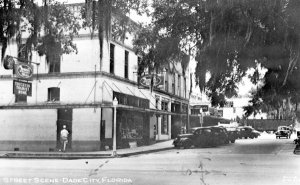 The following article is taken from East Pasco’s Heritage.

Note: The obituary of Henry Clay Griffin says he was the 2nd mayor of Dade City. Note: A biography of Henry Clay Griffin says he was elected mayor in 1888, 1889, and 1890. Note: A 1923 Tampa Tribune article lists the first mayors of Dade City as: H. W. Coleman, Capt. Henry Griffin, Capt. J. B. Johnson, W. I. Porter, J. K. Ward, C. F. Thompson, Frank Price, O. L. "Buck" Dayton, J. C. Carter, R. B. Sturkie, H. D. Cosner. Note: A 1921 Banner article says Dade City "was incorporated in 1885. Mr. D. O. Thrasher was elected mayor." Note: A 1927 Banner article reports that J. A. Hendley recalled that Dade City was incorporated in 1884 at a meeting held in the old Baptist church and that D. O. Thrasher was the first mayor. His obituary says that Capt. J. B. Johnston served two terms as mayor of Dade City. A 1963 newspaper article reported that in 1888 H. W. Coleman was elected as Dade City's first mayor. The obituary of Fred Harwell Varn (1900-1965) stated that he was a former mayor of Dade City. 1884 David O. Thrasher (?) (first incorporation) 1885 E. A. Hall (first incorporation) 1888 H. W. Coleman (?) or Henry Clay Griffin (?) 1889 John B. Johnston (second incorporation) or Henry Clay Griffin (?) 1890 Henry Clay Griffin (?) 1891 1892 1893 1894 1895 1896 1897 1898 George W. Dayton 1899 George W. Dayton 1900 John B. Johnston 1901 John B. Johnston 1902 John B. Johnston 1903 James Knox Ward 1904 James Knox Ward 1905 David O. Thrasher 1906 R. W. Thompson 1907 Edward Pasco Wilson (was mayor 8 years, according to obituary) 1908 1909 W. Irving Porter 1910 1911 Jasper C. Carter 1912 Jasper C. Carter 1913 (A biography of Robert B. Sturkie says he was mayor 1912-13) 1914 Dr. R. D. Sistrunk (Sistrunk resigned 4/17/14; A. F. Price named acting mayor) 1915 Alfred Francis Price 1916 Alfred Francis Price 1917 E. M. Craig (resigned 6-6-17, moved to a farm outside town; replaced by J. A. Peek) 1918 James Ambrose Peek 1919 Orville L. Dayton 1920 Orville L. Dayton 1921 Frederick Daniel Cosner 1922 Frederick Daniel Cosner 1923 Frederick Daniel Cosner 1924 Frederick Daniel Cosner (resigned in June, replaced by Orville L. Dayton) 1925 Frank P. Ingram 1926 James E. Turner 1927 William Friedman 1928 William Friedman 1929 James Franklin Croley 1930 1931 Johnson Younger O'Neal 1932 William Friedman 1933 William Friedman 1934 R. S. Bechtelheimer 1935 R. S. Bechtelheimer 1936 R. S. Bechtelheimer 1937 R. S. Bechtelheimer 1938 R. S. Bechtelheimer 1939 (William Thomas Cash was said to be mayor about this time) 1940 Frank M. Ashbrook 1941 Frank M. Ashbrook 1942 Frank M. Ashbrook 1943 Frank M. Ashbrook 1944 Frank M. Ashbrook 1945 Frank M. Ashbrook 1946 C. Leroy Williams 1947 C. Leroy Williams 1948 James Franklin Croley 1949 James Franklin Croley 1950 Ed Madill 1951 Ed Madill 1952 W. Glenn Lester 1953 W. Glenn Lester 1954 W. Glenn Lester 1955 W. Glenn Lester 1956 W. Glenn Lester 1957 W. Glenn Lester 1958 Victor V. Adams 1959 Victor V. Adams 1960-1963 John S. Burks 1964 J. Austin Sperry Jr. 1965 J. Austin Sperry Jr. 1966 Charles F. Touchton Jr. 1967 Charles F. Touchton Jr. 1968 Willard Lamb (resigned in September) 1968 Ed Vierling acting mayor 1969-1972 James L. Huckabay Sr. 1973 J. Edward Starling 1974 Francis Faso (resigned Nov. 5, 1974) 1974-1977 Agnes Lamb 1978-1979 J. Blake Dunson Sr. 1980-1982 Lawrence Puckett 1982-1984 William Brewton 1984-1986 William Dennis 1986-1988 David L. Williams 1988-1990 Charles McIntosh 1990-1992 Pat Weaver 1992-2000 Charles McIntosh 2000-2004 Scott Black 2004-2008 P. Hutchinson "Hutch" Brock 2008-2012 Scott Black 2012- Camille Hernandez |
Presidents of The Greater Dade City Chamber of Commerce
Source: The Greater Dade City Chamber of Commerce, 14112 8th St., Dade City FL 33525.
| 1960 | H. A. Freeman | |
| 1961 | E. V. Garren | |
| 1962 | Lawrence Puckett | |
| 1963 | Lawrence Puckett | |
| 1964 | George Nicolai | |
| 1965 | Ernest Griffin | |
| 1966 | Leon Douglas | |
| 1967 | Phillip Williams | |
| 1968 | Edward Garren | |
| 1969 | Edward A. McNally | |
| 1970 | C. L. Goddard | |
| 1971 | A. R. McClelland | |
| 1972 | Thomas Clark | |
| 1973 | Melvin DuBose ? | |
| 1974 | E. Stevens | |
| 1975 | E. S. Dix | |
| 1976 | E. S. Dix | |
| 1977 | Patricia Burdick | |
| 1978 | Patricia Burdick | |
| 1979 | Albert Joseph Kiefer | |
| 1980 | Leonard Stovall | |
| 1981 | Leonard Stovall | |
| 1982 | Ben Thompson | |
| 1983 | Ben Thompson | |
| 1984 | Al Dorsett | Tampa Electric |
| 1985 | Ralph Evans | |
| 1986 | Janet Gibson | Landmark Realty |
| 1987 | Sandra Jones | Humana Hospital |
| 1988 | David Class | First Union National Bank |
| 1989 | Carl Littlefield | Littlefield's Furniture |
| 1990 | Carl Littlefield | Littlefield's Furniture |
| 1991 | Joy Hampton | Lykes Pasco, Inc. |
| 1992 | Rachel Piersall | First National Bank of the South |
| 1993 | Carl Gude | Gude Brothers Construction |
| 1994 | Brian Jarrett | Dick Jarrett Ford |
| 1995 | Ed Lachance | |
| 1996 | Brenda Minton | Tampa Tribune |
| 1997 | Matt Hillen | PHCC |
| 1998 | Matt Hillen | PHCC |
| 1999 | David West | Keep Pasco Beautiful |
| 2000 | Penny Morrill | Sunrise of Pasco County, Inc. |
| 2001 | Charlotte Kiefer | Individual |
| 2002 | Charlotte Kiefer | Individual |
| 2003 | Charlotte Kiefer | Individual |
| 2004 | Jim Scott | |
| 2005 | Joey Wubbena | Dade City Business Center |
| 2006 | Kathy Britton | Coldwell Banker Britton & Associates |
| 2007 | Carolyn Hodges | Hodges Funeral Home |
| 2008 | Missy Lea | Engraving Systems Support, Inc. |
| 2009 | Joey Wubbena | Dade City Business Center |
| 2010 | Joey Wubbena | Dade City Business Center |
| 2011 | Pete Odom | Individual |
| 2012 | Cliff Martin | Jarrett Ford |
Dade City Articles of Incorporation (1889)
An earlier incorporation apparently occurred in 1885. Transcription of this document was provided by Jeff Cannon.Notice of Incorporation
The citizens of Dade City within the boundaries specified below will meet at the Court House on Tuesday the 15th day of January A. D. 1889 at ten o'clock A. M. for the purpose of holding an election to decide the question of no incorporation of the said town of Dade City and also if the majority of votes cast are in favor of incorporation, to elect the following officers viz. A Mayor, Five Alderman, A Marshall and Clerk. The following boundaries include the proposed incorporate limits viz: Beginning at the South East corner of the SE1/4 of the SE1/4 Section 27, Township 24 South, Range 21 E. thence East1/4 of a mile to find a starting point, thence North three quarters of a mile, thence West three quarters of a mile, thence South three quarters of a mile, thence West one hundred and ten yards, thence South one quarter of a mile, thence East fourteen hundred and thirty yards, thence North one quarter of a mile to point of beginning. The registered residents within said boundary & limits are urged to attend the election and to participate in it. Polls will be opened at 10 a. m. on said day and closed at 4 P. M.
Citizens of Dade City
Dade City FLA Nov 6th 1888
Pursuant to the above Notice published weekly for a period of thirty days previous to the 15th day of January A. D. 1889 in the Pasco County Democrat, a newspaper published weekly in the town of Dade City, Pasco County, Florida. Forty seven qualified voters being not less than two thirds of those whom it is proposed to incorporate came to the Court House in Dade City where the Polls were duly and legally opened on the 15th day of December A. D. 1889. R. H. Hartley, J. P. Wallace and J. J. Smith being duly impowered to act as managers and inspectors of said election proceeded to incorporate the city of Dade City and complying with the laws relation to incorporation proceeded to and elected the following officer to wit:
For Mayor- Jno B. Johnston
For Councilmen- F. P McElroy, D. Clermont, J. T. McMichael, A. A. Boone, J. E. Lee
For Clerk and Assessor- Jno. C. Calhoun
For Marshall and Collector- Wm. Beard
And the following bounds were adopted for the City of Dade City viz: Beginning of the South East corners of the SE quarter (1/4) of SE quarter (1/4) of Section Twenty Seven (27), Township Twenty Four (24) South of Range Twenty-one (21) East thence east one quarter of a mile to field a starting point, thence North three fourth of a mile of a mile, thence West three fourths of a mile, thence South three fourths of a mile, thence West one hundred and ten yards, thence South one quarter of a mile, thence east fourteen hundred and thirty yards, thence North one fourth of a mile to point of beginning. And the following seal was adopted as incorporation. Seal of said City of Dade City.
{SEAL}
Jno B. Johnston, Mayor
D. J. Clermont, Alderman
F. P. McElroy, Alderman
J. T. McMichael, Alderman
All ut
J. E. Lee, Alderman
J. C. Calhoun
City Clerk
Waivers of Incorporation and Registered Voters
1-T. J. Howard 2-D. J. Current 3-J. T. McMichael 4-G. M. Roberts 5- E. R. Wallace 6-J. U. Senniur 7-H. W. Coleman 8-John B. Johnston 9-Henry Macon 10-J. C. Overstreet 11-J. D. Sumner 12-D. T. McLeod 13-T. H. Thompson 14-W. A. Vickers 15-C. W. Bell 16-Will Cohen 17-D. Dortch 28-Wash Robles 19-J. C. Sumner 20-J. E. Lee 21-George W. Young 22-W. H. Garner 23-A. A. Boone 24-J. C. Calhoun 25- J. A. Grady 26-J. A. Hendley 27-C. T. Lewis 28-S. F. Huckabay 29- J. J. Smith 30-C. T. Seay 31-J. B. Roberts 32-W. Kindall 33-H. O. Benton 34-R. L. Seay 35-Wiley Sprouls 36-B. D. Sturkie 37-W. U. Ferguson, 38-H. J. Burton 39-H. H. Henley 40-J. G. Wallace 41-J. G. Roberts 42-T. L Shofner 43-T. B. Porter 44-F. S. Daiger 45-J. K Davis 46-J. P Wallace 47-R. H. Hartley
Recorded this 18th day Jany A. D. 1889
H. H. Henley Ck of Ct.
By M. G. Rowe D. C.
American Dust Bowl Affects Dade City
This article, by Arno Surls Webster, is taken with permission from the EPHS website.
Recently, my daughter and son-in-law were telling me about a news story about satellite pictures of dust being blown from Africa to South America and sometimes to Florida, when I happened to remember our experience with dust from the American dustbowl during my childhood in Dade City.
When I was about 9 years old, around 1934, our family lived just north of Dade City on highway 301 near Jordon Lake, which is east of the road near the present Moose Lodge. Our little house faced a lane that turned to the right off 301 and the back of the property sloped down to the lake.
In that year, huge dust storms struck the Midwest, the result of draught and the effects of extensive plowing of the virgin topsoil of the Great Plains. While disastrous for those farmers and the American economy, for us in Dade City it was a persistent nuisance.
The news reported black, red or tan dust blowing east from South Dakota, Kansas and Oklahoma to Chicago, Boston, Cleveland, Washington DC; for us, the dust was tan. It settled on, in and around everything.
Of course we had no air conditioning, so the windows were open a good part of the time, but even when closed, the dust filtered into the house and settled on the pots and pans, the beds, the floor, it was on our clothes; a little grit found its way into our food. When you closed your mouth, there was grit in your teeth.
Our house was so small that we ate our meals on the screened back porch. The dust accumulated about a quarter inch on the dining table between meals. Mama hung blankets, bedspreads and sheets all about the porch to deter it, but it still got in. We had our meals in a blanketed twilight.
From our house down to the lake, my daddy planted corn. During this time, the corn sprouted and came up to about four inches high with two little leaves. Shortly, it was covered with dust, never to be seen again. But, we replanted.
Sometimes the sky looked hazy or “smoky” from the dust and it made for very pretty sunsets.
At the time, the Federal government in Washington, D. C., debated the Frazier-Lemke Farm Bankruptcy Act which would decide whether or not to help the dust bowl victims. As I recall from discussion among the adults in my family and their friends, for a while, it seemed that the congressional vote would defeat the proposed financial aid proposal. Then, a black cloud of dust covered Washington and the Frazier-Lemke act was passed.