HISTORY OF EDUCATION IN PASCO COUNTYHistory of Pasco High School And Earlier Schools in Fort Dade and Dade CityYearbooks on Flickr: 1938 | 1939 | 1941 | 1942 | 1944 | 1945 | 1947 | 1948 | 1950 | 1952 | 1953 | 1954 | 1955 | 1956 | 1968 | 1969 | 1970Yearbooks as PDF files: 1938 | 1946 | 1947 | 1948 | 1949 | 1951 | 1951 Supp | 1953 | 1957 | 1958 | 1959 | 1960 | 1962 | 1963 | 1964 | 1966 | 1967 | 1970 | 1971 | 1973 | Some yearbooks were provided by Norman Carey (PHS ’71), Virginia Dew Blake, and J. W. Hunnicutt (PHS ’55). The PDF yearbook files were provided by Ariel Huey of PHS. Pictures of Schools in Dade City 1991 PHS Reunion hosted by the Class of 1941 Newspaper article, pictures, and video clip: PHS Teachers Martha Walker and Greta Adams This page was last revised on March 21, 2019. In the 1870s and 1880s Fort Dade was located in the vicinity of Mount Zion Cemetery. In the 1880s the newer community of Dade City was established a few miles to the east. In a 1922 article in the Dade City Banner, C. B. Taylor wrote, “The first school in this neighborhood was established in the loft of Tyner’s gin near Fort Dade. The furniture consisted of a long desk made from a plank and of benches made from boards, the legs being stuck in holes at the four corners, nails were scarce and too expensive to use. A Mr. Plumbley was the first teacher.” Tyner is probably Jonathon Gideon Tyner (1800-1875). The famous author and soldier Francis Calvin Morgan Boggess (1833-1902) taught at the Fort Dade Academy in the early 1850s. In his autobiography, Boggess wrote: When the author landed in Fort Brooke the country had but few settlers and it was impossible to get employment. He had no money but found a gentleman and lady from Alabama and lived with them as one of the family. Mr. Gideon Tyner, who lived at Fort Dade came down to Tampa to catch a supply of mullet. He had no school in his vicinity and he prevailed on Mr. Boggess to go and teach school for them. The Savannah Morning News of Nov. 22, 1875, has: Not long since, a worthy gentleman from North Carolina came to this county in search of health, and fixed his home in the neighborhood of Fort Dade. He opened a small school with a view to instruct the little ones, but his kindness, generosity, and earnest efforts in their behalf, soon increased the school to such an extent, that his small house could illy afford room for his pupils. With a heart abounding with love for his charge, he intimated to the citizens of the neighborhood that he would gladly furnish the means to purchase a tract of land and build thereon a large, neat and comfortable house, and donate the same in perpetuity to the neighborhood, if they would select the land and appoint a committee to superintend the building of the house. On Saturday, the 13th inst., a meeting of the citizens of Fort Dade neighborhood convened at the Masonic Lodge, to consider of and devise measures to avail themselves of this generous offer. The meeting organized by electing R. M. Wilson, Esq., Chairman, and Judge W. B. Center Secretary. The chairman, in a few brief but eloquent words, explained the object of the meeting; after which Col. D. H. Thrasher, Hon. N. A. Carter, Parson Swaine, Manning Smith, and others followed, and in glowing language set forth the importance of educating the young and rising generation of our State and county, and depicting the curse of ignorance and the disadvantages and setbacks of the uneducated, each speaker taking occasion to eulogize the donor of the generous gift aforesaid. On motion of Col. Thrasher, the chairman appointed the following committee to select the location and superintend the building of the house, to wit: J. R. O’Berry, S. L. Hancock, J. W. Hudson, Robert Sumner, N. A. Carter, D. H. Thrasher, W. J. Albritton and Manning Smith, to which said committee the chairman on motion was added. It was unanimously resolved, that the Savannah Morning News be requested to publish the proceedings of the meeting. The name of the magnanimous and generous son of the old North State is the Hon. P. Wilkins, the remembrance of whose noble act will never be forgotten by the good people of Fort Dade, and long after his earthly race is run and his soul has crossed the deep waters the young beneficiaries of his munificence will rise up and bless the name and deed of P. Wilkins.” The Fort Dade Seminary in Hernando County is mentioned in the Sunland Tribune of Jan. 6, 1877.  An 1877-78 list of Hernando County schools shows the Fort Dade Seminary operated that year from Oct. 1, 1877, to Dec. 22, 1877, with W. C. Dodd the teacher. The trustees were A. C. Sumner, N. A. Carter, and W. L. Mobley. On Mar. 11, 1876, the East Florida Banner of Ocala reported:
On July 14, 1877, the Thomasville Times of Thomasville, Ga., reported: The Fort Dade settlement is perhaps making more rapid strides in the march of improvement than any other section of the county. Its productive hammocks are being rapidly cleared into farms and its waste places built up. An 1877-78 list of Hernando County schools shows the Fort Broome School operated that year from Oct. 15, 1877, to Jan. 18, 1878. The teacher was Robert J. Marshall. The trustees were J. G. Wallace, Robert Sumner, and Isaac Lanier. Fort Broome was located “out two and a half miles a little southeast of Dade City near a pond just below the E. S. Larkin farm,” according to Hendley. On June 19, 1879, the Sunland Tribune reported that John Raymond was the teacher at the Fort Broom School at Ft. Dade. It reported that he today closed his first session with by giving a public examination which was opened with a prayer by Parson Barns. To contribute to the occasion, patrons and friends furnished a fish fry picnic dinner. A 1963 newspaper article described the Fort Dade Academy as “one of the first log school buildings. It was improved and moved through the years and was finally discontinued around 1902 when the building was sold for $1.” According to a talk given in 1921 by Mrs. J. A. Hendley, the first Dade City school was a Baptist church. Children used the long church seats, as there were no desks. The next place used for a school was a room over a store, “just south of the cigar factory.” The next building used was “the one the Masons built for their own use almost opposite where Lottie Williams now lives.” Then came the building pictured below, which she describes as the first building for school purposes to be built by the county, built on land given by the S. A. L. railroad. A 1940 newspaper article reporting on the 88th birthday of Benjamin L. Blackburn has: “Before moving to Tampa, Mr. Blackburn was a resident of Dade City during its pioneer stage and was one of the early school teachers of this section, teaching in the Oak Grove Baptist Church that was then located in the center of the old part of the present Dade City cemetery, a burial ground being located at that time about the church.” This church was located at Fort Dade, and it was probably in the 1870s or early 1880s. A letter to the Goldsboro Messenger from Fort Dade, published on May 1, 1882, has: “We have a flourishing school of about sixty pupils, with two competent teachers.” An 1883-84 list of Hernando County schools shows a Cartersville Academy with teacher J. A. Cunningham and trustees N. A. Carter and A. C. Sumner. The Fort Dade Messenger of July 11, 1884, has an advertisement: “Fort Dade High School! Tuition in this school embraces the various branches taught pupils in all high schools. Terms Liberal. Pupils from abroad can obtain board in the town of Fort Dade in convenient distance. S. L. Hancock, Charles Croft, Henry Jordan, Trustees.” According to the recollection of D. E. Sumner, “Mr. Lastinger was the first school teacher that taught in Dade City.” Hernando County school board records indicate that in 1880-81 J. B. Lastinger was the teacher at the Surveyor’s Pond school. An 1885-86 list of Hernando County schools shows a Dade City school, but does not name a teacher. The 1886-87 Florida State Gazetteer and Business Directory shows M. A. Murphy as the teacher at Fort Dade. It shows Dade City, with a population of 100, having a school. J. F. White was listed as a teacher. School board minutes of Sept. 5, 1887, show N. A. Carter, Jss. N. Sumner, Isam D. Howell as the trustees of Fort Dade Academy, No. 8. School board minutes of Dec. 5, 1887, have: “The Supt. submitted the proceedings of a meeting of the trustees of Dade City School, held in consultation with him in regard to procuring a more capacious house for school at this place. The proceedings were concurred in by the Board and the Supt. was instructed to allow five dollars per month for the rent of the upper story of the Snelson house. The School Board beg to call the attention of the Trustees and Patrons of the Dade City School to the necessity of their taking some immediate steps to provide a good and substantial as well as commodious house at this place.” According to a 1963 newspaper article, in 1887 a two-story frame schoolhouse was erected in Dade City. However, this date seems wrong based on the above. A deed dated Nov. 9, 1889, transferred property in S30 T24 R21 from Levi Eiland and his wife to the school board. The first high school in Pasco County was organized in 1889, according to a 1924 history article. There is a reference to a “graded and high school” in the school board minutes of Aug. 8, 1889. On Aug. 28, 1889, the Pensacola News reported, “Professor W. C. Dodd has been chosen principal of the Pasco county graded school.” The 1924 history article has: The original school was a small affair and was located in what is now a part of the Dade City Grammar school, the building being partly erected by the county, and partly by the generosity of H. W. Coleman and Dr. McElroy, who gave $500 each. ... Mr. Coleman also was instrumental in securing the land on which the building as well as the site of the present modern school was erected, which was donated to the county for this purpose by the Florida Central and Peninsular railroad. ... The attendance was small for the town was just starting to grow, and lack of roads and transportation kept the few children in the country, who were of high school age and advancement, from attending. In fact, little real high school work was attempted. School board minutes of Aug. 21, 1890, have: A petition from the patrons of the Pasco County Graded and High School was read before the Board asking that Prof. F. E. Cooper be commissioned principal of said school. By motion the Board granted the request, and as the Supt. under the instructions of the Board had offered the principalship of said institution to Prof. Geo. L. Lowery of Newnansville Florida and that offer had been accepted the Board tendered their regrets to Prof. Lowery and expressed a wish that he would in no wise be (illegible) by their action, and that nothing derogatory to his character had been adduced before the Board but that the ruling was made through a matter of economy. By motion the salary of Principal of the Graded and High School was fixed at $65.00 per month. The 1924 history article says that W. C. Dodd was the principal and F. E. Cooper was his assistant. This seems to be backwards, based on the school board minutes, although perhaps the decision reported in the minutes was later changed. The Oct. 15, 1891, Florida School Journal has: “Dade City has a grade school now in every sense of the term. I have thoroughly graded and arranged it and everything bids fair for a successful years’ work. Come down soon and I will show you the best little graded school in the state. I have a fine lot of co-workers. Success to you, A. E. Booth.” The same issue of the journal identifies A. E. Booth as the principal of the Dade City graded public schools. He is also identified as the principal in the 1892-93 school year in a contemporary report. The 1924 history article has: “Following Prof. Dodd in charge of the school came a Mr. Lowry, of whom no other record can be found. Other principals up to 1899, when the records of the county superintendent’s office first become available, were a Mr. Booth, L. C. Ray, and Robert M. Ray. (Prof. W. C. Dodd died in Texas in 1900 at age about 70. His obituary stated, “During his younger days Prof. Dodd was a prominent educator in the South, and has filled the presidency of colleges at Thomasville, Dawson and Americus, Ga., and at Leesburg and Dade City, Fla.”) A newspaper from May 17, 1895, reported that L. C. Ray was reappointed the principal of the High School. There is a reference to a “Prof. N. G. McCollough at Dade City, Florida” in a May 31, 1895, newspaper. An 1895-96 national education report, giving information from the 1894-95 school year, shows L. C. Ray as Principal of Pasco County High School. It indicates the number of instructors for secondary students was one male and no female. On Feb. 10, 1898, the San Antonio Herald reported, “The Dade City graded school will remain open for the full term of ten months, while the balance of the county has to be satisfied with six months.” On Sept. 5, 1898, school board minutes have: “A petition was filed by the citizens living in the neighborhood of the old Fort Dade School house asking that a school be established at the old school building; on motion it was refused, as it comes within the three mile limit.” School board minutes of Oct. 3, 1898, have: “On motion a special school was granted at Fort Dade.”  In the 1899 report to the state for the two years ending June 30, 1898, Superintendent D. O. Thrasher wrote: The County Graded and High School flourishes under the principalship of Prof. R. M. Ray, ably assisted by a corps of highly efficient and well qualified teachers; the work of this school has excelled all previous years and stands upon a higher moral and intellectual plane tan ever before in the history of the school, an by its good work has won the confidence, and so interested its patrons that they are enthusiastic on the subject for a better and higher education of the youth. Under these favorable circumstances, I am putting forth a greater effort to elevate it to the highest plane of usefulness, that it may not be only in name, but in fact, a Graded and High School abreast with the finest schools in the land. The prescribed course of study prepares the pupil for the collegiate course and furnishes our common schools with teachers. In 1899-1900 Herbert S. Phillips was principal. While principal of Pasco High School, he read law in his spare time in the office of J. A. Hendley and possibly with other lawyers of the time. Phillips later became U. S. attorney for the Southern District of Florida and later a prominent lawyer of Tampa. An 1899 report to the state by superintendent Robert M. Ray has: The school as organized, when it came under the management of the writer in 1896, was composed of a principal and three assistant teachers, who were recommended by a board of three trustees. The school, last year, had an enrollment of 160 legal pupils, under a corps of five teachers, and the results accomplished were a credit to the institution. Besides the legal pupils, fifteen of the county teachers were in attendance for periods of from two to four months. The superintendent, Hon. D. O. Thrasher, reports that the most effective work in the county is accomplished by the teachers from this school. At the inception of this school, the people, to a limited extent, murmured on account of one school being favored more than another as to length of term, but any prejudice that may have existed has passed away, and they are now complaining because of threats of curtailing the length of the term. The school this year is under the management of the writer and four excellent assistants: Prof. H. S. Phillips, Mrs. Jno. B. Johnston, Miss Mary McCullough, and Miss M. L. Wever. The attendance is larger than ever before, and we number pupils from all sections of the county, and again the county teachers are with us.
 According to the 1924 history, Phillips was succeeded by John DeVant, Robert Lovell, W. E. Everett, J. C. V. Worthy, M. McCullough, and P. W. Corr. DeVant is probably John C. Davant Jr., b. Oct. 2, 1880, shown in the 1880 census as a teacher living in Brooksville. The report to the state by County Schools Superintendent D. O. Thrasher appearing in the report of June 30, 1900, has: Owing to the advanced classes in our country schools, the Graded and High School is a necessity. Our County High School continues to grow in favor and usefulness. Prof. N. McCullough, Principal, assisted by Misses Alice Leitner, Mattie Jordan, and M. L. Weaver, who are doing a thorough and practical work in moral as well as literary training. This school supplies our county with teachers, and some of the best in the county. School board minutes of Feb. 4, 1901, have: “By unanimous consent - the Pasco County Graded and High School and the Dade City School were separated. The term of the former extended four months.” Minutes from July 1, 1901, indicate Mrs. J. B. Johnston was appointed as Principal of the high school and Miss Alice Lutner was her assistant. The high school is numbered “0,” apparently to distinguish it from the other schools in the county. The school board subsequently discovered that Mrs. Johnston had taught black teachers during the summer in the Peabody Summer Normal School for Colored Teachers in Gainesville, and her appointment was rescinded. The minutes of Aug. 5, 1901, report “On the first Monday in Sept. 1901 the Board will select a principal for the County High School.” [Mrs. Johnston would have been the first woman to serve as principal of a Pasco County high school had the appointment not been rescinded. It is possible that she did serve as principal in the 1900-1901 school year, but evidence is lacking.] Minutes of July 7, 1902, indicate that V. C. Waugh and J. Walter Williams were the first and second choices for Principal of the high school. Subsequent principals named were W. E. Everett, G. W. Bossmer, W. B. Bell, Linton L. Tucker, and Prof. Angel. School board minutes of Oct. 6, 1902, have: “Mr. J. M. Mitchell informed the Board that the Fort Dade school house had fallen down, was badly decayed and in almost a worthless condition, and offered one dollar for the same; on motion his offer was accepted.” On Sept. 18, 1903, the Tampa Morning Tribune reported, “The Dade City High School opened yesterday morning with a good attendance and fine prospects for a good school. Prof. W. H. Everett, of Bowling Green, is principal, and Miss Mary McCullough, Miss Minnie Sims and Miss Futch assistants.” The 1903 Sanborn map of Dade City shows a wooden school building, the first of three constructed on the school site. [This building was razed in 1928 and used to build a new colored school.] On Sept. 10, 1904, the Tampa Tribune reported, “Prof. W. E. Everett, after spending his vacation in Kentucky, has returned and will open school Monday.” On Sept. 27, 1904, the Tampa Morning Tribune reported, “The Dade City High School began work September 15, with an enrollment of 146 pupils. Prof. Everett is principal, Miss Riherd, first assistant, Miss Futch, second assistant, Miss Mamie Sturkie, third assistant, and Miss Pardee, primary teacher.” The minutes of June 5, 1905, report that Mr. Haycock and Mr. Roller were awarded the contract for the Dade City school for $765.00. This second building was the wooden Annex building, which was constructed in 1905 or 1908. [A local researcher recalls that in the 1950s this building was called “the old wooden building.”] A photograph dated 1905 shows these students and teachers: William Stephens, Maud Osburn, W. E. Everett, principal, Ella Osburn, Lula Burkett, Mignon Geiger, Bonnybelle Shofner, May Burkett, Trudy Taylor, Amy Guyman, Lucy Batchelor, Jessie Ray, Margery Geiger, May Tait, Love McMahon, Maoma Hill, Jewell Altmond, Willie Bachelor, Ruth Summer, Willie Bigger, Gertrude Osburn, Omah Hays, Oma Geiger, Annie Tait, May Ferman, “Peachy” Henley, Mabel Carroll, Jeanette Seay, John Sumner, Harry Hill, Ira Soar, Glenn Sumner, James Dormany, John Embry, George Heath. The 1906-07 school year might be considered the first year of what would now be called a high school. A list of graduates (below) shows the first graduate in 1907. A newspaper article about the 1927 graduation calls it the 21st for the high school. On Aug. 28, 1907, the Gainesville Daily Sun reported that Dr. P. W. Corr left for Dade City, where he has accepted the principalship of the Dade City high School. Minutes of Jan. 7, 1908, indicate that P. W. Corr was Principal of the high school. On Jan. 16, 1908, the Gainesville Daily Sun reported, “The South Florida Normal Institute, Dade City, has reached an enrollment of 322. The school board has contracted with Prof. P. W. Corr, as principal, for the next five years, and it will meet next Friday to open bids and let contract for a large annex to the present building. No school in the State is doing better work or making more rapid growth than the South Florida Normal Institute. The cornerstone of the new building will be laid with Masonic honors.” On Jan. 27, 1908, the Gainesville Daily Sun reported, “A large two-story annex is being added to the present school building in Dade City. It is a marked step forward in Dade City’s educational progress.” On Feb. 27, 1908, the Arcadia Champion reported that P. W. Corr was recently elected principal of the Dade City High School for the coming five years. It also reported that the school board had recently made a $3000 addition to the high school for the use of the normal school conducted by Corr. The obituary of Prof. Corr has: “He was principal of Dade City high school for nine consecutive years, during which time the school reached a peak of efficiency that had never previously been attained. Mr. Corr added many desirable features to the school, including home economics, vocal music and gardening. In his gardening class the pupils were assigned tracts on which they did real gardening and farm work. He also placed a small printing plant in the school, enabling boys and girls to learn the rudiments of printing.” A brief biography of Corr is here. The 1924 history article has: Prof. Corr remained in charge of the school for nine years, and it was during this time that the school first became a real high school. Prof. Corr was a natural educational builder, and succeeded in surrounding himself with a faculty composed of men and women of great teaching ability. Among others who have been mentioned as teaching under him was Dr. J. Y. Yokum, later president of the State University. To the efforts of Prof. Corr also are due the enlarging of the school building which is now used as a grammar school and the erection of the fine brick building which now houses Pasco high. In the report to the state appearing in the June 30, 1908, report, Superintendent John Barnes wrote, “The Dade City High school has a splendid new building in addition to the six large, well-lighted rooms previously reported. The faculty consists of a principal and seven assistants. The school is doing good work.” [In the photo above, the “six large, well-lighted rooms” are the building on the left, and the building the right is the “splendid new building.”] On Dec. 7, 1908, all students at the Dade City school attended a program commemorating the 100th anniversary of the birth of Jefferson Davis. A portrait of Davis was presented to the school by the president of the UDC. On Sept. 2, 1909, the Tampa Morning Tribune reported: The Dade City high school opened Monday with over 300 scholars. Prof. Corr conducted the exercises, making a few forceful and appropriate remarks, followed by Dr. Tribble of Columbia college, Senator Dayton and J. C. Carter, each in turn giving good talks, impressing the youth of this town not only with the importance of an education but the many advantages they have over the older people. In securing the services of Prof. Corr the people of Dade City are indeed blessed. His labors in behalf of our children are constant and untiring and he is ever ready to go beyond his strength to serve his pupils. In his judgment he is firm, wise and courteous and gives general interest to each department of work. He will be ably assisted this term by Misses Alyse Corr, Hattie Caldwell, Inez and Lula Cochran and Daisy Brook, who have for three years taught in this school so satisfactorily and successfully; Misses Amy Guyman, Carrie O’Neal, Mabel Carroll, Bozeman, Ralph and Prof. Blanton, our new teachers, who come to us so highly recommended. It is an assured fact that we will have the most flourishing school in the state. The Class of 1912 is said to have included a Miss L. Carter, although that name does not appear in the table below. A postcard postmarked in 1912 and showing the school identifies it as “Dade City High School.” School board minutes of July 1, 1912, show that a school was granted for Fort Dade. On Oct. 13, 1912, the Tampa Morning Tribune reported: At a meeting of the Board of School Directors here last Monday, the contract for the erection of a new cement and brick High School building for Dade City was let to W. A. Jester, of Bartow, the contract price being in the neighborhood of $15,000. Work will begin on the new building within the next ten days and the contract calls for its completion by April 1st next.
According to McCormick, the brick high school was completed in 1913 in time for spring graduation, which had a class of 8 girls, although only 5 are listed in the table below. On April 3, 1913, the Tampa Morning Tribune referred to the school as Pasco High School. On March 30, 1914, the Tampa Morning Tribune reported, “The Dade City High School basketball team defeated the Leesburg High School team, 14 to 9.” On Sept. 11, 1914, the Dade City Banner reported that opening ceremonies for the new year were held on the High School auditorium. It reported: Dade City has exceptionally fine educational facilities. Two modern school buildings stand on a large shaded campus. Besides a regular course in the Science and Arts, the school has a special course in Domestic Science and in Music, with competent teachers in each department. The Chemistry laboratory is adequate and complete; the auditorium is large and well ventilated, and the grounds are big enough to accommodate the pupils and allow them room for their different games without crowding them. Plans are on foot for a big year in athletics. The High School boys met Monday and organized a baseball team and the girls met and organized a basketball team. The boys also intend to put out a basketball and football squad. Athletics have always played an important part in the High School here, and prospects are good for some real exhibition games. A good crop of athletes present themselves and successful teams are assured. Another feature of the High School here is the school paper, which is edited, set up, and printed by the students, the school having its own printing outfit. This department is conducted by Prof. Corr. On Nov. 20, 1914, the Dade City Banner reported: “The Dade City high school delighted a large audience with a musical concert Thursday evening at the high school auditorium. An excellent musical program had been arranged and was successfully carried out, much to the enjoyment of all present. The entertainment was given for the benefit of the boys' and girls' basketball teams, and a neat sum was realized, which will be quite an aid to the school in financing the basketball teams for the coming season.” A school newspaper from about 1915 has a photograph of the faculty, showing: Mr. P. W. Corr, Principal; Miss Catherine Cook, Music; Miss Hattie Caldwell, Latin and History; Miss Maoma Hill, Science; Mrs. McWherter, Domestic Science; Miss Alys M. Corr, English and Printing. The newspaper reported that since the photo was taken, Mrs. Lander had succeeded Mrs. McWherter, who with her husband had gone to accept a government position in the Philippines. The newspaper lists the grammar school faculty as: Mr. Paul McWherter, 8th grade; Mr. Barry Padgett, successor to Mr. McWherter; Mr. Arnold Zellner, 7th grade; Mrs. Antoinette Martin, 6th grade; Miss Nan Bennett Caldwell, 5th grade; Miss Jean English, 4th grade; Miss Lula Cochrane, 3rd grade. It lists the primary faculty as: Miss Nan Ward, 2nd grade; Miss Edith Carter, 1st grade, A; Miss Maggie Miles, 1st grade, B. Another school newspaper from about 1915 has: “Of the many High Schools in Florida, this is the only one that owns its printing plant, and in which the work of getting out the paper is done by the students themselves.” The school newspaper reported at the end of the 1914-15 school year, “We did not do much in athletics this year, as some of our best athletes have left school. As our representatives that went to Leesburg did not do well enough, we thought it best not to send them to Gainesville. The girls basket ball team played quite a few games, and did very well. As far as we got in base ball was going to the diamond to practice two or three times. Some boys practiced throwing quoits, and putting shot, but they started too late to participate in any contest. High jumping was taken up, but as it was too violent an exercise, it was dropped.” On April 30, 1915, the Dade City Banner reported: “Graduation exercises of the Pasco High School were held in the high school auditorium Tuesday evening, at which time the class of 1915, consisting of four girls and two boys, received diplomas. The following are the names of those who have thus proven their scholarship: Olivette McGeachy, Nellie Brown, Blanche Claxon, Grace Gilbert, Frank Ziegler and Richard Beech.” In January 1916 Sidney Catts, a candidate for Governor, conducted the opening exercises in the chapel. The Pasco School News reported on Feb. 15, 1916: “Prof. Corr attended the Marion County Teachers' Association last Saturday. Prof. Cassels, Principal of the Ocala high school, informed him that the school board has lifted the ban against interschool games. We now hope to have a game with Ocala.” On May 12, 1916, the Dade City Banner reported: “The Pasco High School of this city has issued its Annual, the Pascorean, an attractive booklet of forty-two pages bound with a handsome cover. The book was edited by the seniors and the mechanical work, including the type-setting, press work, and binding was done by the class in printing in the high school. The Annual is profusely illustrated throughout with pictures of the high school classes, athletic teams, individual pictures of the graduates, pictures of the faculty and other views. The booklet, both mechanically and editorially, is a very creditable piece of work, and the seniors and class in printing are to be congratulated on the success of the undertaking.” There were 10 graduates in 1916. A photo of the class of 1916, apparently taken before their senior year, shows Mollie Tucker, Dewey Hudson, Clemmie Croft, Ralph Coleman, Frank Ingram, Van Ness Cole, Ruth Davis, Lessie Redding, Sallie Brown, Hettie Huckabay, and Richard Craig (perhaps a teacher). On July 7, 1916, the Dade City Banner reported: “The county school board, which on Wednesday took up the appointment of teachers for the coming term, refused to re-appoint Prof. P. W. Corr as principal of the high school on the recommendation of the local trustees, basing their reason for refusing on the grounds that a petition signed by a majority of the patrons of the school had been presented to them protesting to them against the reappointment of Prof. Corr.” On Aug. 6, 1916, the Tampa Tribune reported, “The Board of Public Instruction has finally decided on a principal for the Dade City High School, having selected for that position Prof. R. W. Van Brunt of Tallahassee. Prof. Van Brunt has been principal of the Palatka school until this year and comes highly recommended by State Superintendent Sheats.” The 1924 history article has: Following Prof. Corr came R. W. Van Brunt, now principal of the Citrus county high school at Inverness. He was followed by J. W. Asbury, who is superintendent of schools in Marion, Ill. The present principal, Prof. G. H. Williams, a former pupil, who is now completing his second term here, is like Prof. Corr, a developer. Under his leadership, and with the whole-hearted co-operation of the trustees and patrons, the school has grown as never before, and bids fair to soon require larger quarters. A good library has been built up, laboratory apparatus and other equipment for the study of science has been added, and last year the school was recognized by the State Department of Education as a Fully Accredited School with a rating of “A-1,” the equal to the best in the state. May nothing happen in the future to keep it from always being in the front rank of the educational institutions of the state. On Aug. 21, 1916, the Tampa Morning Tribune reported, “Miss Nina Percival, of Zephyrhills, stopped off in Dade City on her way back from the summer training school at Gainesville, and contracted to teach in the high school [in Dade City] the ensuing year.” A photo of the class of 1917, taken before their senior year, shows Albert Craig, Alfred Zinsser, Annie Boone Seay Annie Gilbert, Ethel Hawkins, Eunice McGeachy, Florrie Cray, Forrest Mobley, Fred Cochrane, Grace Claxon, Grace Oosting, Harold Golden, Inman Bessenger, John Shearer, Julia Waters, Lessie Redding, Lewis Case, Lillian Bessenger, Margaret Crawley, Maryte Hamilton, Reed Claxon, Richard Craig, Ruth Hamilton, and Thelma Cummings. [Annie Gene Gilbert, born Feb. 14, 1899, was a daughter of Rev. Mozelle L. Gilbert, the county schools superintendent.] On Dec. 6, 1917, the girls basketball team lost to Citrus High School, 22-21, at Dade City. The lineup for Dade City: Lelia Boring and Katherine Lattimer, forwards; Elise Thornton and Elizabeth Craig, centers; Jane Butts and Eldora Hines, guards. On Nov. 18, 1918, the Dade City Banner reported: The Dade City school re-opened Monday after being closed for four weeks on account of the influenza. The school was opened by order of Judge J. A. Hendley, court commissioner, acting on the injunction case brought by George B. Massey against the county board when the schools were closed on October 8th. The county board met last Monday and confronted by the order of the court and a petition signed by most of the patrons of the Dade City school requesting that the school be opened, decided that the responsibility had been shifted from their shoulders and that the Dade City school could remain open. Certain other schools in the county were ordered opened on the 7th and 11th, while in communities where there remained cases of influenza the opening of the schools were left for further action. The Sand Pond school will open next Monday. School board minutes of June 6, 1921, show that John W. Asbury was appointed principal over the protest of two of the trustees. L. R. Sims had declined the job. In 1922 The Red and the Black reported, “It is the ambition of the class of ’23 to have an annual. The last issue of the Pascorean was in ’16, and the class of ’23 will be the largest ever graduated from Pasco High, wish to have the honor of reinstating it.” On April 28, 1922, the Dade City Banner reported that the 16th annual commencement of the Pasco high school was held in the auditorium Monday night. There were eight graduates. Emily Eck was the salutatorian and Bessie Goldsby was the valedictorian. On May 19, 1922, the Dade City Banner reported that J. W. Asbury had resigned as Principal to accept an offer to become superintendent of schools in Marion, Illinois. He had held a similar position there before coming to Pasco County. On June 5, 1922, Miss Nina Percival was appointed to teach science and Prof. E. H. Schuyler was appointed to teach mathematics. In the report to the state appearing in the June 30, 1922, report, the superintendent wrote, “We have four schools of the county doing high school work; one is a senior high, one is an intermediate, and two are doing junior work.” In August 1922, Mrs. Alice Hunter, who had been teaching in the high school in Palmetto for the last two years, was appointed to a vacancy in the faculty. On Sept. 1, 1922, the Dade City Banner reported: The high school faculty is unusually strong this year and all things point to a most successful term. For the first time in years, if not in its history, the principalship is held by a Dade City man, Professor G. H. Williams having been a student in the grammar school when a boy. The entire faculty consists of G. H. Williams, principal, Senior English, Junior and Sophomore Mathematics. E. H. Schuyler, History, Senior and Junior Mathematics. Miss Nina Percival, Science. Mrs. Alice Hunter, Latin and English. On Sept. 29, 1922, the Dade City Banner reported, “Prof. R. D. Moore of Tampa has been appointed as a teacher in the Pasco high school and began his duties yesterday.” On Jan. 10, 1923, the Tampa Morning Tribune reported, “The Pasco County High school of Dade City is desirous of arranging basketball games with teams in it class. The Dade [City] boys are particularly anxious to get a game for Friday or Saturday of this week either in Dade City or elsewhere. Anyone willing to meet the Pasco five should wire, phone or write Prof. G. H. Williams, Pasco County High School, Dade City.” In April 1923 there were 30 graduates, 15 boys and 15 girls, the largest in school history. At this time the faculty consisted of Mr. Hugh Williams, Mr. Schuyler, Miss Nina Percival, and Mr. Moore, according to a newspaper article. On Sept. 28, 1923, The Red and Black, the Pasco High School newspaper printed in the Dade City Banner reported: For the first time in its history P. H. S. is trying to organize a football team. Although we have not enough candidates for the team we have a fairly good line-up and plenty of school spirit. We wish to express our thanks to the business men of the town, who have volunteered to help the team financially. That is in the way of securing outfit for each member. We have received challenges from several teams already. Although the candidates are inexperienced in the game we believe we have good results. Our coach is an experienced one from Georgia Tech., and we feel sure that we will be victorious. On Oct. 5, 1923, The Red and Black reported: The Foot Ball Boys received their suits Monday and their first game will be with St. Leo on Saturday over there. Come on boys, we’re bettin’ on you if you can’t win give them a good fight. Several of the business men of the town have contributed money for the help of the team of which are the following. James Jackson, $5.00; Mr. Austin, $5.00; Herbert Massey, $5.00; Jack Massey, $5.00; Charlie Dowling, 50c; Harry Tipton. 50c; W. V. Mahoney, $1.00; Earl May, $3.00; J. B. Nides, $1.00; Alton Smith, $1.00. The first-ever football game played by Pasco High School was on Oct. 6, 1923, vs Saint Leo, at Saint Leo. St. Leo won, 13-0. The following Saturday, the two teams played again, this time in Dade City. The second game was a scoreless tie. On Oct. 12, 1923, the Red and Black column in the Dade City Banner reported that Pasco was scheduled to play Mulberry at Mulberry on Oct. 20. On Nov. 2, the column reported that Pasco played Fort Meade at Fort Meade. On Nov. 3, Pasco played Sarasota at Sarasota. On Nov. 16, the column reported that Pasco was to have played Largo on Saturday but did not because some of the Largo players had been injured. So Pasco played the Plant City second team at Plant City. That game ended the football season. For the class of 1924 Margaret Huckabay was valedictorian and Goldie Gerber was salutatorian. There were 7 girls and 8 boys in the class. On June 12, 1924, the school board rejected the nomination of principal for the Dade City school. In June 1924 A. F. Price and E. S. Slough, trustees of the Dade City special school district, resigned their positions to protest the action of the school board in rejecting their recommendation for the appointment of Miss Trilla Reed as principal. According to the Dade City Banner, the school board took the position that the duties of a principal required a man to properly perform them. Subsequently, Thomas P. Maynard was named principal. (Miss Reed did become principal in 1928.) On July 11, 1924, the Dade City Banner reported, “F. P. Maynard, the newly appointed principal, is a man 51 years of age and comes here from Mayo. He was educated at Valpariso college and at the Normal school at Jasper; has taught at Lake Butler four years, Trenton two years, Webster three years, Mayo five years, Marianna two years and Abbeyville, Ga., two years. He holds three state life certificates and is highly recommended. He specializes in teaching mathematics, Latin and English. Mrs. Maynard is also reported to be an experienced teacher, and may take a position in the schools.” On Sept. 20, Pasco High School played Hernando High School in a football game at Brooksville. The Dade City Banner of Sept. 26, 1924, carries an announcement: “Foot Ball TODAY! Dade City High School vs Largo High School. Friday, 3:30 P. M. See the boys in their first scholastic game on the home grounds.” On Oct. 3, 1924, Pasco lost a football game to Plant City 78-0, according to the Tampa Morning Tribune. However, the Red and Black column in the Dade City Banner reported the score as 76-0. On Feb. 6, 1925, The Red and Black has information about Principal Sidney Daniel Padgett, born in Smoaks, S. C., on May 2, 1895. From 1923 to 1925 he had been Principal of Union County High School. On Aug. 25, 1928, the school board announced the resignation of W. L. Carter as Principal and the appointment of Miss Trilla Reed to the office of principal of the Dade City high school. On May 2, 1929, the Pasco County News reported, “The twenty-third annual commencement of the Pasco County High School was held in the High School auditorium April 26-29 inclusive.” The valedictorian was Donald Taylor, and the salutatorian was Randall Musselman. At the graduation held on May 26, 1930, Mary Smith was the valedictorian and Virginia Boyce was the salutatorian. On July 7, 1930, Paul Delavan was appointed principal. Paul Tuttle Delavan (b. 1888, Alma, Michigan; d. Feb, 12, 1949, Nassau County, Florida) was part of an astronomical expedition to Argentina when in 1913 he discovered a comet which is known as Delavan’s comet. Ruth Jones of San Antonio recalled Delavan as “the most absent-minded of all professors.” She recalled a day when Delavan drove to town to run an errand, then forgot he had driven and started walking back. On the way, some students passed him in their car. When he got back, “sweating to beat the world,” he asked the students why they hadn’t stopped to pick him up. “Well, you had your car,” they told him. “I did?” he replied. On Feb. 1, 1937, he received a master's degree and subsequently worked as the director of the Bushnell school. On May 15, 1931, the Dade City Banner reported that eleven students would graduate on May 25. The class of 1932 consisted of 28 students, the largest class since 1924. On Nov. 11, 1932, the Dade City Banner reported, “Under the direction of Coach Allen Entz Pasco High school is well advanced into its second season of football.” On Nov. 18, 1932, Pasco defeated Gulf in a football game, 7-0. In 1933 the valedictorian was Gladys Howard, with a four-year average of 96.8. Her sister Ruth was the salutatorian, with a four-year average of 95.2 On Nov. 3, 1933, Pasco played a football game vs Tarpon Springs at home. On Sept. 4, 1936, the Dade City Banner reported that Paul T. Delavan was appointed Principal of Pasco High School, and these other teachers were appointed: Miss Nina Percival, Mrs. Milfred B. Huckabay, Miss Frankie Major, Miss Dorothy Lock, Mrs. Mary C. Weyher, Mrs. Viola Waldorf, Miss Louise Thomson, Mrs. Lula B. Bucklin, Mrs. Dorothy Browning, R. M. Wildeson, Leon R. Luckenbach. In 1937, Troy Jones was the valedictorian and Bette Evans and Stanley Burnside were salutatorians. A yearbook, called “The Pirate,” was published in 1938. [The 1941 yearbook includes a statement, apparently erroneous, that it is the first issue of “The Pirate.”] On May 27, 1938, the Dade City Banner reported that Pasco High’s largest graduating class, consisting of 50 students, received diplomas Monday night. The four honors students spoke, in place of the usual salutatorian and valedictorian. A microphone was used by the speakers for the first time in the history of the school. In 1942 there were 52 graduates. Dorothy Sparkman was valedictorian; Norma Hawes was salutatorian. The 1945-46 football team was undefeated and won the West Coast Conference championship under the Dickinson system. On Sept. 25, 1947, the St. Petersburg Times reported, “A recently reorganized school district consisting of the smaller districts of Pasadena, Pasco Station, and Blanton in a recent referendum voted a bond issue of $400,000 to finance the erection of a new Pasco High school and to enlarge the grammar school within Dade City. Over 900 votes were cast.” On Dec. 17, 1947, Pete Norton presented the Tribune Trophy for the West Coast Championship to the football squad and the student body of Pasco High School for the third consecutive year. Captain Eddie Gasque received the trophy and in turn presented it to James St. Clair, the President of the Student Council. The 1947-48 team was the third PHS team in a row to win the championship. The head football coach was Ray Hurn, in his first year. On April 19, 1948, the School Board approved the final plans for the new Pasco High School. On June 18, 1948, the New Port Richey Press reported: “At a meeting of the Board of Public Instruction on Wednesday, of last week, the bid of approximately $361,000 by the Paul Smith Construction Co. of Tampa was approved for the construction of a new school building in Dade City for pupils of the Senior and Junior high grades. The new building will be erected on school property in the block south of the present building. The contract time is nine months and construction is scheduled to start at once. After the new building is completed, it is expected the old building will be used for some of the grades from the Dade City Grammar School.”  According to McCormick, the new Pasco High School was completed in 1949 at a cost of $381,000. Thomas Burch Cornelius was the first principal in this building. The building was used as Pasco High School from 1949 through graduation in 1970. [This building is was later used by Pasco Middle School but was demolished in April 2010.] In May 1953, a delegation which included PTA leaders and about 20 students attended a school board meeting to defend Principal O. S. Bandy, whom the board had intended to replace after one year in the position, apparently for a lack of discipline at the school. In 1953 the valedictorian was Carolyn Tait and the salutatorian was Joy Ann Dew. In June 1957 the Pasco High School Pirates won the state Class A baseball championship under coach Jim Pannell. The 1961 football team under Coach Ned Madison had a 10-0 record in the regular season. On Dec. 19, 1964, the Pasco Pirates defeated Auburndale in boys basketball, 100-63, setting a scoring record for the team. In the same game Jerry Gaddis scored 41 points, also setting an individual scoring record. His performance broke the old mark of 35 points set by Jerry Smith in 1962-63. After Pasco Junior High moved to the present Pasco High School campus about 1965, the building was used as high school classrooms for the Social Studies Department. When the high school moved to the “hill” in 1970, the building became the area Adult Education Center. According to McCormick, in the mid-sixties, Pasco High was a very strong school academically. The students had a choice of four courses of study - Vocational, College Prep, Business and General. The school required a C average to graduate. Allegedly, one of the other county high schools complained about the C average and Pasco School Board established 1.5 grade point average as the requirement for graduation. Patricia Tehani Poe, a teacher who began at PHS in September 1969, died in an auto accident on Nov. 9, 1969. She was 26 years old. Her husband was a coach and teacher at PHS.
The 1983 football team was 12-0 under coach Don Herndon. The team won the Gulf Coast Conference championship and the district and regional championships, and was runner-up in the northern sectionals. On Dec. 18, 1992, Pasco High School defeated Tampa Jesuit 28-16 to win the Class 3A state football championship. Among the Pirates players were future Dallas Cowboy running back Troy Hambrick and future NFL linebacker Darren Hambrick. The Pirates are the only team in Pasco County football history to win a state title. The win ended a 14-0 season under Coach Perry Brown. Brown had a 60-22 record during his tenure as head coach from 1989 to 1995. The high school name was changed from Pasco Comprehensive back to Pasco High School in the fall of 1996. The 1998-99 football team had a 10-0 record under Ricky Thomas. The team captured the Class 4A-District 8 championship and a first-round playoff victory against Inverness Citrus. Thomas was the head football coach from 1996 to 2002 and had a record of 45-29 during that time. (As a football player at PHS, Thomas ran for 1,300 yards and 18 touchdowns in 1973. He also played at Bethune-Cookman College. Thomas became a coach in 1979, starting at Hernando High as a junior varsity football and basketball coach. He returned to Pasco County to coach football at Pasco and Weightman middle schools. He went 103-10. In 1996 Thomas became the first black coach at PHS. He went 45-29 in his seven seasons at Pasco making the playoffs three times, reaching the region semifinals, and winning district and conference titles before stepping down in 2002.) The 2008 football team had a 12-2 record, making it to the Class 3A state semifinal but losing to Godby, 28-14. The team defeated Gulf High School 50-0 in an earlier playoff game. Head coach was Tom McHugh. In the spring football game in May 2010, Pasco defeated Zephyrhills 56-0 in a game called after two quarters because of a lightning strike. On Oct. 15, 2010, Pasco’s football team defeated Anclote 61-0. That brought the team’s record for the season to 6-0. On Oct. 14, 2011, Pasco’s football team defeated Hudson 70-0. On Dec. 2, 2011, the team made the final four in the state tournament by defeating Tampa Jesuit 31-7. On Dec. 9 Pasco lost to Wakulla 41-38 in the state semifinal. On Oct. 19, 2011, the JV football team finished its seven-game season with no points scored by any opponent in any game. At the end of the season, head JV coach Rick Gavin told a reporter, “Gerald, this season has simply been unbelievable. When we first opened practice back in August I really didn’t know if we would win a ball game.” On Oct. 12, 2012, Pasco’s football team defeated Hudson 63-0. On Nov. 24, 2012, Pasco defeated Gainesville East 52-0 in a regional semifinal football game. Pasco lost the regional final to Robinson, 49-21, on Nov. 30. Principal Patrick Reedy retired Dec. 31, 2012. He was succeeded by Kari Kadlub. On Aug. 30, 2013 the Pirates lost a footbal game to Sunlake High School. It was Pasco’s first lost to a county team since 2007. On May 2, 2014, school district officials and administrators, teachers, and students from Pasco High School celebrated with 17-year-old senior Vanessa Jasmin Garcia at a hospice in Dade City as she was awarded an honorary diploma. She was not able to travel to the high school for a special graduation ceremony that had been planned for her in advance of the school’s regular graduation ceremony. A newspaper article is here. At the start of the 2014-15 school year the Cambridge AICE Program was added at PHS and Pasco Middle School. In November 2018 head football coach Tom McHugh ended his career as head coach, with a 86-50 record. He had been head coach since 2007. Two famous alumni of Pasco High School are David and Howard Bellamy, Classes of 1968 and 1964, respectively, who as the Bellamy Brothers became a popular country music act. Their hit song Let Your Love Flow reached number one in 1976. David Bellamy and Jim Stafford wrote Spiders and Snakes, a popular hit recorded by Stafford.
EARLY PASCO HIGH SCHOOL GRADUATESMost of these lists were taken from a handwritten document at the Pioneer Florida Museum. Please email me if you see any transcription errors.
PRINCIPALS
Note: The 1945 yearbook states that during 1943-44, Cornelius succeeded Leslie, “who had served the two previous years.” This implies that Reed did not serve as Principal at this time.
Students Were Family to Teacher (1986) This article appeared in the Tampa Tribune on Sept. 20, 1986. By CAROL JEFFARES Nina I. Percival told the freshmen students that year she hoped to remain a teacher long enough to see their class graduate. It was 1915 — the first year Percival taught at Pasco High, recalled one of those students, Myrtle Hunt of St. Joseph. Percival did remain those four years to see Hunt, the former Myrtle Burnside, and her seven of her classmates graduate in 1919. And Percival remained another 42 years. Teaching was Percival’s life, Hunt said. She never married, and her family was her students. She taught, in some cases, three generations during her career that spanned nearly 50 years. Percival died in 1981 at the age of 99. But before her death, some 250 former students signed and presented Percival with a scroll that reads: “We who have passed through your hands on our way to maturity do offer this as testimony to the continuing results we have reaped because of your kind, beneficient and thorough teaching. You will live in our hearts, and we thank you for those days when you gave of yourseif to us.” The daughter of Mr. and Mrs. James Chapman Percival, she was born Aug. 10. 1882, in Stanton, Mich. — the first girl in two generations of the family’s history. Percival graduated in 1901 from high school in Stanton. In 1907, due to poor health, Percival came to Florida to spend the winter months in Green Cove Springs. She returned to her home state in 1908 in much better health. But her father, seeing the physical improvements of his daughter. thought the mild Florida climate would provide the ideal living conditions for his family. They moved to Zephyrhills. But Percival remained in Michigan for two more years, waiting to make sure her family was happy in Zephyrhills before joining them in 1911. In Zephyrhills, Percival worked for two years as a clerk at Hennington’s Dry Goods Store. At that time schools were badly in need of teachers, and Percival was offered a teaching job by school trustees. It took some persuasion, but the trustees finally convinced Percival to take steps to become a teacher. In the summer of 1913, she enrolled in South Florida Normal Institute in Dade City. The institute, operated by Professor P. W. Corr, prepared students to take the Florida Uniform Teachers’ Examination. Percival was required to take examinations in 13 different subjects. But it was science that she would teach for the next 48 years. During the 1913-1914 and 1914-1915 school years, Percival taught at the Zephyrhills School, a wooden structure built in 1910 which housed first through 12 grades. Her first teaching job paid only $30 a month. In the fall of 1915, Percival came to Pasco High, formerly called Dade City High School. Percival was part of a five-teacher staff that included Corr, who doubled as principal and mathematics instructor. During the summer of 1915, Percival took courses at the University of Florida. And while there, she was offered another teaching poaition for more pay. She sent her resignation to the Pasco County School Board but got three telegrams pleading for her to return to Dade City on Aug. 9, 1916. She did. And during her second year at Pasco High, Percival set up a recording and filing system to provide permanent records of students’ grades. For many years to come Percival bore the complete responsibility of keeping those records. In 1929, Percival resigned again — deciding to leave the teaching field because she felt she “was not reaching the boys in a guidance capacity,” she once stated. She went to Birmingham, Ala., to take a business course. But once again Percival was persuaded to return to Dade City after receiving a telegram in late November of that same year. The telegram was from A. F. Price, chairman of the Pasco County School Board, and it stated simply: “Things are not going right at Pasco High, and you are needed there.” Percival received the telegram on a Friday and was back at her teaching post the next Monday. Percival graduated cum laude in 1936 from Florida Southern College in Lakeland with a bachelor of science degree. In 1946, she was elected to membership in Delta Kappa Gamma, a state teacher’s sorority. And in 1948, the state Department of Education selected Percival as one of 15 science teachers to conduct a workshop at the University of Florida. The workshop was to discuss methods of teaching science in high school. Percival retired as a full-time teacher in 1953. But she continued to substitute teach — sometimes for periods of up to six months — until 1961. Percival was “tired and whipped down,” Hunt said. Hunt saw her after a day of substitute teaching, and Percival told her that day she thought she would quit. “The students just aren’t like they use to be,” Hunt said Percival told her. Through the years, “Miss Percival” remained dear in the hearts of those she had taught, Hunt said. She was always a favorite — even in those first years of teaching. In the 1916 edition of The Pascorean, Pasco High’s yearbook, the editor, Frank Pedrick Ingram, wrote: “Now for an attractive and most popular teacher, Miss Percival ... Of course all of you fellows are acquainted with her. Miss Percival is always in a hurry, attends to her own business but (is) ready for a joke, and never seen in a disagreeable mood. This means much to us, and seems a ‘calm after a storm’ where we always find a quiet refuge in her classroom.” Percival was also notorious for detecting not only when students were chewing gum but also determining its brand and flavor. At a 1976 gathering hosted by her former students when Percival was 93, she said that one day all the boys in her class entered the room at the same time and all chewing gum of a different flavor. “And they were just waiting for me to tell what I smell,” she said then. Nearly 500 of her former students attended that 1976 reception to honor their former teacher. It was held at the Edwinola, where Percival had once lived while teaching at Pasco High in the early days. There were only six other regular boarders at the hotel when Percival lived there. “Five of them were men, so you can see I had a time,” she said, always retaining her sense of humor. Other former students honored Percival in 1955 by naming the chapter of the Future Teachers of America in Dade City after her. And at the dedication of Jackson Memorial Hospital in 1961, the graduating class of 1934 presented a furnished room for patients and dedicated it to Percival. Percival died Nov. 29, 1981, at Zephyr Haven Nursing Home.
History of the Dade City School (1921)The following is a talk given by Mrs. J. A. Hendley to the Dade City school children in chapel, as published in the Dade City Banner on Jan. 21, 1921. She was speaking to the students in the new brick high school building. The Grammar school she refers to is the two wooden buildings at the corner of 14th Street and Church Ave. When Mr. Asbury asked me to talk to you, I studied a good while on what I should talk about that would be both interesting and helpful, and finally decided to give you the history of the Dade City school. I have seen the school grow from a one-room building, with one teacher, without any system or order, with a three or four months' term, during the year, to the facilities and advantages that you now enjoy. The first school was over in the cemetery (not dead, but almost). The building used was the Baptist church, a very rough crude building, with wooden shutters for windows, and as it was a church building, there were no desks—the children had to use the long church seats, which were little better than benches. You can imagine how comfortable they were. But you must bear in mind, that was a long time ago, when the country was sparsely settled and the people had little to do with. The next place used for a school room was over a store, just south of the cigar factory. The next building used was one the Masons built for their own use almost opposite where Lottie Williams now lives. Then came the building on the corner, now the Grammar school. This was the first building for school purposes to be built by the county. “Such an expenditure of money,” was bitterly fought. It may be of interest to you to learn that the S. A. L. railroad gave the land where the old building now stands. A few years ago the county bought the site and erected this building. I may add here that this building is only a part, as originally planned. Now I want to tell you about some of the men and women that have attended this school, and have gone out into the business world and made good. The greater number of them were born and brought up here, went to school with inadequate buildings and no equipment, but they made the most of their advantages and opportunities. The first one to mention is John Mills, one of the best engineers on the Seaboard; drives one of the “limited” engines and passes through here several times a week. Ben Grey is an instructor in army tactics at West Point. Charles Lewis, a successful merchant in Texas. Dr. Walter Seay, practicing medicine in Jacksonville. Coming on a little later there were the Brown boys, Dr. George Brown is a prominent dentist in St. Petersburg. His brother, R. L., is a traffic manager for one of the rail roads in Jacksonville. John Blocker and his brother Albert are esteemed business men in St. Petersburg. Cooper Staley is a professor of mathematics in the University of Chicago. Too much can not be said of this young man. His career is wonderful. G. E. Mabry, an attorney and prominent businessman of Tampa. His brother, Milton, was recently elected to a high county office Hillsborough county. Another brother, Capt. Dale Mabry, is commander of Langley field, one of the largest aviation fields in the United States. Dr. John Bigger is at the head of one of the largest Presbyterian hospitals in Korea. His brother, Lew, is a practicing physician in Kansas. Courtney Clark is a clothing merchant in Denver, Col. This list would be incomplete if mention were not made of Johnnie and Jimmie Rodgers. Few men have had less of this world’s goods or fewer advantages than these little boys had but they made good. One is a Baptist minister and the other has a large shoe store in Miami. Wendall Gilbert is our present tax assessor and his brother Lester is assistant business manager for the Times Union. Dr. Roscoe Hendley is considered one of the best dentists in the state of Washington. Will Dormany is in the mercantile business in Palmetto. Then there are the Embry boys, that the most of you are acquainted with. Ashton is a lawyer in Washington, D. C., and manager for a large baking corporation. His brother, John, former consul at at Omsk, Siberia, is now in the banking business in Hong Kong, China. Milus is traveling sales man for the Times-Union; Edwin during the year was captain in the Naval air service, is now assistant to U S. Commercial attaché in South America. William Turnley, during the war, was assistant chemist for the Du Pont Power Company, is now attending medical school in Virginia. Norton Gaskins is in the foundry business in Lakeland. Then in our home town we find Woots Huckabay, Ralph Coleman, Younger O'Neal, Henry Clay Griffin, and Stanley Cochrane, well established in the business world. Robert Sturkie, Orville Dayton, Pasco Wilson, Clyde Johnson and Frank Ingram, attorneys at law. And then there are the McGeachy boys. All attended this school and fitted themselves for responsible positions. During the war Preston was an expert mechanician with the aviation forces and was also a flyer; he is now foreman of one of the largest garages in Tampa. His brother, Dennis, is head bookkeeper for the Tampa Hardware Company. His twin sister, Mrs. Ida McGeachy Sparkman, is deputy clerk for Pasco county. Mention must be made of the two Sumner boys, Wamboldt and Homer, who gave their lives for their country during the great war. They were on the S. S. Tampa when it struck a mine and went down in the English channel. Both these boys were very young, but had positions in a bank in Tampa. Dorsey and Douglas M. Michael are business men in Tampa. Franklin Sumner is a builder and contractor of the same city. There is a family of children who attended school here that reminds me of the story of the “jewels.” The story goes that two girls grew up together in the same town, and were very close friends, and remained so during her girlhood days. After they had finished school they each married, one a very wealthy man, and moved to the city, the other married a good man, but poor, and “many children played around her door.” After many years the one who went to the city, decided she would visit the friend of her girlhood. Unlike her friend she was not blessed with children, but she possessed many beautiful jewels, and took them with her to show her poor friend. After this friend had looked at and admired them, she said “I too, have some jewels that I would like to show you. I think they are wonderful.” Whereupon she called in her family of beautiful children, and said these are my jewels.” The family that I have in mind were “jewels” to their mother when they were young, and have continued to be since they have become grown. A large family and all doing well in the business world. For lack of time I can't say anything about the girls, but they have kept pace with the boys. Many of the best teachers in the state are girls who have gone out from this school, others have entered the business world. There are many others, both boys and girls, that I would like to speak about but have not the time. These young people that I have mentioned have set the standard for Pasco county high school—it rests with you to keep it up. They found their place in the world, no one found it for them, and it will be the same with you. You must find your place, no one will find it for you, and after you have found it, it rests with you to keep it, no one will do it for you. This is the only world in which you will live (material I mean) and you will only pass this way one time, so do as the former students of this school have done—make the most of your opportunities.
From the 1941 YearbookThis article refers to the building constructed in 1912-1913, the campus located on 14th Street, between Church and Howard Avenues. It was torn down in 2006. The next Pasco High School, completed in 1949, was across Howard Ave. to the south. The current location is on State Road 52, SW of town. PASCO HIGH’S MAIN BUILDING. Pasco High’s main building is an aristocrat made of brick but it does not look down in disdain on its wooden neighbors on the campus. Because of its age and culture it has too much sense for snobbishness. When this structure was started it was planned that later another section would be added across the back to make the crossarm of a “T.” This, as one sees, has not been done. However, Pasco High has managed without it even though it has been crowded. Because this building houses on its lower floor the principal’s office and library and on its upper floor the auditorium, and because it is the largest building, it is usually spoken of as the “main building.” It isn't lovely. It isn't modern. But it has sheltered and nurtured many fine boys and girls. It is filled for each and every student who has entered its portals with many happy memories. And we love it. THE SCIENCE BUILDING. In the frame house that stands southwest of the main building is the science department, capably presided over by Miss Percival. Most freshmen go “pop-eyed” with wonder when they get inside. So many things to investigate, so much to marvel over. Pickled snakes and hornet’s nests! Barometers and microscopes! Jars and bottles of poisonous looking substances! Diagrams! Bunsen burners! Oh, boy! What fun! How fascinating. Now for a trip safely through the labyrinth. THE VOCATIONAL BUILDING. What’s in a name! But, anyway, the north building on the campus does house the commercial department and the home economics laboratory, both of which have quarters on the second floor. Miss Voss ably presides over the typewriters and Miss Lewis inducts her students (just girls, no boys allowed, one exception) into the mysteries of cooking and sewing. To give this north structure weight, two home rooms of freshmen are housed on the lower floor this year, one on the upper. And, Oh! girls! There’s a powder room in the lower back hall. Coach Jones (of “Why don't you try reading this stuff once in awhile?” fame) holds forth on social studies in the room on the right as you enter. In the room on the left Miss Bunn assembles the dazed ones that register for her mathematics classes and expounds to them the confounding study of the science of numbers. THE CAFETERIA. Do you see that gray building northwest of the main building? It leads a double life. Yes, indeed! It’s classroom and cafeteria. And a torture chamber, too, if you have to sit through a study hall just before noon. Those “dee-licious” aromas will get a strong man down. Only an iron grip on one’s response to food and a proper deference for Emily Post keep the hungry animal within us at bay when the hamburgers begin to flavor the air! That whirring noise isn't a time bomb in the bookroom. It’s Mrs. Coleman s electric mixer whipping up goodies for famished students. So sit tight, you math students who have to gather around the long green tables on benches without backs! And keep your mind on your business, you study hall stoogies! The bell will tell you when it’s meal time no matter what the inner man says. THE JANITOR’S SUPPLY HOUSE. Need a hammer? How about some nails? Where’s Mr. McKinney? Is the door locked? Visitors to the school often comment on our well-kept grounds and the cleanliness of our buildings. These are due to Mr. McKinney and his helpers who keep their supplies and tools in the small building just out the back door of the main building.
History-Making Final Ceremony for Pasco High (1970)This article appeared in the Dade City Banner in 1970.The year 1970 will go down in history as the last time two high schools in Dade City held graduation ceremonies. For this year is the last that high school students will walk the halls of the building now housing both Pasco and Mickens High School. Next year all students will graduate from the new Pasco Comprehensive High School now under construction. Pasco High School will be graduating its 63rd class Monday. This class will graduate 205 seniors, quite a contrast from the handful that was graduated from a two-story wooden frame building in 1907. Miss Carrie O’Neal was the first graduate of Pasco High School. In 1913, the high school was moved to a brick building and its first class contained eight girls. Its present facility on 14th Street was built in 1949. The first class graduated from it in 1948 before it was completed. Now 22 years later, the last high school class will leave the building, which will serve eighth and ninth graders next Fall. Graduation will be Monday night at 8 at the Dade City Stadium. Miss Karen Lamb will give the salutory address on “The Need for Communication.” Bill Dacko, class president, will speak on “The Right to Question” and Jimmy Hancock, student body president will talk on “A Better School System Now.” The Valedictory will be given by Monica Barthle on “Education—Past, Present and Future.” Mrs. Mack Anderton, chairman of the Board of Public Instruction, will present diplomas with the assistance of Chester W. Taylor Jr., school superintendent. |
 According to McCormick’s summaries of the school board minutes,
on Oct. 8, 1912, a bid for a two-story brick school house designed
by A. Roberts was let for $13,997.50. This building, the third one at the site, was constructed
in 1912-13 by the L. M. Eck Company. It was in use
as the high school through 1948-49, when the a new high school opened
across the street south of Howard Avenue.
According to a school newspaper from about 1915, the architect was A. Roberts and
the builder was W. A. Jester. The newspaper indicated that the older building was now being used
as a grammar school.
The original columned portico and exposed stairway were later removed as were the large garret
windows in the attic. The second floor was originally a large open
room used as the school auditorium but was partitioned off for
classrooms. The building was demolished in April 2006.
According to McCormick’s summaries of the school board minutes,
on Oct. 8, 1912, a bid for a two-story brick school house designed
by A. Roberts was let for $13,997.50. This building, the third one at the site, was constructed
in 1912-13 by the L. M. Eck Company. It was in use
as the high school through 1948-49, when the a new high school opened
across the street south of Howard Avenue.
According to a school newspaper from about 1915, the architect was A. Roberts and
the builder was W. A. Jester. The newspaper indicated that the older building was now being used
as a grammar school.
The original columned portico and exposed stairway were later removed as were the large garret
windows in the attic. The second floor was originally a large open
room used as the school auditorium but was partitioned off for
classrooms. The building was demolished in April 2006.
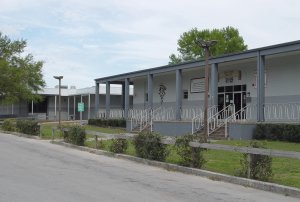 According to McCormick, when Pasco High School moved to the present location, the name
was changed to Pasco Comprehensive High School.
According to McCormick, when Pasco High School moved to the present location, the name
was changed to Pasco Comprehensive High School.